

There are moments in politics when a confession is more revealing than an investigation. A politician, carried away by the confidence that comes with power, may disclose what an entire opposition party has spent years trying to establish. In Nigeria, where political memory is often shorter than a campaign promise, such admissions deserve to be preserved for posterity.
The latest revelations concerning the September 2024 Edo State governorship election raise a disturbing question about the quality of our democracy. What happens when politicians who acknowledge the credentials and competence of a candidate nevertheless work against him, not because of his policies or character, but because of their personal quarrels with the man supporting his candidacy?
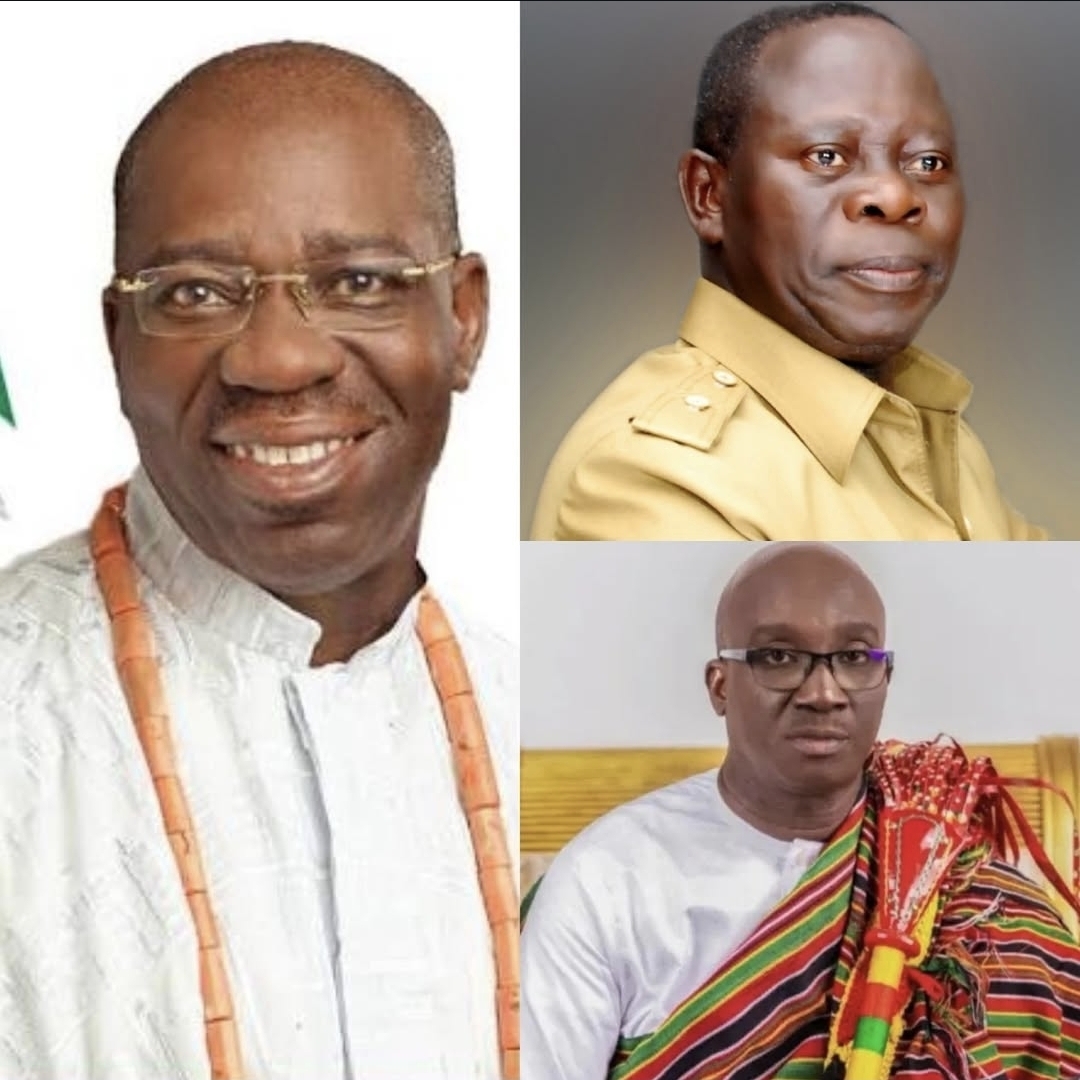
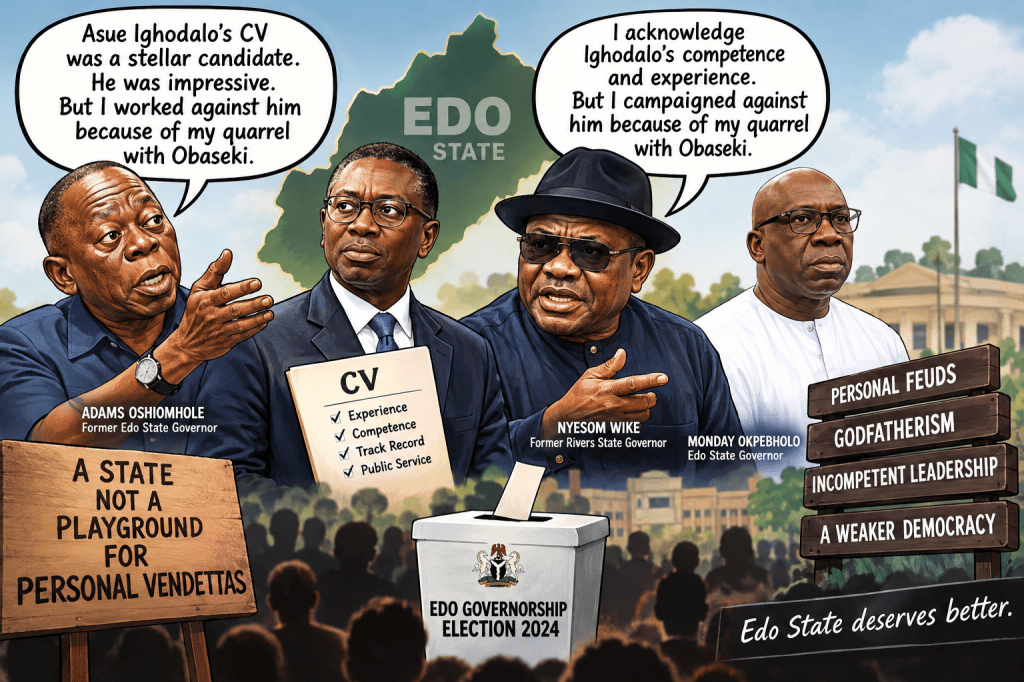
Adams Oshiomhole, former governor of Edo State and senator representing Edo North, and Nyesom Wike, former governor of Rivers State and Minister of the Federal Capital Territory, have both brought this question into sharp focus through their statements about Asue Ighodalo, the Peoples Democratic Party’s candidate in the 2024 Edo governorship election.
Their admissions invite us to examine a troubling feature of Nigerian politics: the substitution of personal loyalty and political revenge for the public interest.
The Candidate They Acknowledged, but Would Not Support
Asue Ighodalo entered the 2024 governorship contest with a substantial professional record. A lawyer and businessman, he had served as chairman of Nigerian Breweries and participated in economic advisory work associated with successive Edo administrations. He had also been involved in the state’s economic discussions during Oshiomhole’s tenure and subsequently under Godwin Obaseki.
His qualifications were not, therefore, an entirely unfamiliar quantity to the political establishment he sought to succeed.
Oshiomhole’s reported acknowledgement of Ighodalo’s impressive curriculum vitae is particularly revealing when considered against the political hostility between Oshiomhole and Obaseki. The two men had once been allies, but their relationship deteriorated spectacularly, culminating in Obaseki’s departure from the All Progressives Congress in 2020 and his subsequent re-election on the PDP platform.
The political divorce was bitter. In Nigerian politics, however, a quarrel between two powerful men rarely remains confined to the two men. It acquires a constituency, a party structure, a collection of loyalists and, eventually, an invoice presented to the electorate.
Wike’s position is equally revealing. In his recent account of the 2024 contest, he acknowledged Ighodalo’s qualities as a candidate but explained his refusal to support him by reference to his conflict with Obaseki. According to the account reported by Premium Times, Wike said Ighodalo had visited him several times to seek his support, but he declined because he viewed an Ighodalo victory as a means of allowing Obaseki to retain political influence.
That is the political calculation at the heart of this controversy. The issue, as Wike himself reportedly explained it, was not simply whether Ighodalo possessed the requisite experience or qualifications. It was whether supporting him would benefit a man with whom Wike had fallen out.
For the relevant reports and statements, see the accompanying video interviews and Premium Times’ account of Wike’s admission.
The Governor Who Became Collateral Damage
Monday Okpebholo of the All Progressives Congress won the 21 September 2024 election, according to the results declared by the Independent National Electoral Commission. He received 291,667 votes against Ighodalo’s 247,274, while Labour Party candidate Olumide Akpata received 22,763 votes. The margin between the first two candidates was 44,393 votes.
These figures matter. They remind us that the electorate did cast ballots and that Okpebholo’s emergence cannot simply be described as an appointment by Oshiomhole or Wike. He contested on the APC platform and was declared elected through the formal electoral process.
But the democratic question goes beyond the arithmetic of the result.
What responsibility do powerful political figures bear when they use their influence to oppose a candidate for reasons unrelated to that candidate’s own merits, policies or suitability for public office? What does it say about our political culture when a candidate’s acknowledged qualifications become secondary to the personal grievances of men who wield influence over party structures and political networks?
The problem is not that politicians have personal disagreements. They are entitled to their disagreements, their loyalties and their political choices. The problem arises when the exercise of those choices is driven by a desire to punish a rival, while the consequences are borne by millions of people who have no seat at the private negotiating table.
Edo State is not a family estate in which a quarrelling patriarch decides which relative may inherit the keys. It is a constitutional state whose citizens are entitled to expect that political competition will be conducted in pursuit of public office and the public good.
The governor’s performance must, of course, be judged on verifiable evidence: policies implemented, public services delivered, public money accounted for and the constitutional responsibilities of the office discharged. A candidate’s impressive résumé does not automatically guarantee good governance, just as a less impressive résumé does not by itself establish that a governor is incapable. But if influential politicians admit that their opposition to one candidate was driven by personal animosity towards his political sponsor, citizens are entitled to ask whether the public interest was ever the principal consideration.
A Democracy, or a Private Club?
Nigeria’s constitutional order is founded on popular sovereignty. Section 14(2)(a) of the Constitution of the Federal Republic of Nigeria 1999, as amended, declares that sovereignty belongs to the people of Nigeria, from whom government derives all its powers and authority.
Section 14(2)(c) provides that the participation of the people in their government shall be ensured in accordance with the Constitution.
These provisions establish a principle that should be elementary in any democracy: political power exists for the people, not for the convenience of those who control political parties.
The constitutional arrangement does not eliminate political parties, internal party disputes or the influence of experienced political figures. Parties must choose candidates, organise campaigns and persuade voters. Political endorsements and opposition are legitimate parts of democratic competition.
Nor does the Constitution require every politician to support the candidate he privately considers most qualified. Oshiomhole and Wike were free to make their own political choices, subject to the law.
The deeper objection is therefore not that either man was legally obliged to support Ighodalo. It is that their reported explanations expose a political culture in which the fate of a state’s governorship contest can become entangled with personal feuds that have little to do with the needs of the electorate.
A constitutional democracy cannot guarantee that every voter will make a wise choice, or that every successful candidate will prove to be an outstanding administrator. It can, however, demand transparency, lawful competition, accountability and respect for the electorate’s capacity to decide.
When political leaders treat elections as instruments for settling private scores, they weaken the democratic culture even where the formal electoral machinery continues to operate.
The ballot box remains in place, but the political conversation surrounding it becomes distorted.
The Sin of Political Godfatherism
Political godfatherism thrives where access to power depends less on institutions and public persuasion than on the approval of influential individuals. It turns political parties into vehicles for personal ambition and converts public office into a prize in contests among rival power brokers.
The godfather’s logic is deceptively simple: if a rival must not be allowed to benefit, the rival’s candidate must be defeated, regardless of the consequences for the state.
It is a logic that makes government an extension of personal rivalry.
Wike’s reported explanation is particularly important because it suggests that his opposition to Ighodalo was connected to the prospect of Obaseki retaining influence through a successor. That may explain Wike’s political calculation, but an explanation is not a justification. The people of Edo State were entitled to have their own interests considered independently of the dispute between the two men.
The same question applies to Oshiomhole. If his opposition to Ighodalo was substantially motivated by hostility towards Obaseki, then the people of Edo State deserve to know how much of the campaign was about competing visions of governance and how much was about the unfinished business of a political feud.
There is a difference between opposing a candidate because one rejects his policies and opposing him because one dislikes the person who supports him. The first is a contest of ideas. The second risks turning an election into a referendum on personal resentment.
And when the politicians themselves acknowledge that distinction, their words deserve serious scrutiny.
The Résumé Is Not the Constitution
There is, nevertheless, an important distinction to preserve. Democracy does not mean that the candidate with the longest curriculum vitae must win. An election is not a recruitment exercise conducted by a board of directors, and voters are not merely shareholders selecting a chief executive on the basis of professional qualifications.
A candidate may possess extraordinary professional achievements and still fail as a political leader. Another may have a less distinguished corporate career and prove effective in public office. Political competence includes judgement, integrity, administrative ability, responsiveness and an understanding of the public interest.
The electorate must be free to assess those qualities.
But that freedom becomes less meaningful when influential politicians manipulate the political environment primarily to settle scores. Citizens cannot be expected to make a fully informed choice if political competition is shaped by private arrangements, opaque alliances and personal vendettas that are only revealed after the election.
The relevant question is not whether Ighodalo’s CV entitled him to become governor. It did not. His candidacy entitled him to compete, and his qualifications entitled voters to consider what he might offer the state.
Equally, Okpebholo’s election gave him the legal mandate associated with the result declared by INEC. His administration must be judged on its own record, rather than on the credentials of his opponent or the motives of those who opposed that opponent.
What citizens should reject is the assumption that powerful politicians may use public elections as weapons in private wars and then expect the public to treat the consequences as an ordinary feature of democratic life.
The Accountability Question
The most disturbing aspect of these admissions is the possibility that politicians can acknowledge the merits of a candidate, explain why they opposed him for reasons connected to a personal feud, and suffer no meaningful political consequence for the admission.
There is no automatic constitutional offence in refusing to support a candidate because of a personal disagreement with another politician. Neither does an admission of political hostility, without more, establish that an election was unlawful or that the declared result was invalid.
Those questions must be decided on evidence and under the applicable law.
Political accountability, however, is wider than criminal liability. Voters may properly ask whether those who seek to influence their choices have acted in the public interest. Political parties may be challenged over the quality of their candidate-selection processes. Journalists may investigate the networks, promises and calculations that shape electoral contests. Civil society may demand that public office be treated as a responsibility to citizens rather than a trophy in elite competition.
The law provides the framework within which elections are conducted. Democratic culture determines whether politicians respect the spirit of that framework.
That is why these statements matter. They offer citizens an opportunity to look beyond party slogans and ask what really motivates those who seek to shape political outcomes.
Edo State Is Not the Property of Its Political Class
The people of Edo State are not an audience hired to applaud the quarrels of political elites. They are citizens whose taxes, livelihoods, security, education, healthcare and economic prospects are affected by the quality of their government.
Their state is not an annex of Oshiomhole’s political history, Obaseki’s political ambitions or Wike’s personal grievances. Nor should any candidate be treated merely as a proxy through whom one politician can defeat another.
If a politician believes a candidate is unfit for office, he should explain why. If he believes another candidate offers better policies, he should make that case. If he objects to the conduct of an incumbent governor, he should identify the conduct and subject it to public scrutiny.
But if the decisive consideration is that the candidate is associated with a political rival, then the public deserves an honest account of the difference between a campaign for good government and a campaign for personal revenge.
The distinction matters because the costs of these political calculations are not paid by the men who make them alone. They are paid by citizens who must live under the government that emerges, whether or not the political choices that shaped the contest were made with their interests in mind.
Conclusion: Who Governs for Whom?
Oshiomhole and Wike have offered explanations that should prompt a wider debate about the ethics of political influence in Nigeria. Their statements, as reported, suggest that the dispute over Ighodalo’s candidacy was shaped in significant part by the personal conflicts surrounding Obaseki.
That does not establish that Okpebholo’s election was unlawful, nor does it prove that Ighodalo would necessarily have governed Edo State better. Those are separate questions requiring separate evidence.
It does, however, expose the danger of a political culture in which personal animosity can become a major consideration in deciding who should govern a state.
Democracy is not merely the process of counting votes. It is also the principle that public power must be pursued and exercised in the public interest. Elections may be won through lawful political competition, but the quality of that competition depends on whether citizens are treated as participants in self-government or as spectators to contests among powerful individuals.
The ultimate question is simple: when a politician works against a candidate he considers qualified because he dislikes the candidate’s political sponsor, whose interests is he serving?
The answer should concern every Nigerian, regardless of party affiliation.
Edo State belongs to its people. Its governorship is a public trust, not a settlement in a private quarrel. The office of governor is not a consolation prize in a political feud, and the electorate should never be treated as the collateral damage of a godfather’s grudge.
Nigeria will begin to build a more mature democracy when political leaders understand that defeating a rival is not the same thing as serving the public, and when voters insist on judging candidates by their records, ideas, integrity and performance rather than by the private battles of those who stand behind them.

