

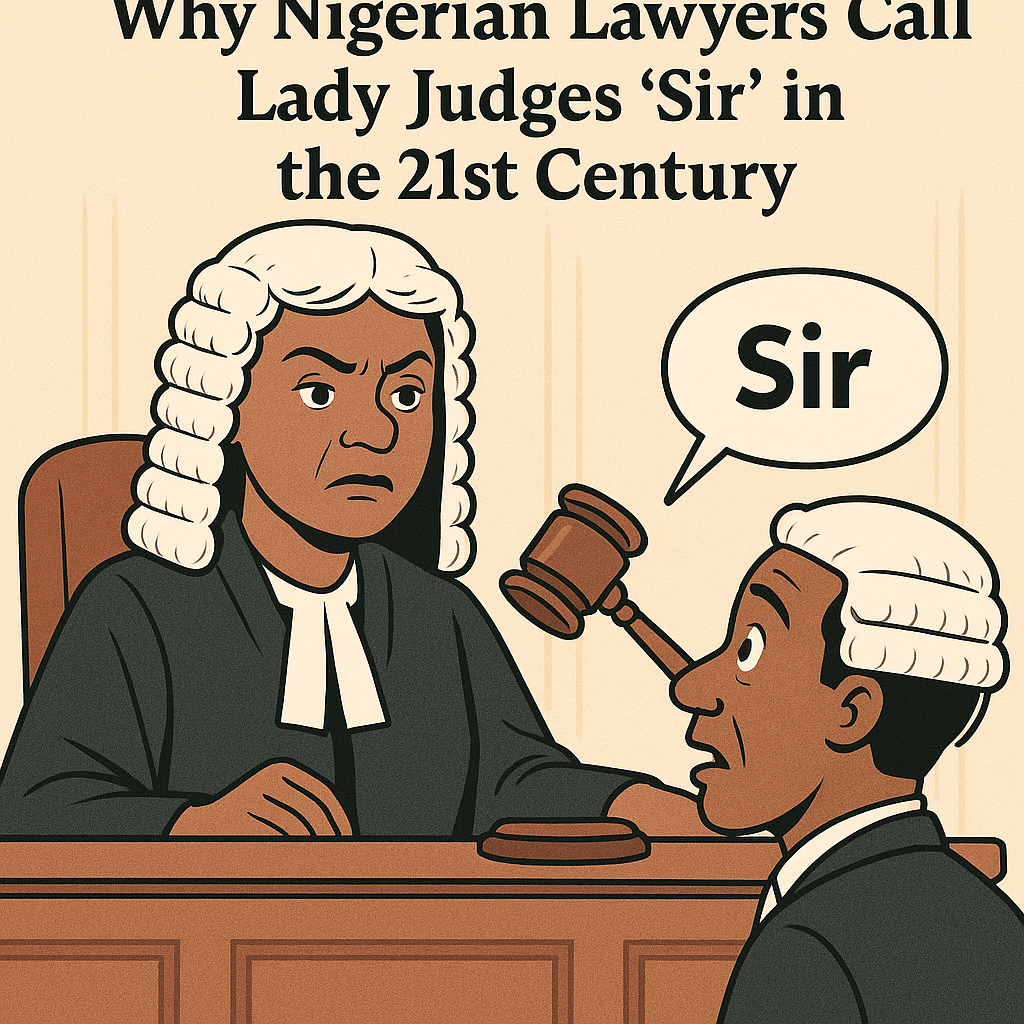
In Nigeria’s courtrooms, even the 21st century must wait its turn. The legal profession, frozen in colonial etiquette, still calls female judges “Sir.” Here’s how history, tradition, and a dash of fear conspired to make modernity plead guilty.
The Courtroom Time Warp
If there’s ever been a courtroom moment that captures Nigeria’s unique relationship with modernity, it’s the sight of a lawyer standing before a woman in full judicial glory and saying with reverence:
“Much obliged, My Lord Sir.”
The phrase echoes through mahogany-lined chambers as if Queen Victoria still reigns and electricity is a passing fad. The problem? The 21st century arrived — but the Bar didn’t get the memo.
A Colonial Hangover
The habit dates back to the colonial courts, when every judge was male and the title “Sir” was as standard as the wig. When women finally ascended to the Bench, rather than adapt, the legal establishment simply carried on — because in Nigeria, tradition is sacred, even when it makes no sense.
Lawyers mutter Latin in traffic, quote res ipsa loquitur at bus stops, and treat modern reform like a contempt proceeding. To call a lady judge “Ma” or “Madam,” they fear, might collapse the entire judicial order.
The Fear of Reform
For many Nigerian lawyers, Sir is not a gendered term but a shield — protection against offending authority. The Bench is revered, almost mystical. Better to be archaic than be in contempt. Thus, in one courtroom, gender disappears and hierarchy becomes holy writ.
The result? A curious distortion where female judges are “Sir,” senior advocates are “Learned Gentlemen,” and feminism is adjourned sine die.
Elsewhere in the World
Across the Commonwealth, courts have evolved. In the UK, Canada, and Australia, “My Lady” or “Your Honour” acknowledges both gender and office. But Nigerian lawyers hold fast to their colonial relics — as though time stopped in 1954 and decorum froze in powdered wigs.
Conclusion: Justice Is Blind — and Tone-Deaf
So when next you hear a lawyer say, “As Your Lordship pleases, Sir,” to a woman on the Bench, remember: it’s not deliberate disrespect — it’s an unbroken chain of historical confusion, reverence, and linguistic inertia.
In Nigerian courts, the law may be blind — but it’s also deaf to the century it lives in.
 Centre for Nigeria Progress