

May 10 2026, (THEWILL), President Tinubu has waded into the feud within the Progressives Governors Forum, PGF, over the alleged misappropriation of over N800 billion allegedly raised by APC governors, to fund the President Tinubu’s re-election campaign.
The crisis had led to the factionalisation of the Forum with Kwara State Governor Rahman, Ogun State Governor Abiodun and several others declaring Enugu State Governor Mbah, as new Chairman of the Forum.
THEWILL reports that Imo State Governor Uzodinma, Chairman of the PGF, who acted as custodian of the funds became evasive when asked to render accounts, leading to a conflict that polarised the Forum and split it down the middle at the weekend. The development heightened tension within the party and caused its big wigs to work the phone lines for hours, trying to restore some order among the warring governors.
According to THE WILL sources, the Forum’s governors had agreed to make their own contributions to the presidential campaign through monthly deductions from their Federation Account Allocation Committee, FAAC, share into an account controlled by Governor Uzodinma under the Renewed Hope Ambassador, RHA, platform.
The RHA was formed to communicate the federal government’s policy reforms and achievements at the grassroots across the country ahead of the 2027 general election. Upon their agreement, Governor Uzodinma was said to have approached and convinced the former Minister of Finance and Coordinating Minister of the Economy, Wale Edun, Chair of FAAC to authorise the monthly deductions from contributing states.
With activities for the 2027 campaign now in top gear, the governors, according to THEWILL sources, again, agreed with the president and key strategists to the creation of a separate structure from the RHA to deal specifically with his re-election. We can exclusively report that the group is called the Renewed Hope Network, RHN. The donations were then expected to be transferred to the accounts of the RHN. That was when trouble started. Governor Uzodimma, according to our sources, told his colleagues that the money had been expended….!!
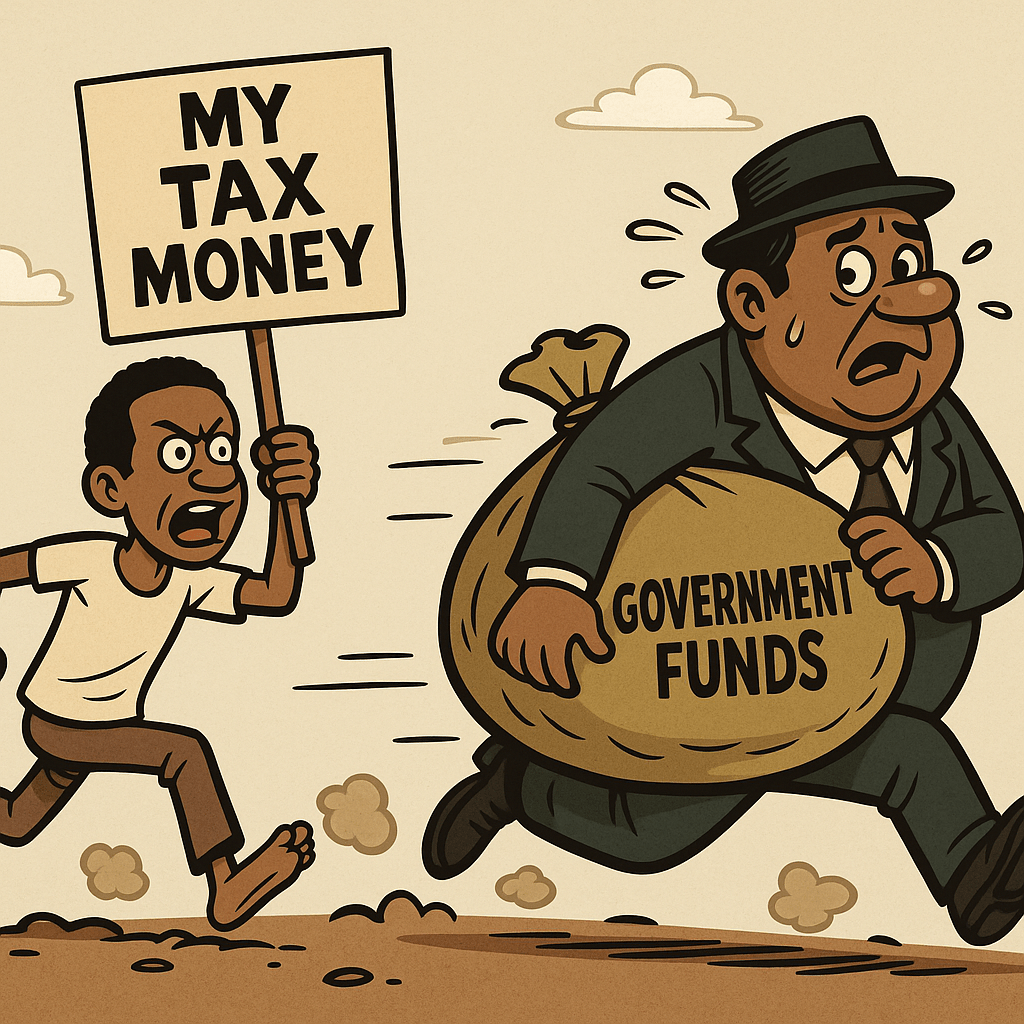
The People’s Money, The Party’s Pocket. A constitutional architecture so elegant, it is a shame about the people operating inside it.
There is a particular kind of audacity that flourishes only in tropical climates and high offices, the audacity of a man who knows exactly what the law says, nods respectfully in its direction, and then does the opposite with the serenity of someone who has never once been held accountable for anything. Nigeria has perfected this art form. Nowhere is it on more spectacular display than in the management, or more precisely, the mismanagement, of the Federation Account.
The Constitution and Practice
Two questions have recently been put to me about the Federation Account Allocation Committee (FAAC) that are worth exploring in some depth, because they expose the gap between the Nigeria that exists on paper and the Nigeria that exists in practice. The first is whether FAAC distributions are subject to the discretion of the Federal Executive Council alone, or whether other arms of government have a legitimate role. The second, more volcanic in its implications, is whether a ruling party can, by agreement among itself, siphon a percentage of public allocations at source for its own political purposes before those funds reach the appropriation process.
The constitutional answer to both is clear. The political answer is, as always, more interesting.
The Architecture of the Federation Account: Who Controls the Tap?
Let us begin with the first question. The short answer is that FAAC distributions are emphatically not subject to the sole discretion of the Federal Executive Council. The constitutional design is deliberate on this point, and understanding why requires appreciating what FAAC actually is.
FAAC is not a Federal Government committee that graciously invites the states to observe. It is a joint intergovernmental body comprising the Minister of Finance (who chairs), all thirty-six State Commissioners of Finance, and representatives from the Central Bank of Nigeria, the Revenue Mobilisation Allocation and Fiscal Commission (RMAFC), the National Bureau of Statistics, and the major revenue-collecting agencies, FIRS, NCS, and NNPCL. The distribution of the monthly pool requires multi-stakeholder deliberation. Deductions from the distributable pool are discussed and approved at FAAC, where commissioners of finance represent their states and the local governments within their jurisdictions. The Federal Government cannot, on a Thursday afternoon, simply decide to redirect the pool.
That is the constitutional theory. In practice, the Federal Government controls the revenue-collecting agencies that feed the pool, controls the NNPCL that determines what actually gets remitted versus what gets “operationally deducted,” and chairs the committee that distributes what remains. This gives the Federal Executive enormous informational and structural leverage, which is not the same as legal discretion, but which functions, in the absence of robust accountability, as something uncomfortably close to it.
The National Assembly has a distinct but real role. It sets the Revenue Allocation Formula via statute, on recommendation from RMAFC, a review process that requires legislative approval and therefore invites the full contact sport of Nigerian inter-regional politics. NASS also creates or abolishes the statutory transfer obligations that reduce the distributable pool before sharing begins. Every time Parliament enacts a law establishing a new commission or development fund with a mandatory FAAC deduction, the NDDC, UBEC, the North-East Development Commission, it is exercising fiscal power that directly shrinks what the states receive each month. The legislature does not appropriate the distribution, but it shapes the architecture within which distributions occur.
The judiciary, meanwhile, has not been absent. The Supreme Court has issued landmark rulings on LGA financial autonomy, on the constitutionality of State-Local Government Joint Accounts, and on the scope of executive discretion in managing federation revenues. Courts do not sit at the FAAC table. But they have, on more than one occasion, told the people who do sit at that table what they are not permitted to do.
So the answer to the first question is: no, the Federal Executive does not have sole discretion over FAAC. The constitutional design distributes authority across the three tiers, invites legislative oversight of the formula, and preserves judicial review of the process. Whether those institutional checks actually constrain executive behaviour is, of course, a separate question, and a question whose answer is considerably less encouraging.
Spending the Money: Where Appropriation Enters the Frame
The constitutional architecture distinguishes carefully between two moments in the life of public revenue: distribution and expenditure. The first is automatic and constitutionally mandated. The second is emphatically not.
Section 162 of the 1999 Constitution establishes the Federation Account and mandates that all federal revenues, with narrow exceptions, be paid into it and distributed among the three tiers. This distribution happens as a constitutional obligation, not as a discretionary act of the Federal Government. The National Assembly does not vote each month on whether Kebbi State receives its share.
But the moment those allocations land at each tier, the constitutional regime changes entirely. For the Federal Government, received revenues flow into the Consolidated Revenue Fund under Section 80(1), and Section 81(1) is unambiguous: no money shall be withdrawn from the CRF except where charged on the Fund by the Constitution itself, or authorised by an Appropriation Act. The states face an identical structure under Sections 120 and 121. No governor may legally spend state FAAC receipts outside the annual budget approved by the State House of Assembly, except for constitutionally specified first-line charges (judicial salaries, the governor’s own remuneration, and so on) and the interim provisions under Sections 82 and 122, which allow up to fifty percent of the previous year’s appropriation to be spent pending a new budget.
The constitutional chain, stated plainly, is: distribute automatically → receive into the Consolidated Revenue Fund → spend only via appropriation. It is an elegant system. It is also, in significant parts of Nigeria’s governance landscape, a historical artefact.
Governors spend outside approved budgets routinely. Supplementary appropriation bills are passed retroactively to legitimise expenditure already incurred. Virement, the reallocation of funds between budget lines, is deployed at scales that bear no resemblance to its intended purpose. Several states have operated without a budget at all for extended periods, running on the Section 122 interim provision as though it were a permanent governance strategy rather than a constitutional emergency measure.
Nobody, as a general matter, is prosecuted for this. The State Houses of Assembly that are supposed to provide oversight are populated largely by members who owe their political existence to the governor they are meant to supervise. The structural conflict of interest is so complete as to have become invisible.
The Party Levy: A Constitutional Essay in Audacity
Now to the second question, and the more seismic one. The allegation that the APC agreed among itself to deduct a percentage of FAAC allocations at source for party political purposes, before the appropriation process, deserves a methodical constitutional autopsy.
I am going to analyse the constitutional implications regardless of whether the arrangement was formal or informal, acknowledged or denied, because the practice of ruling parties financing themselves from public allocations is not a secret in Nigerian political discourse. Academic research on Nigerian electoral finance has consistently documented that both the PDP and the APC maximally deployed incumbency to mobilise funds, and that state governors who control substantial resources are known to provide bulk financing to the ruling party. The question is what the law makes of it.
The answer is: quite a lot, and none of it favourable.
First: the appropriation requirement. State FAAC receipts are public funds. They must pass through the State Consolidated Revenue Fund. They may be spent only by Appropriation Act. No State House of Assembly in Nigeria has ever passed an “APC Party Financing Appropriation Act.” This means any diversion of FAAC receipts to a political party, before or outside the appropriation process, is unconstitutional on its face, full stop, regardless of how it is characterised, structured, or rationalised.
Second: the Electoral Act. The Electoral Act places limits on individual and organisational donations to political parties. Routing government allocations to party coffers via governors would breach these donation limits, and the source of the funds (public money held on constitutional trust) would transform a mere regulatory breach into something considerably more serious.
Third: the nature of the Federation Account itself. Section 162 creates a constitutional trust. The revenues in the Federation Account are not the property of the ruling party. They are not the personal property of the governors who receive their state’s share. They are not at the disposal of party leadership, however senior. They belong, as a matter of constitutional architecture, to the respective tiers of government, held on trust for the public purposes those tiers are constitutionally obligated to serve. Pre-appropriation diversion to a political party is not just an irregularity. It is a fundamental breach of the trust that underpins the entire fiscal federation.
Fourth: the criminal dimension. Depending on how such arrangements are structured and executed, they could engage the Corrupt Practices and Other Related Offences Act, the Money Laundering (Prevention and Prohibition) Act, and potentially provisions of the Criminal Code. The ICPC and EFCC would have, in a functional accountability system, a great deal of interest in the mechanics of the arrangement.
Nigeria does not, as a general matter, operate a functional accountability system in relation to the politically powerful. This is known.
The Deeper Disease
What the party-levy allegation really illuminates is not merely financial misconduct. It illuminates the structural disease at the heart of Nigerian governance: the systematic and deliberate collapse of the distinction between party and state.
In a functioning constitutional democracy, political parties are private associations that contest for the right to operate the state. They are funded by members, donors, and in some systems by regulated public grants. They do not own the state. The civil service serves the state, not the party. Public revenue belongs to the public, not to whoever currently holds office. These distinctions are not technicalities. They are the load-bearing walls of democratic governance.
In Nigeria’s operating political culture, these walls have been structurally compromised for so long that many have forgotten they were ever supposed to exist. The governing party does not merely control the state; it treats the state as an extension of itself, its revenues as party revenues, its institutions as party instruments, its civil servants as party employees. Opposition governors complain that they are “disconnected from the centre,” unable to access federal benefits for their states, which is, if true, a spectacular admission that federal resources are being distributed on partisan rather than constitutional lines. The parties have not captured the state in the dramatic coup-like manner of textbook authoritarianism. They have simply, quietly, over time, dissolved the membrane between public and private, between state and party, between the people’s money and the party’s pocket.
The constitutional architecture anticipates and prohibits all of this. Section 162 is clear. Sections 80 and 120 are clear. Sections 81 and 121 are clear. The Electoral Act is clear. The criminal statutes are clear.
Nigeria’s constitution is, on paper, one of the more elaborately designed federations in the world. Its fiscal federalism provisions are detailed, multi-layered, and carefully balanced. It is an operating system of genuine sophistication.
The problem, and it is not a small one, is the people running it.
 Centre for Nigeria Progress