

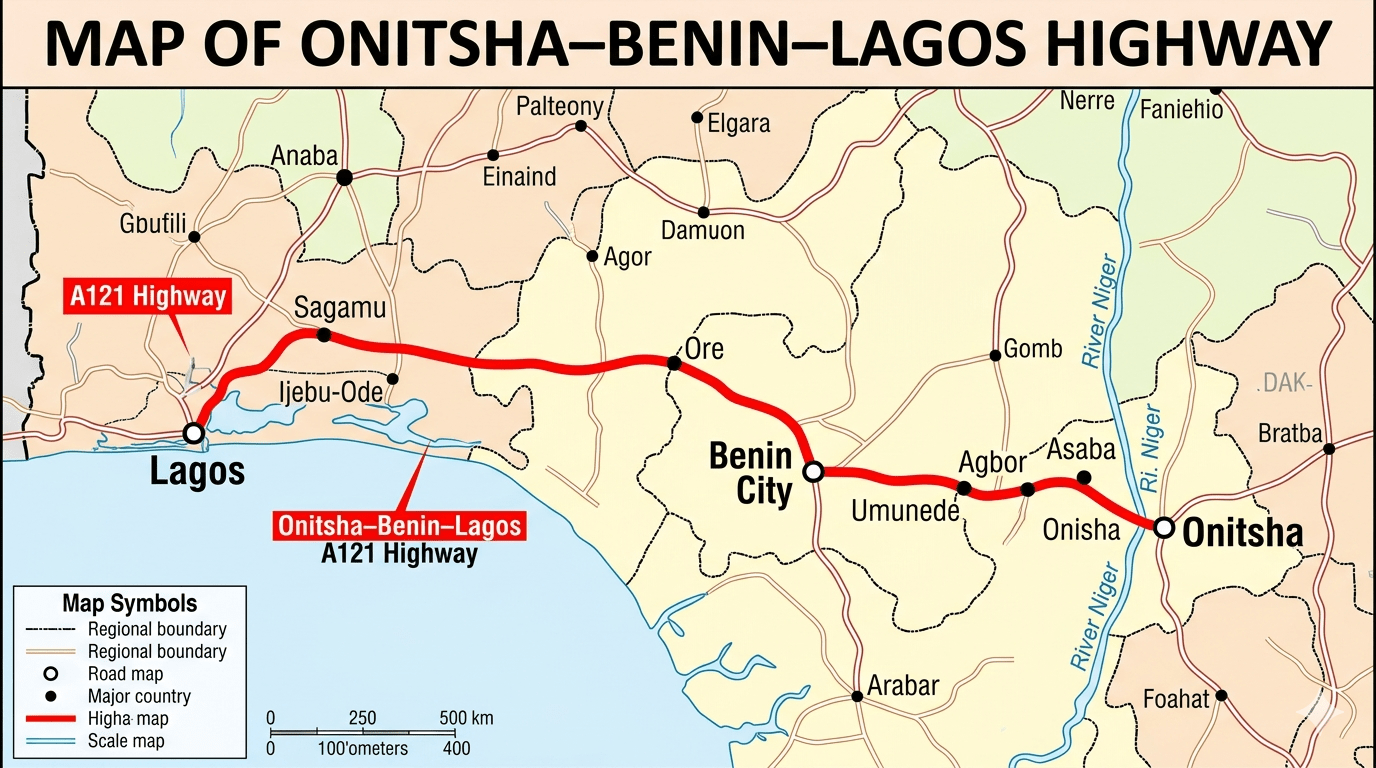

If you want to understand whether a state is responsive to its people, don’t start with speeches, manifestos, or glossy policy documents. Start with a road. In Nigeria, take the Onitsha–Benin–Lagos highway. It will tell you everything.
This is not just any road. It is a commercial artery—arguably one of the most economically significant corridors in the country. It binds together Lagos, the nation’s commercial capital, with the industrial and trading ecosystems of the South-East and parts of the South-South. Goods, labour, capital, and culture flow through it daily. Or at least, they are supposed to.
What actually flows along this highway today is something closer to chaos.
Infrastructure as Indictment
The Onitsha–Benin–Lagos highway is in a state of chronic disrepair. Craters masquerade as potholes. Travel times are unpredictable. Logistics costs are inflated. Vehicles break down with depressing regularity. This is not merely an inconvenience; it is an economic tax imposed by state failure.
Layered on top of this physical decay is a more sinister reality: insecurity. Kidnappings, armed robberies, and brazen attacks have become disturbingly routine. Just yesterday, armed groups reportedly killed scores and abducted others for ransom along this very route.
Now pause and consider the absurdity.
This same corridor is littered with multi-agency checkpoints—police, military, paramilitary, all visibly present. Yet the road remains unsafe. The state is not absent; it is present but ineffective. There is a difference, and it is far more damning.
The Theatre of Control
Nigeria has perfected a particular aesthetic of governance: the appearance of control without its substance. Checkpoints provide optics. They signal activity. But they do not deliver outcomes.
For the ordinary trader moving goods from Onitsha to Lagos, or the passenger navigating this route, the calculation is brutally simple: the state extracts (time, money, dignity), but does not protect.
That is the definition of an unresponsive state.
The Railway That Never Was
The tragedy is not just failure—it is the persistence of avoidable failure.
A functional railway linking Lagos to the East would have transformed this equation entirely. It would have reduced pressure on the highway, lowered transport costs, improved safety, and integrated regional markets more efficiently. It is not an exotic idea; it is basic economic infrastructure.
But here lies a revealing historical footnote: this corridor was not prioritised during the colonial era because it did not primarily serve colonial extraction interests. Rail lines were designed to move raw materials from hinterlands to ports—not to knit together domestic economic networks.
Fair enough. Colonialism was never about local development.
But independence came in 1960. That excuse expired 65 years ago.
Independence Without Reorientation
The deeper problem is not that colonial infrastructure was misaligned with domestic needs—that is expected. The problem is that post-independence Nigeria has largely failed to reorient infrastructure toward its own economy.
Successive governments have either lacked the imagination, the political will, or the incentive structure to prioritise projects like a Lagos–East rail corridor. Such projects are not “sexy.” They do not lend themselves easily to ribbon-cutting theatrics or quick political wins. They require long-term thinking, coordination, and discipline.
In their place, we have an unproductive status quo: overburdened roads, underdeveloped rail, and an economy that pays the price daily.
When Tragedy Becomes Routine
The recent killings and abductions on this highway should provoke national outrage. They should trigger emergency interventions, coordinated security reforms, and accelerated infrastructure planning.
But experience suggests otherwise.
In Nigeria, tragedy has a short shelf life. Outrage spikes, statements are issued, committees are formed—and then the system resets to its default setting: inertia.
That is why expecting immediate relief feels almost naive.
The Subnational Question
Which brings us to a more uncomfortable question: where are the state governments?
The Onitsha–Benin–Lagos corridor cuts across multiple states, each of which depends on it for economic activity. Yet there is little evidence of coordinated, state-led intervention to address its dysfunction—whether through regional security frameworks, infrastructure partnerships, or advocacy for federal action.
Why?
Part of the answer lies in Nigeria’s highly centralised federal structure, where states often defer to the federal government on major infrastructure. But that explanation is increasingly insufficient. Economic self-interest alone should compel more proactive engagement.
Another part is political fragmentation. Coordination across states requires alignment of interests, trust, and institutional mechanisms—none of which come easily in Nigeria’s political landscape.
But perhaps the most honest answer is this: leadership is often reactive, not strategic. It responds to crises but rarely anticipates them.
A Road, A Mirror
The Onitsha–Benin–Lagos highway is more than a failed piece of infrastructure. It is a mirror held up to the Nigerian state.
It reflects a system where:
- Economic priorities are poorly aligned with infrastructure investment
- Security presence does not translate into security outcomes
- Long-term planning is sacrificed for short-term optics
- Subnational actors wait rather than lead
And most importantly, it reflects a state that does not consistently respond to the everyday realities of its people and its economy.
Until that changes, the road will remain what it is today: not just a pathway between cities, but a running commentary on governance failure.
And for those who must travel it, a daily reminder that in Nigeria, even the most vital lifelines can be left to decay—until they become death traps.

