

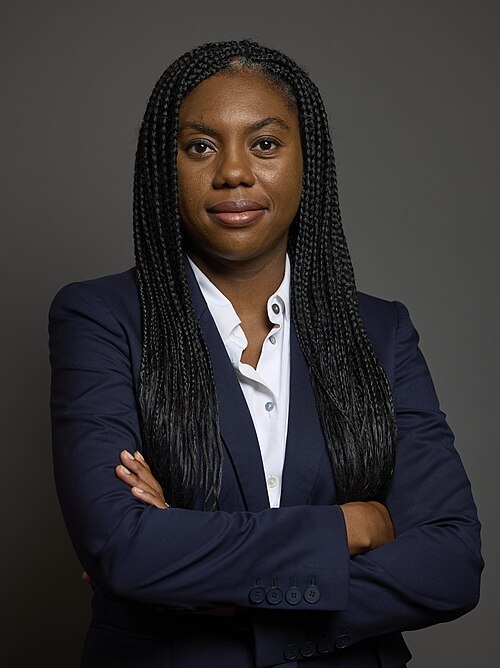

Olukemi Olufunto Adegoke arrived in Britain with a hundred pounds and a future. Her children were born into it. Now she proposes to dismantle the scaffolding that made all of it possible and she wants credit for the demolition.
There is a peculiar theatre that plays out whenever a conservative political party, having lost badly, casts about for a leader who might restore its fortunes. The party looks for someone who is, in the clinical language of the focus group, “different” and then labours, with touching dedication, to ensure that this different person professes ideas that are entirely the same. The Conservative Party of the United Kingdom, surveying the wreckage of its 2024 electoral annihilation, selected Olukemi Olufunto Adegoke Badenoch as its new leader. Black. Female. Nigerian heritage. Married to a white British banker named Hamish, mother to three mixed-race children growing up in these islands. In any other reading of history, this would be the story of a remarkable nation making good on its own stated ideals. But Kemi Badenoch, it turns out, has a different story to tell and she is telling it, with increasing urgency, to an audience that will never fully accept the narrator.
The audition is well underway. The role she is performing is nanny to the aggrieved white majority. The script requires her to agree, out loud, that the majority has been put upon; that the protections designed for people like her are in fact the source of national decline; and that, if given the opportunity to govern, she would cheerfully dismantle them. Last week she announced her intention to repeal the Public Sector Equality Duty “in its entirety” the legal framework, embedded in the Equality Act 2010, that requires public institutions to consider the impact of their decisions on people with protected characteristics: race, sex, disability, and others. The Duty was not conceived as a favour to minorities. It was conceived as an instruction to the state to behave consistently. It is, if anything, a conservative instrument. That Kemi Badenoch has chosen it as her opening sacrifice on the altar of the culture war tells us something about who she imagines is watching.
ACT I
The Man with the Megaphone
Nigel Farage Reform UK’s leader, fraternity brother to a certain Donald Trump, and the most reliably combustible figure in British public life has spent the better part of a decade perfecting a single argument: that the white majority of these islands is the true persecuted class, its interests subordinated at every turn to the sensitivities of minorities of race, sexuality, and national origin. He does not make this argument quietly.
When Henry Nowak, an eighteen-year-old Polish-British student, was murdered in Southampton last December stabbed by a man named Vickrum Digwa, a Sikh, who then told arriving police that he had been the victim of a racial attack, causing officers to handcuff the dying Nowak instead of rendering aid Farage did not pause to grieve before reaching for his megaphone. He pronounced the case proof that Britain operates a “two-tier system” in which white lives count for less. He called for an end to DEI, to positive discrimination, to what he described as “anti-white prejudice.” Digwa has since been convicted of murder and sentenced to life imprisonment. The family of Henry Nowak asked, explicitly, that their son’s death not be used to manufacture division. Farage obliged by using it to demand a culture war.
Here is where the arithmetic becomes inconvenient. Vickrum Digwa, the man who killed Henry Nowak, is British. No immigration crackdown however stringent, however theatrical, however loudly announced in a speech co-designed with Reform’s communications team would have kept him out. He was already here. Similarly, the young Black men whose crimes Farage has periodically elevated to the status of national emergency are, in many instances, as British as Kemi Badenoch herself. Born and raised in these islands. Schooled here. Entitled to vote here. Immigration reform, however one constructs it, cannot reach them. The story is not spoiled by this detail; it is simply not told.
There is a further irony that the Reform narrative habitually discards. The majority of violent crime in the United Kingdom is committed by the majority white population. Some of those perpetrators are, in fact, European immigrants Poles, Romanians, others who arrived under the very freedom of movement that Brexit was supposed to curtail. This inconvenience is observed, noted, and silently archived. It does not fit the story. It would require Farage to explain that “British culture” is sometimes defended by people who are also not from here and that the alien they wish to expel has a habit of being the alien they’ve already admitted.
ACT II
The Follower at the Pulpit
A week after Farage finished his oration over Nowak’s grave, Kemi Badenoch took to her own platform and echoed his conclusions. The Public Sector Equality Duty, she declared, had become “a minefield that exposes almost every significant public decision to legal challenge.” It had been weaponised to promote “dangerous and divisive agendas.” It must go. The phrase “common sense” was deployed, as it invariably is when a politician reaches for the comfort of the unexamined.
One pauses here to note what Kemi Badenoch was doing between 2022 and 2024. She was serving as Minister for Women and Equalities. She was, in that capacity, the statutory guardian of the very framework she now proposes to dismantle. She appointed commissioners to the Equality and Human Rights Commission. She spoke, in the language of the office, about promoting equality and human rights across the United Kingdom. She was, in other words, the nanny’s previous employer and has now applied to be nanny in the opposing household, bringing the keys.
The strategy, if it deserves that name, is structurally self-defeating. Badenoch is competing for voters who, having acquired Farage, have no reason to accept a substitute. Reform offers them the authentic article: an older white man who has been saying these things for thirty years without the complication of personal contradiction. Badenoch offers them the same argument delivered by the person the argument was designed to demote. There is something almost Shakespearean in the geometry of it the minor character who speaks the villain’s lines and expects to receive the villain’s applause.
ACT III
The American Import
What we are watching, translated into its proper geopolitical register, is the importation of the American culture war into the body politic of the United Kingdom. The vocabulary is American: DEI, two-tier justice, reverse racism, the “great replacement” in its polite-company formulation. The logic is American: that equality laws designed to protect the historically subordinate have become mechanisms of oppression against the historically dominant. Even the strategic alliance between Farage and Trump two men who share the same contempt for institutional constraint dressed in the costume of the common man is the transatlantic franchise in full operation.
The United States provides the laboratory evidence for what this culture war produces. Those European settlers who arrived as the original aliens the Scots-Irish and the Germans and the Italians, despised and excluded in their turn became, over time, simply “white.” They joined the majority project and redirected their anxiety about displacement toward the next wave. Today, their descendants stand in county courthouses in Texas and Florida, declaring that the migrant is an existential threat to the nation that their own grandparents arrived at by inflatable raft or steerage berth. The European aliens of America now constitute the nativist consensus. They have forgotten, entirely, the terms of their own admission.
The culture war’s most reliable trick is to convince each arriving wave that they were always the hosts and that the subsequent wave are the invaders. Kemi Badenoch has persuaded herself, or is performing the persuasion, that she is of the hosts. Her children, two daughters and a son, growing up mixed-race in a Britain that Nigel Farage is redefining by the week, will eventually discover the limits of that persuasion. The Reform voter who applauds their mother’s speeches does not see those children as British in the way that he sees himself as British. He sees them as the complication. As the detail that doesn’t fit the story. As the alien which is, after all, what the Americans call migrants.
ACT IV
The Sword and Its Edge
There is a final observation to be made, and it is not a charitable one. The culture war does not respect those who serve it. Its logic is a sword, and the sword does not pause to thank the hand that polished it. The victors of this war those who successfully establish in British public life the principle that equality law is oppression, that protected characteristics are an affront, that the state owes its first loyalty to those who have always held its keys will wield that sword against the likes of Kemi Badenoch and her children. They do not regard her as a Conservative leader. They regard her as an unusually useful politician of a kind they have historically regarded as provisional members of the national project.
She was born in the UK to Nigeria parents and returned to Britain as a young woman with a hundred pounds. She worked at McDonald’s. She studied for her A-levels. She became a software engineer, then a politician, then the leader of His Majesty’s Official Opposition. By any honest account, this is the story the equality laws were partly designed to make possible the structural guarantee that even those who arrive with nothing are not legally excluded from the positions to which talent and industry might carry them. She is, in the precise and unromantic language of the Equality Act, a person with protected characteristics who has succeeded in a society that her own proposals would make marginally less hospitable to the next Kemi Badenoch.
History will record whether she noticed.
The audition continues. The part of devoted nanny to the aggrieved majority is still available. Kemi Badenoch is giving it everything she has. The household she is applying to join has its own children and they look nothing like hers.

