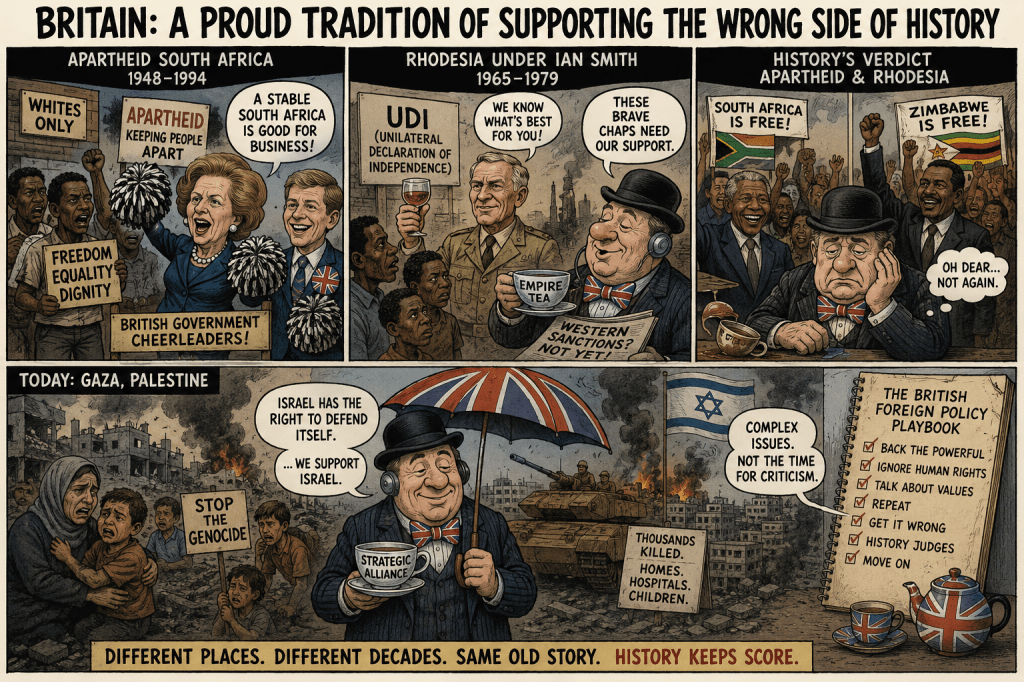
Britain and the Art of Backing the Wrong Horse

History is often described as a great teacher. The problem is that governments rarely attend the lessons.
Few countries have demonstrated this more consistently than Britain in its foreign policy adventures. There is a remarkable continuity in British statecraft: an uncanny ability to identify the wrong side of history and then support it with admirable determination, eloquent speeches, and a great deal of confidence.
During the apartheid era in South Africa, the government of Prime Minister Margaret Thatcher resisted many of the sanctions demanded by anti-apartheid activists and governments around the world. While millions viewed apartheid as a moral abomination, British policymakers frequently treated it as a difficult administrative inconvenience that merely required patience, dialogue, and another diplomatic committee.
The defenders of apartheid had many friends in influential circles. Economic interests, Cold War calculations, and strategic considerations were often elevated above the simple proposition that people should not be denied political rights because of the colour of their skin.
History was unimpressed by these arguments.
Apartheid collapsed.
Nelson Mandela walked free.
The democratic South Africa that many Western governments considered unrealistic became a reality.
The British establishment did not stop apartheid. It merely adjusted to its defeat.
The story was not unique.
Before that came Rhodesia. When Ian Smith’s white minority government issued its Unilateral Declaration of Independence (UDI) in 1965, significant sympathy existed within parts of British political life for the settlers who wished to preserve minority rule. There were those who viewed African majority government as a dangerous experiment and preferred constitutional gymnastics to democratic principles.
Yet history again proved stubborn.
The white minority regime eventually disappeared.
Majority rule arrived.
Zimbabwe emerged.
All the speeches defending the status quo now survive only as museum pieces and embarrassing quotations.
One of the enduring features of British foreign policy is its tendency to confuse temporary power with permanent legitimacy. If a regime appears strategically useful, economically valuable, or geopolitically convenient, moral concerns can often be postponed until a later date.
That later date usually arrives after history has rendered its verdict.
Today, many critics see a similar pattern in Britain’s support for Israel during the devastating conflict in Gaza. The British government, alongside its allies, has largely aligned itself with Israeli policy while expressing concern about civilian casualties in carefully measured diplomatic language.
To supporters of British policy, this is a necessary alliance with a democratic partner facing security threats.
To critics, it represents another example of Britain standing beside overwhelming military power while treating the suffering of a stateless population as an unfortunate footnote.
The scenes emerging from Gaza have generated international outrage, allegations of war crimes, and accusations of collective punishment. Around the world, increasing numbers of people view the conflict not through the language of geopolitics but through the language of human rights and national self-determination.
Whether one agrees with that assessment or not, and one does, history suggests a useful warning.
Governments often believe they are making practical decisions based on present realities.
History judges them based on moral realities.
The British political class has repeatedly discovered that distinction too late.
The tragedy is not that Britain occasionally makes mistakes. Every nation does.
The tragedy is the consistency with which British governments of both major parties have displayed an almost supernatural confidence in those mistakes.
The names change.
The justifications change.
The talking points change.
But the pattern remains remarkably familiar.
Yesterday it was apartheid South Africa.
Before that it was Rhodesia.
Today it is Gaza.
Tomorrow there will be another crisis, another ally, another carefully crafted statement from Whitehall explaining why immediate moral clarity must once again be postponed in favour of strategic necessity.
And once again, history will take notes.
History has a habit of keeping receipts.