

Nigeria is a country of many mysteries.
Nobody knows who really fixes the price of tomatoes. Nobody knows why government projects are always “90% completed” for fifteen years. And increasingly, nobody knows how so many politically explosive cases seem to find their way before the same judge.
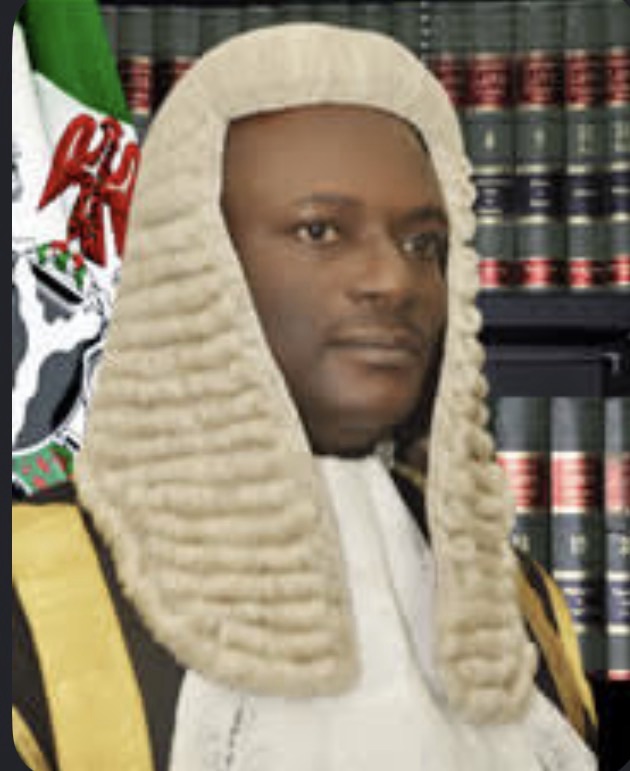
The latest controversy surrounding Justice Peter Odo Lifu of the Federal High Court, Abuja, has once again placed the spotlight on the uncomfortable intersection between law, politics, and public perception.
To be clear, courts do not exist to please the public. Judges are not elected politicians. Their duty is to interpret and apply the law, not to win popularity contests on social media. A judge can make a legally correct decision that is wildly unpopular.
Yet, when a judge repeatedly finds himself at the centre of politically consequential disputes, scrutiny inevitably follows.
Justice Lifu has become one of the most discussed judges in Nigeria’s recent judicial history.
The Rivers State Expressway
If there is one political crisis that transformed Justice Lifu into a household name, it is the Rivers State conflict.
As the war between factions of the political establishment intensified, several key disputes landed before his court.
In September 2024, he restrained INEC from releasing voter registers for Rivers local government elections, holding that the state electoral commission had failed to comply with statutory requirements regarding notice periods.
Around the same period, he dismissed a suit seeking to replace twenty-seven lawmakers who had defected from the PDP to the APC, ruling that the action was filed outside the legally prescribed time limit.
He also restrained the PDP national leadership from dissolving a Rivers State executive committee aligned with the faction loyal to the Minister of the Federal Capital Territory.
To supporters of these decisions, Justice Lifu was merely applying the law as written.
To critics, the outcomes appeared suspiciously favourable to one side of an intensely political struggle.
The problem, of course, is that judges are expected to explain themselves through judgments, while politicians explain everything through press conferences.
One method is usually less entertaining than the other.
The PDP’s Permanent Family Meeting
Nigeria’s political parties have a remarkable talent.
They can transform ordinary administrative disagreements into constitutional emergencies.
Justice Lifu has frequently found himself acting as referee in these endless family quarrels.
In May 2024, he issued an interim order preventing attempts to remove Umar Damagum as Acting National Chairman of the PDP.
In October 2025, however, he refused to halt the party’s national convention, choosing instead to hear arguments before granting any interim relief.
To lawyers, these are procedural rulings.
To politicians, they are matters of life and death.
A politician denied an injunction often reacts as though the Constitution itself has been kidnapped.
A Judge Who Defended the Right to Protest
Not all of Justice Lifu’s rulings have favoured political establishments.
In August 2024, he dismissed an application seeking to prevent Nigerians from protesting against hunger and economic hardship.
The application was found to be lacking merit.
At a time when governments across the world increasingly seek legal mechanisms to manage public dissent, the ruling was viewed by many as a reaffirmation of constitutional freedoms.
The decision received far less attention than the political cases.
This is perhaps because in Nigeria, constitutional rights rarely trend as effectively as political quarrels.
The N70 Trillion Vanishing Act
One of Justice Lifu’s earliest high-profile decisions involved a federal government effort to recover approximately N70 trillion in allegedly misappropriated public funds.
The court struck out the case after repeated failures by government lawyers to appear and prosecute the matter diligently.
Some observers were shocked.
Others asked a more practical question:
If government lawyers cannot be bothered to attend court to recover N70 trillion, how urgently did they really want the money back?
The ruling highlighted an old truth of litigation: courts can only decide the cases brought before them. They cannot litigate on behalf of absent parties.
The NJC Enters the Conversation
The greatest challenge to Justice Lifu’s reputation has not come from appellate courts but from petitions submitted to the National Judicial Council.
Among the allegations were claims that he received a one-million-dollar bribe, a bulletproof vehicle, and valuable landed property.
These were serious accusations.
In November 2024, however, the NJC dismissed four separate petitions after finding the allegations unsubstantiated.
The Council reportedly went further, suggesting that some complainants were engaging in forum shopping searching for alternative avenues after failing to secure favourable judicial outcomes.
For any judge, official exoneration by the constitutional body responsible for judicial discipline is significant.
Yet in the age of social media, acquittal rarely enjoys the same publicity as accusation.
A rumour travels by private jet.
A rebuttal usually arrives by bicycle.
The Latest Storm
The story is not over.
In June 2026, the African Democratic Congress reportedly petitioned the NJC again, alleging that Justice Lifu entertained proceedings contrary to directives issued by the Supreme Court concerning jurisdiction and case assignment.
Unlike allegations of bribery, which have already been dismissed by the NJC, this complaint concerns procedural and jurisdictional questions.
The matter remains unresolved.
As with every judicial controversy, the appropriate forum for determining its merit is the institutional process established by law rather than partisan commentary.
The Larger Question
The real issue may not be Justice Peter Odo Lifu at all.
It may be Nigeria’s extraordinary dependence on courts to resolve political disputes.
Political parties cannot agree on leadership.
They go to court.
Legislators defect.
They go to court.
Governors quarrel with lawmakers.
They go to court.
Party executives disagree over meeting venues.
Someone files an ex parte application before lunch.
The result is that judges increasingly find themselves making decisions that have profound political consequences.
Every ruling creates winners and losers.
The winners praise judicial independence.
The losers discover constitutional concerns.
Justice Lifu’s career illustrates this phenomenon perfectly.
His defenders see a judge faithfully applying the law despite intense political pressure.
His critics see a pattern of decisions that warrant closer scrutiny.
The NJC has already rejected allegations of corruption. Other procedural complaints remain under consideration.
What is beyond dispute is that few judges in recent years have occupied a more visible position in Nigeria’s legal and political theatre.
In a country where politics increasingly resembles litigation and litigation increasingly resembles politics, perhaps that was inevitable.
Or, as Nigerians might put it, every road now seems to lead to Abuja and eventually to a courtroom.


3 Replies to “The Curious Case of Justice Peter Odo Lifu: When Every Political Road Leads to One Courtroom By Lawson Akhigbe”