

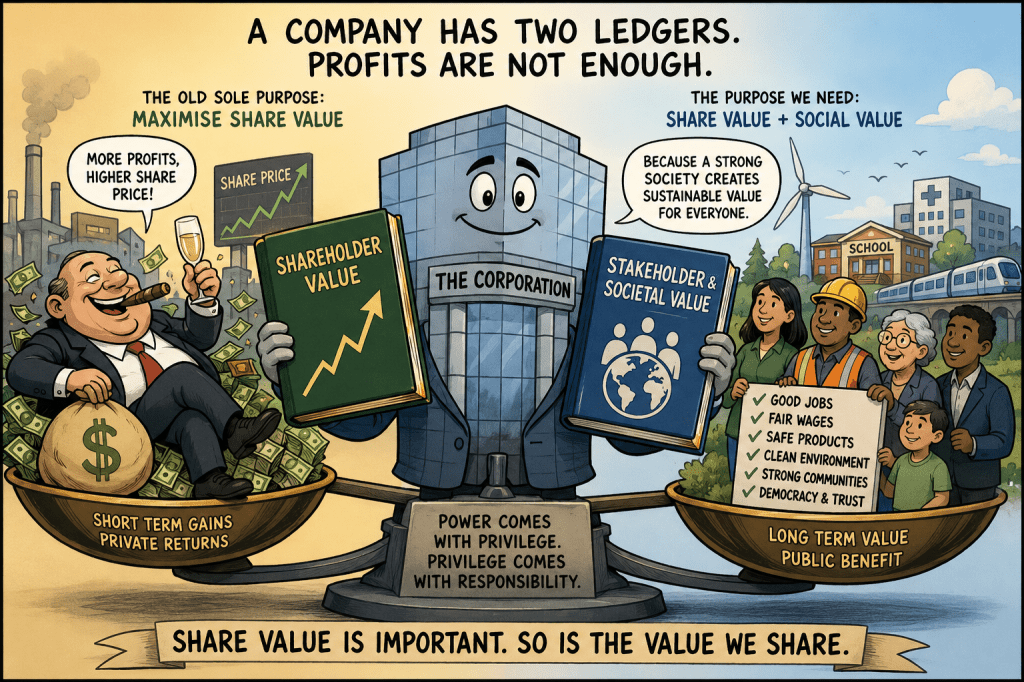
For decades, the governing philosophy of the modern limited company has been brutally simple: directors exist to maximise shareholder value. The company is a machine. Profit is the fuel. Share price is the scoreboard. Everything else is decorative wallpaper.
The legal and financial priesthood of the corporate world have repeated this doctrine so often that it has acquired the aura of holy scripture. Milton Friedman famously argued that the social responsibility of business is to increase its profits. Directors who wander away from this sacred mission risk being accused of betraying their shareholders.
Yet governments themselves have quietly undermined this philosophy while pretending to defend it.
Over the last forty years, states across the Western world have privatised large swathes of public life. Water, railways, energy, prisons, healthcare services, telecommunications, and even elements of defence and welfare administration have been handed to private corporations. Governments did not merely sell assets; they outsourced obligations once considered inseparable from the state itself.
The problem is obvious.
If a corporation is now effectively performing public functions, why is it still legally and morally permitted to behave like a casino gambler whose only duty is to enrich shareholders?
You cannot privatise public obligations and then pretend the public interest no longer matters.
The contradiction has become impossible to ignore.
A water company cannot simply behave like a hedge fund with pipes. An energy company cannot act as though citizens are mere entries on a spreadsheet. A rail operator cannot shrug when commuters are stranded because “shareholder returns” demanded cost-cutting.
When governments retreat from direct responsibility, corporations inherit public power whether they like it or not.
And power without public obligation eventually becomes abuse.
The United States accelerated this distortion with the infamous Citizens United v. Federal Election Commission decision. The ruling effectively expanded corporate political influence by treating corporate spending as a form of protected speech.
Suddenly corporations were no longer merely economic entities. They became political actors.
They could influence elections, shape legislation, lobby governments, fund ideological campaigns, and in some cases exert more influence than the citizens supposedly represented by democratic institutions.
The irony is staggering.
A company can now help shape public policy, influence the lives of millions, alter environmental outcomes, impact employment patterns, and sway democratic debate — yet still claim its only real duty is to increase shareholder returns.
That position is no longer intellectually sustainable.
If corporations wish to enjoy the rights and influence of political citizens, they must also accept the responsibilities of civic citizens.
This is not an argument against capitalism. It is an argument against infantile capitalism.
Modern economies depend upon functioning societies. Stable governments, educated populations, public infrastructure, courts, policing, healthcare systems, and social cohesion are not created by quarterly earnings reports. They are collective investments made by society itself.
Corporations benefit enormously from these structures while increasingly resisting obligations toward them.
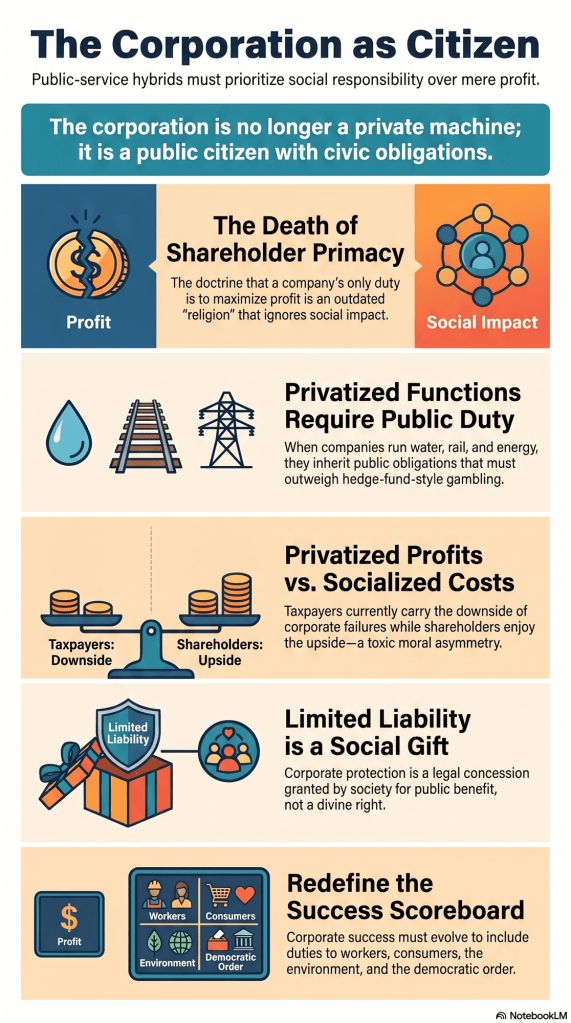
The result is a bizarre moral asymmetry: profits are privatised while costs are socialised.
When banks collapse, taxpayers rescue them. When utilities fail, governments intervene. When pollution spreads, the public pays. When monopolies crush competition, citizens lose choices while executives collect bonuses large enough to purchase small islands.
The public carries the downside while shareholders enjoy the upside.
This arrangement is becoming politically toxic because ordinary people instinctively understand something many economists refuse to admit: markets are not natural weather systems. They are legal creations designed and protected by governments.
Limited liability itself is a gift from society.
Without the state, there is no corporation.
The very concept of a limited company is a legal fiction created by Parliament and enforced by courts. Shareholders enjoy the privilege of risking only their investment while shielding personal assets from liability. That protection is not divine law descending from Mount Sinai. It is a public concession granted for public benefit.
And if society grants that privilege, society has every right to redefine the terms.
Directors’ duties should therefore evolve beyond narrow shareholder primacy. The success of a company should include obligations to workers, consumers, communities, environmental sustainability, and the broader democratic order.
Critics will scream that this creates uncertainty. They will warn that companies cannot serve “multiple masters.” They will predict economic collapse with the same theatrical panic usually reserved for apocalyptic films.
But corporations already balance competing interests every single day. They manage employees, regulators, customers, lenders, suppliers, insurers, and governments simultaneously. Pretending shareholder value is the sole consideration has always been more ideological slogan than practical reality.
The truth is simpler.
A corporation that destroys the society around it eventually destroys the market it depends upon.
An exhausted population cannot consume endlessly. Crumbling infrastructure eventually damages business. Social instability scares investment. Environmental destruction imposes real economic costs. Extreme inequality corrodes democratic legitimacy itself.
Even capitalism requires maintenance.
The old model treated companies as isolated money-making devices detached from social consequences. That illusion may have worked when corporations had narrower functions. It cannot survive an age where private companies increasingly operate the arteries of national life while simultaneously exercising political influence once reserved for governments.
The corporation is no longer merely a private actor.
It has become a hybrid creature — part market participant, part public institution, part political force.
And hybrids require new rules.
The debate is therefore no longer whether corporations should have social responsibilities. They already do. The real question is whether the law will honestly acknowledge the reality that governments themselves created through privatisation and corporate empowerment.
Because once a company becomes powerful enough to shape society, society acquires the right to shape the company in return.
Even Wall Street may eventually discover an uncomfortable truth: civilisation itself is the ultimate long-term shareholder.


A thought-provoking perspective. Businesses play an important role in society, and long-term success should balance profit with responsibility to workers, communities, consumers, and the environment. Strong economies grow best when both businesses and society thrive together.
LikeLiked by 1 person
Some countries have incorporated social responsibility clauses into their large corporate governance as a means of addressing my kind critique. I am hopeful that a balance can be reached for the over all benefit for our communities.
LikeLiked by 1 person