There is a certain elegance to the language of international finance. It rarely raises its voice. It does not shout “suffer.” It says “adjustment.” It does not say “people will struggle to eat.” It says “fiscal consolidation.” It does not say “your transport costs will double overnight.” It says “market correction.”
And nowhere is this diplomatic vocabulary more revealing than in how the International Monetary Fund and the World Bank speak to poor countries compared to rich ones.
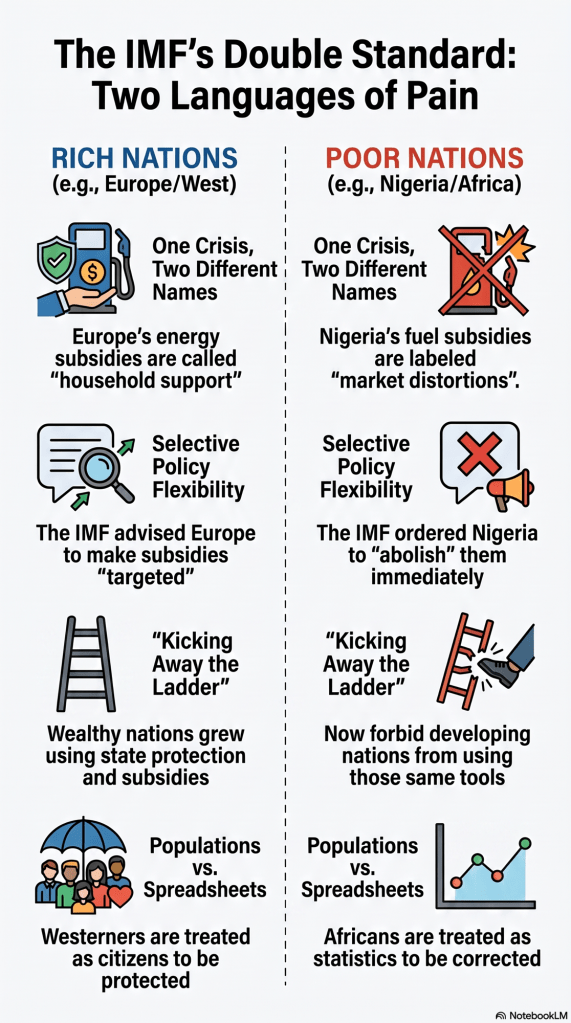
The subsidy that kept a Nigerian mechanic in Oshodi from spending half his income on transportation was “regressive.” The billions in energy relief packages distributed by European governments to their citizens following the 2022 Russia-Ukraine energy shock were, in the vocabulary of the same institutions, “temporary stabilisation measures” and “household support schemes.”
The difference is not economic. It is theological.
When Europe subsidises fuel, it is protecting households from volatility. When Nigeria does it, it is distorting the market. When Germany cushions consumers from energy inflation, it is safeguarding social cohesion. When African governments attempt the same thing, they are accused of fiscal irresponsibility and populism.
The moral framework adjusts depending on which hemisphere one is standing in.
Europe, faced with soaring energy prices after Russia’s invasion of Ukraine, did not embrace the purity of free-market suffering. Governments intervened massively. Price caps appeared. Taxes were reduced. Subsidies flowed. Citizens were protected from the full violence of the market because politicians understood something profoundly simple: democratic societies become unstable when ordinary people cannot afford to live.
The IMF’s advice to Europe was not “remove it immediately.” It was “make it targeted.” There was understanding. There was nuance. There was flexibility.
For Nigeria, the instruction was simpler: abolish it.
No allowance was made for the absence of functioning public transport. No serious recognition that energy costs ripple through every aspect of survival in an economy where generators substitute for electricity and transport determines whether one eats or works. The Nigerian poor were expected to absorb in months what Europe spread across entire state-supported programmes.
Apparently, austerity is a vitamin when prescribed to Africans.
This is not an argument that subsidies are universally efficient or free from corruption. Nigeria’s fuel subsidy regime became a carnival of fraud, rent-seeking, smuggling and elite theft. Entire political dynasties were nourished by the leakage. Tankers vanished into neighbouring countries while invoices multiplied like Pentecostal miracles.
But corruption is not unique to developing nations. Europe wastes money too. America subsidises industries, agriculture and corporations with almost religious devotion. Yet when wealthy nations intervene economically, it is described as strategic statecraft. When poorer countries do it, it becomes evidence of economic immaturity.
The real issue is not whether subsidies should exist. It is whether poor countries are granted the same policy flexibility that rich nations routinely reserve for themselves.
Developed countries industrialised behind tariffs, subsidies, state protection and intervention. Britain did not become Britain through IMF sermons on fiscal discipline. America did not build its industrial base through lectures on subsidy removal. South Korea was not assembled through purity-of-market ideology. Every successful economy in history climbed the ladder with state assistance and then often kicked the ladder away once it reached the top.
The modern economic order resembles an aristocrat lecturing tenants on the dangers of inherited wealth.
There is also an unspoken psychological dimension to this. Western policymakers often assume that pain in developing countries is somehow more absorbable. Inflation in Paris is a crisis. Inflation in Lagos is unfortunate but manageable. European unrest threatens democracy; African unrest becomes another development statistic.
A French commuter protesting fuel prices is defending living standards. A Nigerian worker protesting the same thing is resisting reform.
Even the terminology reveals the hierarchy. European citizens receive “support.” Africans receive “conditionalities.”
One group is treated as populations to be protected. The other as spreadsheets to be corrected.
The irony is that the IMF and World Bank were originally established after the Bretton Woods Conference precisely because the architects of the post-war order understood that unchecked economic shocks produce political extremism and social collapse. Stability required intervention. Governments had responsibilities beyond accounting neatness.
Yet somewhere along the way, the doctrine hardened selectively. Rich nations retained room for pragmatism while poorer nations were handed orthodoxy.
And orthodoxy is always easier to export than to endure.
There is a reason why the citizens of wealthy countries rarely experience the full brutality of the economic medicine prescribed abroad. Democracies in developed countries understand their own breaking points. They know electorates can only absorb so much pain before governments collapse. That is why European leaders cushioned households during the energy crisis instead of announcing that citizens must learn “market discipline.”
The same empathy somehow evaporates at the passport control of the developing world.
Perhaps the deepest frustration is not even the hypocrisy itself. Nations are hypocritical all the time. Power has always spoken two languages: one for insiders and another for everybody else.
The real frustration is the insistence that the contradiction does not exist.
Poor countries are asked to believe that what is prudence in Berlin becomes recklessness in Lagos. That subsidies protecting European voters are economically rational while subsidies protecting African workers are moral hazards. That suffering is regrettable in the North but character-building in the South.
The mechanic in Oshodi notices the difference even if the reports are written in polished Washington prose.
He understands instinctively what many policy papers try desperately to obscure: the global economic system does not merely distribute wealth unequally. It distributes compassion unequally too.