


There is a long and distinguished tradition, in Nigerian public life, of doing something of questionable legality and then calling a lawyer to explain why it was, in fact, perfectly fine. It happens in politics. It happens in procurement. And as I intend to demonstrate it happens in constitutional jurisprudence, where it goes by the rather grand name of the doctrine of necessity.
Now, I want to be clear that the doctrine of necessity is a serious legal principle with a serious intellectual pedigree. I also want to be clear that it has, in the hands of Nigerian courts, occasionally been stretched to cover acts that the drafters of our constitution would have regarded with the same horror with which a tailor regards a customer who has put on thirty pounds since their last fitting and still insists the suit fits perfectly.
The question I want to examine is this: how can a doctrine of necessity validly exist within a constitutional democracy at all? The doctrine is, at its core, a common law creature it was born and bred in the United Kingdom, a country whose constitution is unwritten, uncodified, and essentially a very long-running gentleman’s agreement held together by convention, tradition, and the quiet confidence that nobody will do anything too outrageous. It has no supreme written text. It has no Grundnorm. It has no Section 1(1) declaring that everything must flow from a single, sovereign document.
Nigeria, by contrast, has all of those things. So how did this very British legal houseguest move in, redecorate, and refuse to leave?
First, Let Us Understand What We Are Dealing With
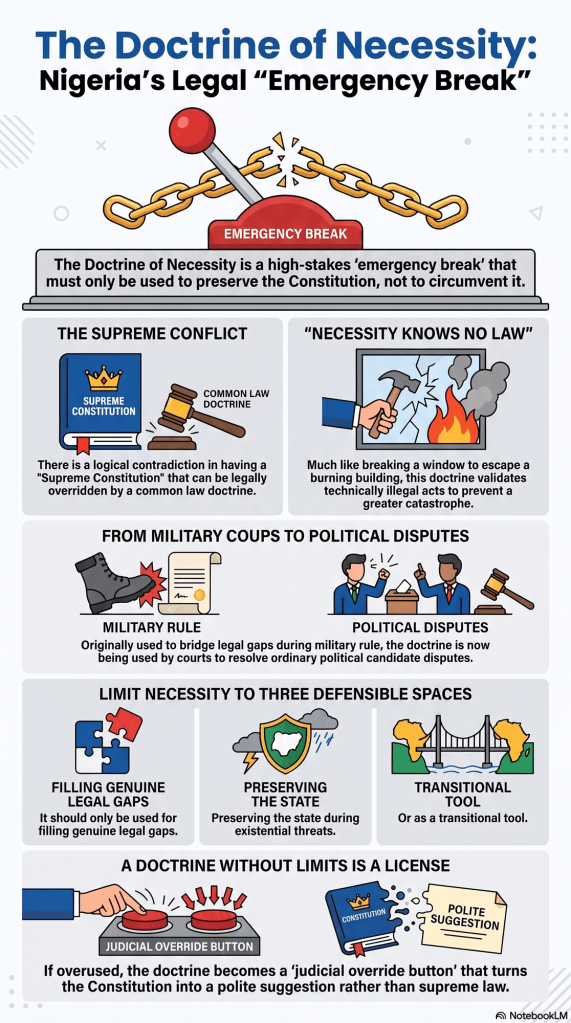
The doctrine of necessity, in its classical common law form, is the legal equivalent of breaking a window to escape a burning building. The act is technically unlawful. But the alternative staying inside and being consumed by fire is worse. Therefore, the law, in a moment of pragmatic generosity, looks the other way and says: that was probably fine, given the circumstances.
The Latin formulation beloved of lawyers is necessitas non habet legem necessity knows no law. Which, when you think about it, is a remarkable thing for lawyers to say, given that their entire professional existence depends on the proposition that everything has a law.
In the United Kingdom, this doctrine makes perfect sense. Parliamentary sovereignty means that Parliament can, in theory, legislate on anything. There is no supreme text to contradict. If necessity validates an otherwise irregular act, there is no higher constitutional norm it offends. The constitution bends because the constitution is, by design, bendable.
But Nigeria operates under the Constitution of the Federal Republic of Nigeria 1999 (as amended). Section 1(1) declares it supreme. Section 1(3) provides that any law or act inconsistent with it is void to the extent of the inconsistency. This is the Grundnorm the basic norm, the foundational legal text from which all authority flows, in the tradition of the great Austrian jurist Hans Kelsen, who I like to imagine would have had a great deal to say about Nigerian constitutional practice and very little of it complimentary.
The fundamental tension, then, is this: if the constitution is supreme, then acts consistent with it are valid and need no doctrine of necessity to save them. Acts inconsistent with it are void and no doctrine of necessity can resurrect them without simultaneously assassinating the supremacy that gives the constitution its meaning. You cannot have a supreme constitution and a doctrine that says necessity can override it. That is not legal reasoning. That is having your constitutional cake and eating it.
And yet — here we are.
How Nigeria Got Into This Predicament: A Brief History of Creative Jurisprudence
To understand why Nigeria’s courts have made peace with this theoretical contradiction, you have to understand Nigeria’s rather turbulent constitutional biography. Nigeria’s post-independence history reads, from a constitutional standpoint, like a man repeatedly setting fire to his own house and then asking the courts to explain why the house is still legally his.
Military coups in 1966, 1983, and 1993 each created a constitutional void a moment at which the existing constitution had been suspended or abrogated, and some new reality had been imposed by force. Nigerian courts, confronted with this reality, faced a choice. They could apply strict constitutional theory, declare every act of every military government void, and thereby plunge the country into a legal abyss in which every contract signed, every law passed, and every court judgment delivered under military rule became legally meaningless. Or they could find some principled basis for accommodating the reality in front of them.
They chose accommodation drawing on Kelsen’s own theory of legal effectiveness (a government that is effective in fact acquires legal validity) and on the common law doctrine of necessity. It was, under the circumstances, probably the right practical choice. A country in which fifty years of transactions and governance are legally void is not a country that functions. But it came at a theoretical price: necessity was thereby admitted into the constitutional household, given a guest room, and told it could stay as long as it behaved.
It did not entirely behave.
The foundational tension was visible even then. In Lakanmi v. Attorney-General (West) (1971), the Supreme Court initially showed admirable backbone, striking down a military decree that retroactively ousted court jurisdiction. The military government’s response was to pass another decree overturning the Supreme Court’s decision. The court, one imagines, took careful note of this exchange and drew appropriate conclusions about the limits of judicial heroism.
When Civilian Courts Started Catching the Habit
The more troubling development came after the return to civilian governance in 1999. One might have expected that, with a functioning democratic constitution back in force, the doctrine of necessity would be returned to the emergency cupboard from which it had been retrieved — to be used only in genuine constitutional crises and not as an everyday judicial utensil.
One would have been disappointed.
In Rotimi Amaechi v. INEC (2008), the Supreme Court validated the substitution of Rotimi Amaechi as the PDP gubernatorial candidate an act for which there was no explicit constitutional warrant partly on reasoning that the alternative would produce a greater constitutional injustice. Let that sink in for a moment. The doctrine of necessity, originally designed to keep constitutional order functioning in the face of military coups and state collapse, was now being deployed to resolve a political party substitution dispute. The burning building had become a mildly uncomfortable room temperature. The broken window had become a lifestyle choice.
In Attorney-General of the Federation v. Abubakar (2007), the court used necessity-adjacent reasoning to navigate vice presidential succession, suggesting that constitutional silence can be filled by necessity to preserve constitutional governance. This is a more defensible use of the doctrine it is, at least, a genuine gap-filling exercise. But even here, one is entitled to ask whether “the constitution does not address this situation” is really the same as “necessity compels us to act,” or whether it is simply a case of judicial creativity being dressed in a more ancient garment than it deserves.
Nigerian courts have justified these expansions on three broad grounds. The first is salus populi suprema lex the welfare of the people is the supreme law, even above the constitution. The second is constitutional continuity the constitution itself demands its own survival, and necessity serves that purpose. The third, which I find most persuasive, is judicial gap-filling: Section 6 of the 1999 Constitution vests broad judicial power in the courts, and this arguably incorporates the power to apply common law principles not expressly excluded by the constitutional text.
The third justification is intellectually honest and theoretically defensible. The first two are, with respect, the kind of reasoning that can be used to justify almost anything, which is precisely the problem.
But What About the Americans? Do They Have This Problem Too?
At this point the sharp-eyed reader will observe that the United States is in a structurally similar position. America also has a written, supreme constitution. America also conducted a revolution partly to establish the principle that government must be conducted according to law, not the whims of those in power. And Marbury v. Madison (1803) established judicial review as the mechanism for enforcing that supremacy making the American commitment to constitutional order, if anything, more explicit than Nigeria’s.
Does the USA have a doctrine of necessity? The official answer is no. The functional answer is: absolutely, but they would rather not talk about it.
American courts have, with considerable ingenuity, managed to absorb necessity reasoning into their constitutional jurisprudence without ever naming it. The technique is rather like a restaurant that serves alcohol in a jurisdiction where alcohol is technically prohibited the thing exists, everyone knows it exists, but it is described on the menu as “specialty fruit beverages” and nobody asks too many questions.
Consider Youngstown Sheet & Tube Co. v. Sawyer (1952), in which the Supreme Court struck down President Truman’s seizure of steel mills during the Korean War. The majority opinion is a robust defence of constitutional limits on executive power. But Justice Jackson’s celebrated tripartite concurrence which has become far more influential than the majority implicitly carves out a constitutional space in which emergency conditions alter the balance of power between the branches. When the President acts in a grey zone, especially in a crisis, courts defer. That is necessity reasoning wearing a separation-of-powers overcoat.
The political question doctrine achieves something similar by different means. When American courts declare a constitutional question to be a “political question” beyond judicial competence particularly in foreign policy or military affairs they are, in effect, allowing executive necessity to operate without judicial interference. The courts do not validate the act; they simply decline to examine it. This is what I would call passive necessity the doctrine operating through judicial silence rather than judicial endorsement.
Post-September 11 jurisprudence made the tension impossible to ignore. In Hamdi v. Rumsfeld (2004) and Boumediene v. Bush (2008), the Supreme Court was navigating the precise collision between constitutional guarantees and executive claims of national security necessity. The court never once invoked the doctrine of necessity by name. It did not need to. The functional reasoning that emergency conditions require some constitutional flexibility, that strict textual application must accommodate the reality of armed conflict was necessity reasoning under judicial camouflage.
The essential difference between the American and Nigerian approaches is, therefore, one of candour. American courts sublimate necessity into other doctrines. They would no sooner openly declare “this act is unconstitutional but we validate it by necessity” than a British politician would openly admit they had no idea what they were doing the thing happens, but one does not say it aloud. Nigerian courts, shaped by their common law inheritance and the bruising experience of constitutional rupture, have been willing to name the doctrine openly. This candour is, in an odd way, more intellectually honest than the American approach. It is also far more vulnerable to abuse, because a doctrine that is named can be invoked by anyone with a sufficiently creative advocate and a sympathetic bench.
The Inescapable Theoretical Problem
Let me return, in conclusion, to the problem I cannot resolve because I do not think it can be resolved, only managed.
If a constitution is genuinely supreme if it is the Grundnorm, the basic norm, the foundation of the legal order then there is, logically, no space for a doctrine that can override it. Acts consistent with the constitution are valid; they need no necessity. Acts inconsistent with it are void; necessity cannot save them without destroying the very supremacy it purports to serve. A supreme constitution and an overriding doctrine of necessity cannot logically coexist. Claiming otherwise is the jurisprudential equivalent of insisting that you are both the tallest and the shortest person in a room.
There are, in my view, only three theoretically defensible spaces for necessity within a constitutional democracy. First, in genuine constitutional gaps where the constitution is simply silent, and courts must fill the lacuna using available legal tools, including inherited common law principles. Second, at the existential threshold where the constitutional order itself faces destruction, and necessity is invoked to preserve the constitutional framework rather than to circumvent it. Third, as a transitional instrument bridging periods of constitutional rupture back toward constitutional normalcy.
These are coherent, limited, principled applications. What they share is that necessity serves the constitution rather than overriding it it fills gaps, preserves the framework, and bridges ruptures. What Nigerian courts have been doing, particularly since 1999, is expanding the doctrine well beyond these limits into ordinary constitutional disputes, where it functions not as a tool of constitutional preservation but as a judicial override button that produces whichever outcome the court regards as the more just or convenient one.
That is dangerous. A doctrine of necessity without disciplined limits is not a doctrine at all. It is a licence. And a roving judicial licence to override constitutional text whenever a compelling “necessity” can be constructed is, in the long run, indistinguishable from no constitution at all just a very long document that courts treat as a polite suggestion.
A Final Word
The doctrine of necessity in Nigerian jurisprudence is, ultimately, a colonial inheritance that survived constitutional independence kept alive by military history, judicial creativity, and the irreducible reality that every constitutional text has gaps which someone must fill. It is not going anywhere, and any analysis that pretends otherwise is engaging in wishful constitutional thinking.
But the United States has shown however imperfectly and covertly that necessity reasoning can be contained within constitutional structures rather than deployed against them. The question for Nigerian jurisprudence is not whether the doctrine exists. It plainly does. The question is whether our courts and our constitutional scholars can develop the doctrinal discipline to keep it within the three defensible spaces I have identified and prevent it from becoming what it has sometimes threatened to become: a solvent that quietly dissolves the constitutional supremacy it formally claims to honour.
Because a constitution that can be overridden whenever a court decides it is necessary is, to borrow a phrase, not so much a supreme law as a very strongly worded recommendation. And Nigeria, after everything it has been through to establish constitutional governance, deserves better than that.


One Reply to “”