There is a distinct, rhythmic art to surviving a Nigerian evening. First comes the sudden, heavy silence that distinct clunk as the transformer down the street surrenders its soul to the heavens. Then comes the chorus of synchronized sighs across the neighborhood, followed immediately by the roar of two dozen small petrol generators clearing their throats.
If you live in Nigeria, you know this routine by heart. You pay your monthly electricity bill to a private distribution company (DisCo), and then you pay the local petrol station to actually keep your fridge running.
What nobody tells you over the din of your I-pass-my-neighbor generator, however, is that you are actually paying for your power outage twice. Once when the DisCo sends you a bill for electricity that never arrived, and a second time when the federal government quietly takes your tax money to bail out that exact same DisCo for failing to deliver it.
Welcome to the ultimate national subscription service: privatized darkness, subsidized by the public.
The Day We “Sold” the Grid
To understand how we arrived at this spectacular arrangement, cast your mind back to November 1, 2013.
Inside a grand government hall in Abuja, then-President Goodluck Jonathan stood before a room of beaming executives, handing over signed ownership certificates for 11 state-owned electricity distribution companies. For decades, the state monopoly NEPA (affectionately decoded as Never Expect Power Always) and later PHCN had run the grid into the dust. Privatization was sold to the public as the silver bullet: real owners, real private capital, real electricity.
The 11 DisCos, along with the national generating plants, were handed over for roughly $2.5 billion.
There was just one tiny detail hidden in the fine print: the new owners were only required to put down 25% of their bid price within 15 business days.
Instead of deep-pocketed infrastructure giants rolling into town with billions in fresh foreign direct investment, the keys to the nation’s power grid were handed over to consortiums that had heavily leveraged themselves with commercial bank debt just to make the down payment.
The results were instantaneous. Within the first 12 months under private ownership, the national grid collapsed 24 separate times. A decade later, that number has blown past 162 grid collapses.
The Trillion-Naira Magic Trick
If you buy a bakery and run out of money to buy flour, the bakery closes, and somebody else buys it at a discount. That is how market economics is supposed to work.
In the Nigerian power sector, however, failure is not a terminal condition it is a business model.
When the new owners realized they couldn’t raise the capital required to fix the crumbling poles and rotten transformers, the state didn’t revoke their licenses. Instead, the Central Bank of Nigeria opened a special financial cushion known as the Nigeria Electricity Market Stabilization Facility.
One intervention led to another. By 2023, across six differently named schemes, public institutions had pumped over ₦2.3 trillion into the very private companies that were supposed to be investing in us. Add a $1.52 billion credit line from the World Bank, and the picture becomes crystal clear:
- The Private Owner borrows money to buy the utility.
- The Utility fails to cut losses (which ran at a staggering 33% against a 21% target, reaching up to 71% in some zones).
- The Government steps in with billions of naira in tax-backed loans to keep the utility standing.
- The Citizen funds the rescue package while sitting in the dark.
It is a head-spinning arrangement. If a DisCo misses its operational targets by a third, it doesn’t get penalized; it gets access to a fresh lending facility.
Recycled Debt and Boardroom Musical Chairs
When the system inevitably buckles under its own weight, the state’s bad-debt recyclers step in to smooth things over.
When Ibadan DisCo defaulted on its acquisition loans in 2022, control didn’t go to angry customers or liquidators. It was quietly absorbed by AMCON the federal bad-debt agency originally created to clean up bank failures.
Up north, Kaduna DisCo managed to rack up over ₦93 billion in market debt for power it had drawn from the grid but never paid for. When regulators issued a 60-day ultimatum to pay up or lose their license, the deadline quietly evaporated. Tucked away inside the regulatory paperwork was a charming detail: one of the shareholders sitting on Kaduna’s debt was none other than the Bureau of Public Enterprises the very government agency that sold them the company in 2013. The seller was, in effect, its own defaulting buyer.
By early this year, unpaid debts owed to the generating companies (GenCos) that actually manufacture the power hit an astronomical ₦6.8 trillion. The annual drag of these endless blackouts on the wider Nigerian economy is estimated at a staggering $28 billion every single year.
The Carousel Never Stops
The policy dance continues uninterrupted. In May 2026, the World Bank quietly canceled $717 million of undispersed loans to Nigeria’s power sector after the government repeatedly failed to hit agreed reform benchmarks. Yet just months prior, in February 2026, a brand-new $500 million program was opened for those same DisCos to distribute 3.2 million smart meters. (Of the roughly 700,000 meters delivered so far, barely 200,000 have actually made it onto customer walls).
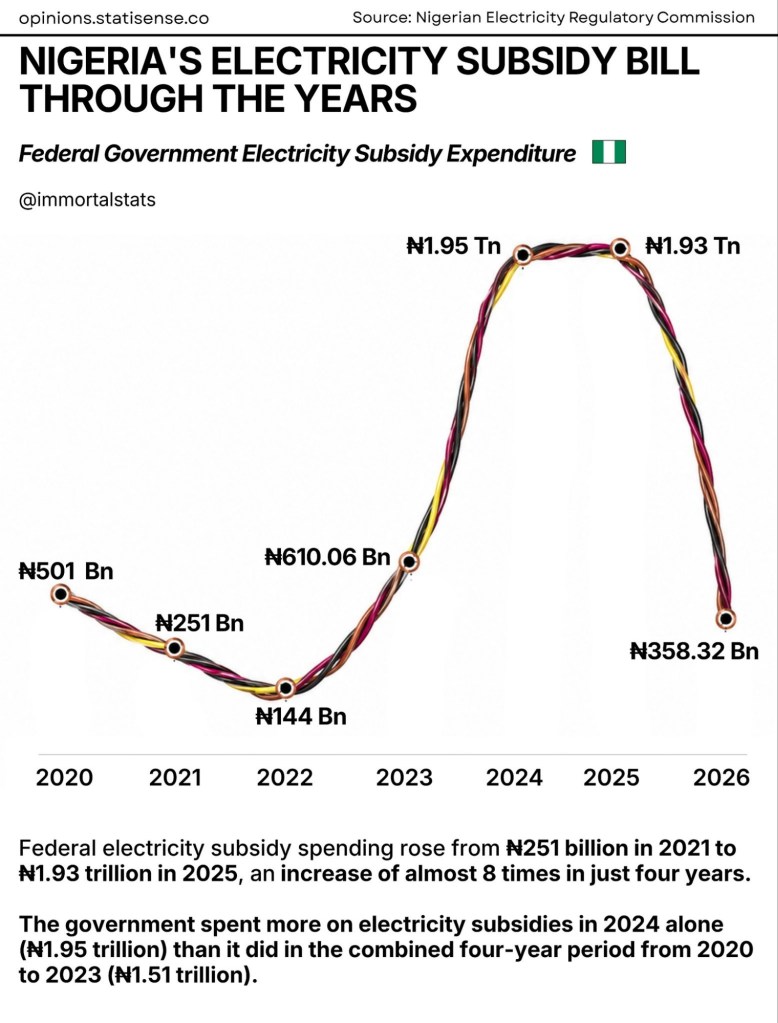
Meanwhile, the tariff shortfall the gap between what power costs to generate and what consumers are billed exploded from ₦140 billion in 2022 to nearly ₦1.9 trillion.
Just this month, in July 2026, the regulator issued a drastic new order: DisCos must now lock away 70% to 85% of their incoming revenue into ring-fenced escrow accounts strictly reserved for capital equipment and infrastructure. The regulator claims companies were sitting on cash instead of upgrading wires; the DisCos claim the order will scare away investors.
It is the exact same argument we were listening to in an Abuja conference room thirteen years ago.
Who Owns the Dark?
Nigerians didn’t lose reliable electricity because privatization is inherently bad. They lost it because the process transformed an operational failure into a self-sustaining financial ecosystem one where public money pours into private hands regardless of whether the lights turn on or off.
So the next time your neighborhood goes pitch black and you reach for the starter rope on your generator, take a moment to admire the sheer scale of the engineering. Not the electrical grid that remains thoroughly broken but the financial machine built around it.
It takes a truly special system to make millions of people buy their own darkness twice.