

There is an old saying that birds of a feather flock together.
It is not a principle of criminal law. It is not evidence of guilt. But in politics, where access, influence and patronage can be more valuable than money itself, the company a government keeps is worth examining.
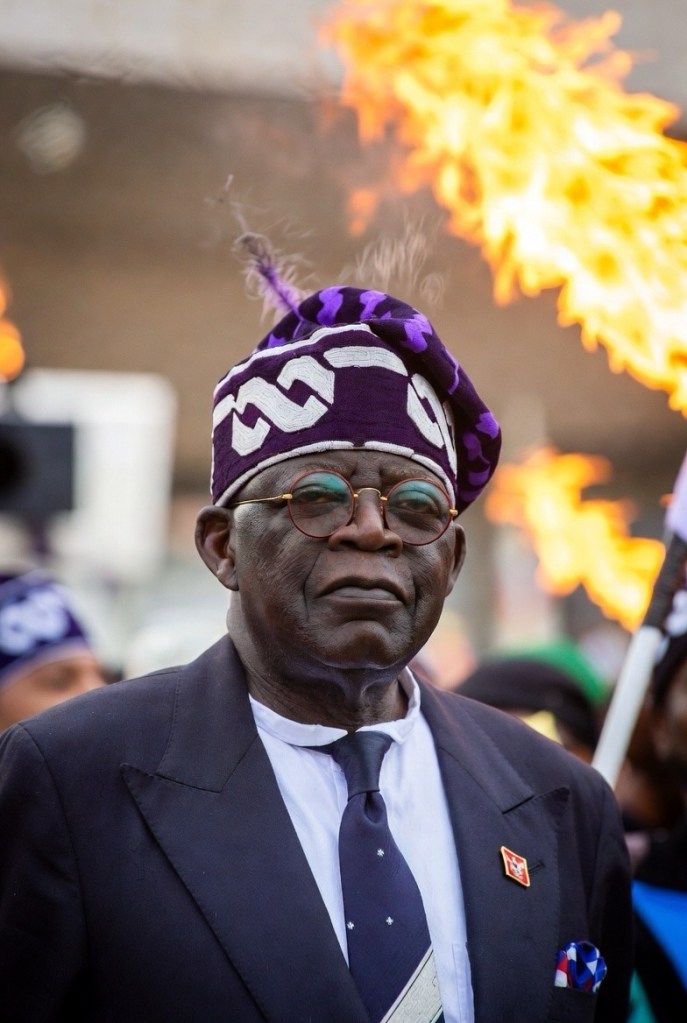
President Bola Ahmed Tinubu did not enter Nigerian politics as a captain of industry. His publicly documented career took him from accounting and professional work in the United States into Nigerian politics, first as a senator and subsequently as governor of Lagos State. Whatever view one takes of his personal wealth, his political career subsequently produced the financial and organisational machinery that made him one of Nigeria’s most formidable political financiers.
There is also the long-running American controversy over $460,000 forfeited by Tinubu in 1993. The available record is important here. American authorities linked the funds to narcotics proceeds, and the money was forfeited. The Nigerian presidency has emphasised that the current American litigation concerns access to government records and that no American court has convicted Tinubu of a criminal offence.
That distinction matters. Forfeiture is not a criminal conviction. Association is not proof of guilt. An EFCC invitation is not a conviction.
But neither should the public be asked to pretend that such matters are irrelevant when assessing the political ecosystem surrounding a government.
And that is where the Tinubu presidency becomes interesting.
The kitchen cabinet and the revolving door
Consider some of the people who have occupied important positions around the president or within his political machinery.
Senator Abdulaziz Abubakar Yari, former governor of Zamfara and now a senator, has been reported as being involved in Tinubu’s political arrangements for 2027. Yari was interrogated by the EFCC in 2021 over corruption allegations. The EFCC had also said it was investigating numerous cases connected with his administration. Those allegations remain allegations and should not be converted into a finding of guilt.
Then there is Abubakar Atiku Bagudu, Minister of Budget and Economic Planning and a central figure in the government’s economic management. His history is considerably more complicated. Bagudu was associated with the Abacha family and became involved in litigation concerning assets linked to the Abacha era. A 2003 settlement with the Nigerian government resolved civil and criminal claims against him in the United Kingdom, while requiring forfeiture of some assets. Separate US proceedings had also concerned assets allegedly connected to the Abacha network.
Again, the point is not that every person with a controversial history is automatically guilty of anything today.
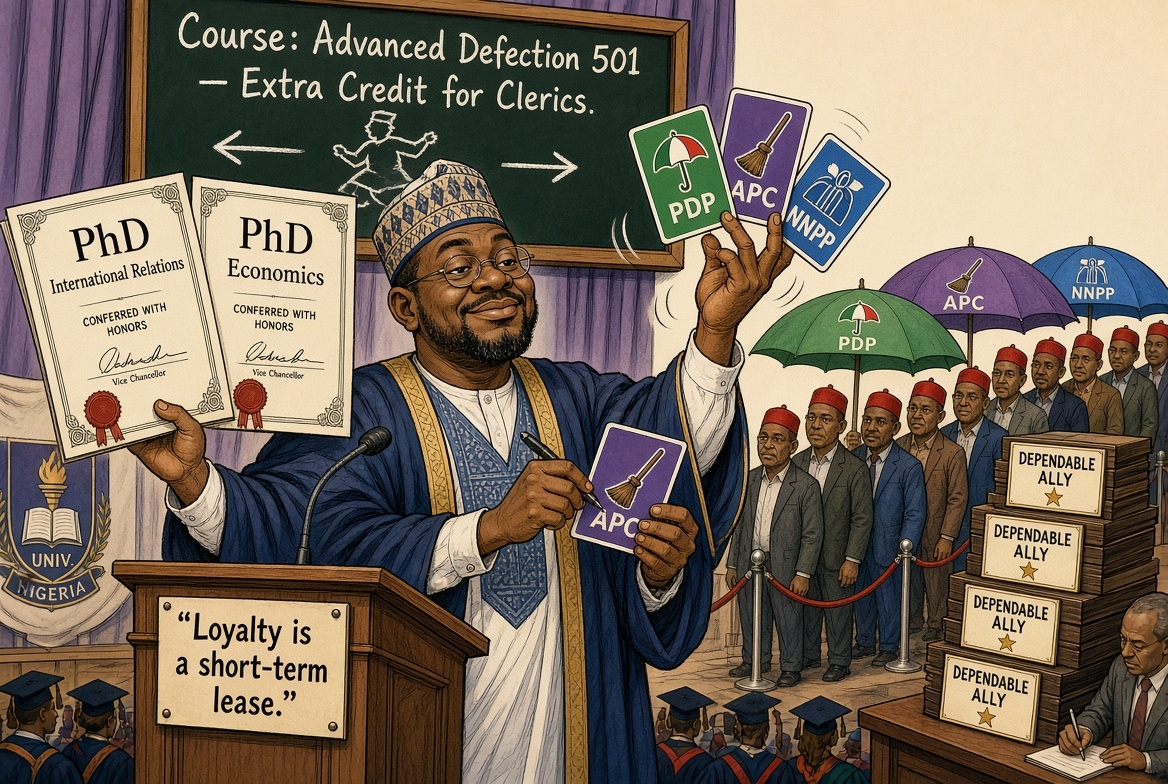
The point is that Nigeria has an extraordinary capacity to recycle politically connected people.
Yesterday’s subject of investigation can become tomorrow’s political strategist. Yesterday’s controversial businessman can become today’s honoured national figure. Yesterday’s political adversary can become tomorrow’s indispensable ally.
The Nigerian political system has developed something approaching a revolving door with very comfortable hinges.
Then there is Gilbert Chagoury
Few relationships illustrate the intersection of business, politics and state power more vividly than that between Tinubu and Lebanese-Nigerian businessman Gilbert Chagoury.
Chagoury’s business empire is substantial, with interests ranging from construction and real estate to hospitality and other sectors. His company Hitech Construction has been awarded major infrastructure work, including the first phase of the Lagos-Calabar Coastal Highway. The federal government describes the project as an EPC-plus-financing arrangement awarded to Hitech.
But Chagoury’s history is not merely a story of successful entrepreneurship.
He was convicted in Switzerland in 2000 in connection with money laundering and aiding a criminal organisation relating to funds associated with the Abacha regime. He paid a fine and returned $66 million to Nigeria. Chagoury has maintained that he did not know the funds were stolen.
His relationship with Tinubu is longstanding.
The issue, therefore, is not whether Chagoury is entitled to conduct business in Nigeria. Of course he is, subject to Nigerian law.
The issue is whether the proximity of politically connected businessmen to the presidency creates adequate safeguards against conflicts of interest, preferential access and the concentration of public contracts among a politically connected circle.
That is a legitimate question in any democracy.
It becomes an especially important question when the same businessman is simultaneously a longstanding associate of the political leader and a beneficiary of substantial public infrastructure contracts.
The Lagos-Calabar Coastal Highway, for example, is not a private road being built in somebody’s back garden. It is public infrastructure financed through a structure involving government and international lenders. The first phase alone has a $747 million syndicated financing arrangement.
The larger the public purse involved, the more important transparency becomes.
And then there is Yahaya Bello
Former Kogi governor Yahaya Bello provides another example of the curious Nigerian political revolving door.
The EFCC has prosecuted Bello over allegations involving approximately N110.4 billion. In June 2026, the Federal Capital Territory High Court rejected his attempt to have the charges quashed, allowing the case to proceed.
Yet Bello has also remained politically relevant and has emerged as a prospective APC senatorial candidate.
This is not necessarily proof of anything other than the extraordinary resilience of political networks.
But it does raise a larger question:
What happens to the credibility of an anti-corruption system when political relevance and proximity to power appear capable of surviving years of investigation and prosecution?
The answer matters because institutions are judged not only by whom they prosecute, but also by whether political connections appear to affect the consequences of prosecution.
From individual cases to a political ecosystem
It would be intellectually lazy to take these names and construct a criminal conspiracy from them.
That is not the argument.
Yari’s EFCC interrogation does not establish criminal guilt. Bagudu’s complicated history does not mean that every action he takes as a minister is improper. Chagoury’s conviction does not make every government contract awarded to Hitech unlawful. Bello’s pending criminal proceedings do not constitute a conviction.
But there is another level of analysis.
A state can be captured without every person inside the system being a criminal.
State capture is fundamentally about the relationship between political power and private influence.
It occurs when public institutions, public resources and public decisions become excessively shaped by a narrow network of political, economic and personal interests.
That is why the South African experience under Jacob Zuma is instructive.
The South African Judicial Commission of Inquiry into State Capture examined allegations concerning the penetration of state institutions and public enterprises by private interests. The resulting record became one of the most extensive investigations anywhere into the relationship between political power, business networks and public institutions.
The lesson from South Africa is not that Nigeria is South Africa.
It is that state capture does not arrive carrying a certificate announcing itself as state capture.
It develops through relationships.
Friends receive access.
Associates receive contracts.
Political allies receive appointments.
Institutions become dependent upon the political executive.
Oversight becomes selective.
And eventually the distinction between the state and the network surrounding those who control it begins to blur.
The Zuma lesson
Jacob Zuma’s presidency became synonymous with the Gupta family’s extraordinary influence over South African politics and state institutions.
The South African Constitutional Court’s proceedings concerning the State Capture Commission themselves demonstrate how seriously the institutions of that country treated the issue.
The important lesson is therefore not the personalities.
It is the mechanism.
State capture is less about one corrupt transaction than about a system in which political power and private interests become mutually reinforcing.
That distinction is important for Nigeria.
A government can award a perfectly legal contract and still have a serious transparency problem.
A minister can have a controversial past and still perform his duties lawfully.
A businessman can have a relationship with a president and still legitimately win a contract.
But when enough such relationships accumulate around the centre of government, the public is entitled to ask whether they are merely coincidences or symptoms of a wider structure of political patronage.
That is where the question of perception becomes a question of institutional design.
And now America has entered the conversation
The United States has traditionally regarded itself as being protected from precisely this sort of political capture by its institutions.
Yet contemporary American political debate increasingly uses the language of oligarchy, plutocracy and state capture to describe the growing relationship between political power, wealthy individuals and corporate interests.
Some analysts have explicitly described concerns about the erosion of institutional guardrails and the increasing influence of politically aligned billionaires and corporations around Donald Trump’s presidency. Others reject the analogy and argue that the American constitutional system remains fundamentally different from classic examples of state capture.
That debate is useful precisely because it reminds us that state capture is not an African disease.
It is a political pathology that can appear wherever wealth, political power and weak institutional restraints begin to feed one another.
The difference is often the strength of the institutions capable of saying: No. This is not how the state is supposed to work.
The real Nigerian question
The question for Nigeria therefore should not be:
“Are all these people criminals?”
That is a question for prosecutors and courts.
Nor should it be:
“Does the president have the right to appoint people he trusts?”
Obviously he does, within the law.
The more important question is:
Does the structure of Nigerian government provide sufficient institutional distance between political power, private wealth and public decision-making?
That question cannot be answered by presidential speeches.
It requires transparent procurement records, accessible beneficial ownership information, published government contracts, effective legislative oversight, independent anti-corruption agencies and courts capable of operating without fear or favour.
It requires citizens to be able to follow the money.
And it requires the government to tolerate questions about its friends with the same enthusiasm with which it welcomes their loyalty.
Because democracy is not simply the periodic act of putting a ballot into a box.
It is the continuing ability of citizens to ask who gets access, who gets appointed, who gets the contract, who benefits, who investigates and who is ultimately accountable.
Birds of the same feather
There is a temptation in Nigerian politics to reduce everything to personalities.
Tinubu.
Yari.
Bagudu.
Chagoury.
Bello.
Zuma.
Trump.
But personalities are only the surface.
Underneath them lies the machinery of power.
The danger begins when political networks become so dense that government looks less like an institution serving the public and more like a private club whose membership happens to control the public purse.
That is why the company a president keeps matters.
Not because friendship proves criminality.
Not because an investigation proves guilt.
Not because every contract awarded to an associate is automatically corrupt.
It matters because democracy depends upon the state belonging to the public, not to the network surrounding whoever happens to occupy the presidential residence.
Nigeria has seen enough political godfathers, business godfathers and government godchildren to know that the boundaries can become remarkably elastic.
The proper response is not hysteria.
It is sunlight.
More disclosure.
More scrutiny.
More institutional independence.
More questions.
And fewer sacred cows.
Because once the birds have flocked together for long enough, the important question is no longer simply which bird belongs to which flock.
It is whether the flock has begun to mistake the whole country for its aviary.

