

A counterfactual on shock therapy, sequencing, and the mercy of the ballot box
The Speech Nobody Scripted
On 29 May 2023, Bola Tinubu stood at Eagle Square and, in the manner of a man discovering a lever in a dark room, announced the end of the fuel subsidy in his inaugural address. By several accounts, the line was not in the prepared text. “Subsidy is gone” was reportedly an ad-lib, followed by a long pause for emphasis, which is the sort of thing one does when delivering a punchline, not when dismantling a thirty-year-old pillar of the Nigerian economy.
The pump prices received the memo faster than the Cabinet did. Petrol went from about N195 to over N500 within days, and Nigerians, who are nothing if not efficient at absorbing bad news, immediately converted it into bus fares, bread prices and a collective sigh that could be heard in Cotonou.
To be fair to the President, the policy itself was not his invention. The Buhari government had already made no provision for the subsidy in the 2023 budget, and all three leading presidential candidates had promised to remove it. The destination was agreed by everyone. The quarrel is about the driving.
The Encore Nobody Requested
Then came the second act. On 14 June 2023, barely two weeks later, the Central Bank unified the exchange rate windows. The naira fell 36 per cent against the dollar on the official market almost at once. Supporters called it price discovery, a phrase that sounds wonderfully scientific until you are the one being discovered.
Economists were not exactly unanimous in their enthusiasm for the timing. Experts warned that unification must be handled with care, lest it snowball into galloping inflation and deeper hardship, given the subsidy removal that had just happened. The President himself conceded the point, acknowledging that the subsidy removal would “impose an extra burden on the masses of our people”. A burden, in this telling, being the polite word for a piano dropped from a height.
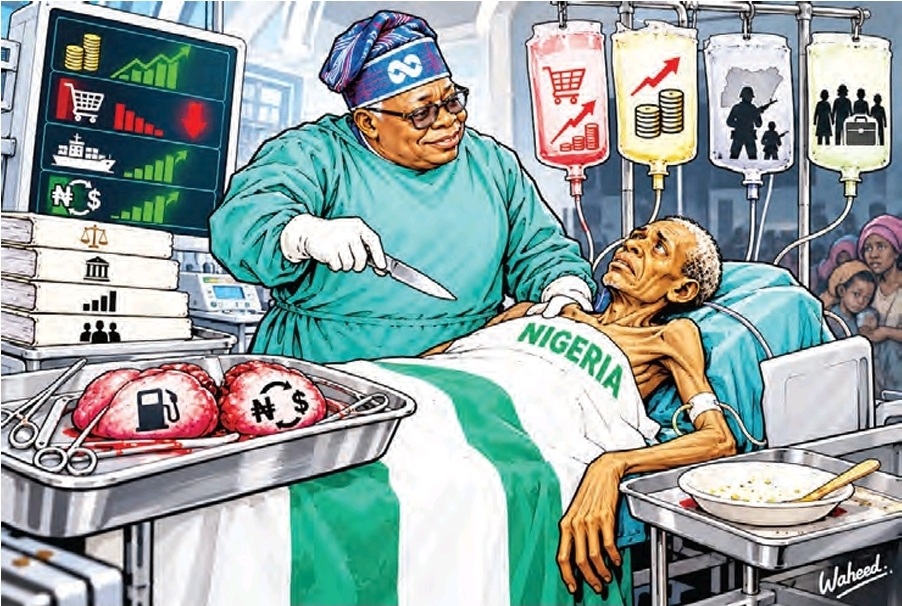
The result was two shocks, one fiscal and one monetary, delivered back to back to the same patient. It was less a treatment plan than a surgeon announcing he would take out the appendix and the kidney before lunch, since the theatre was already booked.
The Counterfactual
Now imagine a different Tinubu, one with democratic instincts and a working relationship with the concept of consequences.
In this version, he removes the subsidy in his first term, and he does it with a plan: transfers that actually reach people, a transport relief scheme that exists before the fare increase and not after the protest, and a wage conversation held in good faith and not under strike threat. Nigerians absorb a price reset the way a body absorbs a vaccine, with a sore arm and a grumble but without hospitalisation.
Then the President goes before the electorate. This is the crucial point. He asks for a second term on the strength of a record. If the first reform worked, he has earned the licence to attempt the second. If it did not, the voters tell him so, and the second shock is never administered to a population that had no say in the first.
Only then, in a second term, with the mandate renewed and the cushions in place, does he harmonise the exchange rate. Two reforms, two doses, one patient who survives to vote on the results.
That is not timidity. That is the difference between reform and revenge.
What the West Gets Right by Accident
The Nigerian reformer might ask why anyone should take lessons in welfare from the West, whose Right has complained about the welfare state for a century. The answer is that the complaint has never become wholesale abolition, and the reason is not kindness. It is arithmetic of a different kind: the arithmetic of seats.
Consider the evidence. In the United States, the politicians who dream aloud of trimming Social Security tend to find, on contact with voters, that it is a live wire. In Britain, Liz Truss attempted a bold fiscal experiment in 2022 and was out of Downing Street after 49 days, a tenure that a decent sourdough starter could outlast. And Labour’s decision to restrict the winter fuel payment in 2024 was later softened after a backlash, proving that even governments with enormous majorities can be taught humility by pensioners.
Nobody in these systems is more virtuous than anyone else. They are simply operating inside a machine where the people who feel the pain also hold the power to end the career of whoever caused it. Nigeria has seen this machine at work too. When Goodluck Jonathan announced subsidy removal in January 2012, the subsidy became a national buzzword and the policy a national argument, and a protest movement helped force a partial retreat. There is an irony worth savouring here: Tinubu and Buhari were both at the vanguard of the opposition to Jonathan’s attempt. Reform, it seems, is an excellent idea in the hands of whoever happens to be in power.
The Ledger, Honestly Kept
In fairness to the defence, the reforms are not without a case. The subsidy was expensive, it fed smuggling and fraud, and the multiple exchange rate windows rewarded the well-connected with arbitrage that did the poor no favours. Even critics concede that the old system could not continue. And the numbers are not all grim: headline inflation eased to 14.63 per cent in September 2026, and the naira strengthened to N1,333 per dollar in mid-October.
But the same ledger carries other entries. Petrol that sold at about N830 a litre before the latest Middle East conflict has since climbed above N1,400 in several places, and the government felt compelled to announce a 30-day petrol discount in October. A discount, three years in, is rather an admission that the cushions were an afterthought.
The case for the counterfactual does not require pretending the old system was good. It requires only observing that a reform can be correct in direction and reckless in speed, and that speed is precisely the variable a democratic leader is supposed to manage. A leader who fears the ballot box sequences his pain. A leader who does not simply schedules it all for the same afternoon.
The Moral for the Margins
The great virtue of democracy is not that it produces wise policy. It produces survivable policy, because the people who bear the cost can fire the person who imposed it. Where that mechanism is strong, reformers learn to pace themselves. Where it is weak, they learn to say “subsidy is gone” and then pause for applause.
Nigeria’s task is not to choose between reform and compassion. It is to build the kind of politics in which the two are forced to shake hands, preferably before the pump prices go up and not after.

