

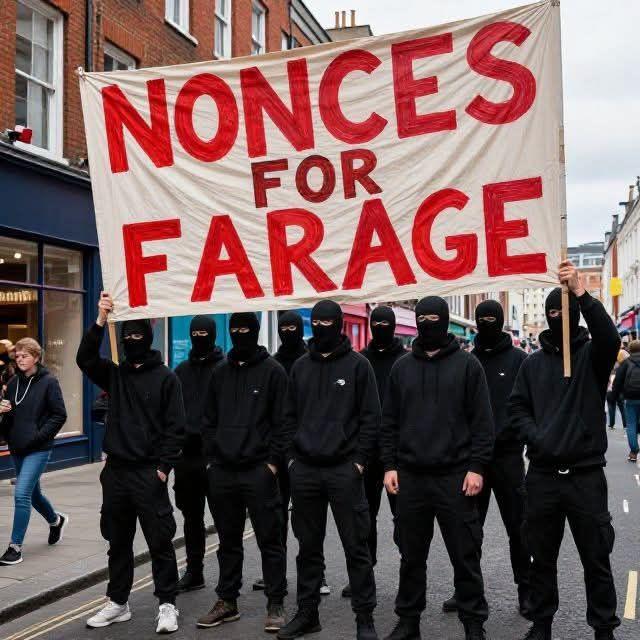

There is a growing question for democratic societies outside Britain: should political leaders and their associates who cultivate an environment of racial hostility enjoy unrestricted international mobility while the consequences of their political rhetoric are experienced by minority communities at home and abroad?
I have previously examined the American Immigration and Nationality Act, particularly section 212(a)(3)(E), which renders individuals involved in Nazi persecution, genocide, torture and extrajudicial killings inadmissible to the United States.
I have also considered the corresponding exclusion powers available under British immigration law.
But there is a wider question which deserves attention. Must we wait until individuals acquire governmental power and begin implementing racial persecution through the machinery of the state before considering the international consequences of their conduct?
I suggest not.
The politics of manufacturing racial hostility
Nigel Farage and Reform UK have made immigration one of the defining features of their political identity. Their campaign against migration has extended beyond the legitimate debate about border management, immigration numbers and the enforcement of immigration law.
The political language increasingly presents immigration as a threat to British identity, culture and national survival.
There is nothing inherently objectionable about advocating stricter immigration controls. Every sovereign country has the right to determine its immigration policy.
But there is a distinction between criticising immigration policy and cultivating hostility towards people because of their nationality, colour, ethnicity or country of origin.
That distinction is fundamental.
The political danger arises when migrants, irrespective of their individual circumstances, become a convenient explanation for economic difficulties, pressure on public services, housing shortages and perceived cultural decline.
Once that narrative becomes entrenched, the distinction between an individual who has committed an immigration offence and an entire community of people becomes progressively blurred.
The result is a political environment in which racial hostility can become normalised.
The Nigerian example: When political hostility becomes dehumanisation
The recent conviction of Glenn Gibbins, a suspended Reform UK councillor in Sunderland, provides a disturbing illustration.
On 9 November 2026, Gibbins was convicted of malicious communication following a Facebook post in which he suggested that Nigerians should be melted down and used to fill potholes.
He received a 12-month community order and 150 hours of unpaid work. His defence indicated an intention to appeal.
The district judge rejected his description of the post as an innocent joke. She considered that it reduced Nigerians to the status of an inanimate substance and was intended to offend and humiliate members of the Nigerian community.
The court also considered his freedom of expression arguments.
The circumstances are particularly disturbing because the targeted community was not an abstraction. Nigerians living in Sunderland were sufficiently distressed to organise a protest and demand an apology.
This was not a disagreement about immigration statistics or the administration of border controls. It was the dehumanisation of an identifiable national community.
There is an important qualification: the post was made in March 2024, before Gibbins became a councillor, and the judge expressly found that it was not politically motivated or part of a wider immigration argument. His conviction does not establish that Farage directly instructed, approved or caused the particular post. However, Farage has encouraged and promoted a political environment where such views are upheld and ventilated.
Nevertheless, his subsequent selection as a Reform candidate, the controversy surrounding the party’s handling of his candidacy and the wider pattern of conduct exposed among Reform representatives raise legitimate questions about political vetting and institutional responsibility.
The distinction between individual criminal responsibility and the political environment in which such attitudes find expression must not be ignored.
Reform UK and Restore: The political ecosystem
Reform UK and Rupert Lowe’s Restore Britain represent separate political organisations, although their political histories and constituencies overlap.
Lowe was formerly a Reform UK MP and an ally of Farage before establishing Restore.
The political competition between these movements raises another concern: whether the pressure to demonstrate who can take the toughest position on immigration encourages increasingly exclusionary rhetoric.
ITV’s October 2026 undercover investigation into Reform UK councillors and candidates recorded individuals making racist, dehumanising and violent remarks about black people, Muslims and Asian communities.
Reform UK responded that investigations had commenced and acknowledged that some individuals who did not share its values had passed through its vetting process.
The significance is not that every Reform member or supporter holds these views. That would be an unfair generalisation.
It is that repeated incidents involving candidates and elected representatives demand more than the routine political response of describing offenders as isolated individuals.
Political organisations must accept responsibility for the standards they establish, the candidates they select and the conduct they tolerate.
The enablers
The Conservative Party cannot entirely escape scrutiny for the political environment in which contemporary anti-immigration politics has developed.
Nor should Labour be exempt from examination.
There is a legitimate debate about what might be described as the Blue Labour approach to immigration and national identity, including the position taken by the current Home Secretary, Shabana Mahmood.
The argument is not that advocating immigration enforcement is racist. It is that mainstream political parties must be careful not to validate narratives that collectively stigmatise minority communities.
When political competition becomes a contest over who can appear most hostile to migrants, the consequences are not confined to electoral campaigns.
The language enters public discourse, influences perceptions and can embolden individuals who interpret political hostility as permission to express their own racial animosity.
Political leadership carries responsibilities beyond winning elections.
Why should the international community care?
This brings us back to the American precedent.
The United States has legislated against the admission of individuals who participated in Nazi persecution, genocide and other specified atrocities.
Britain itself maintains powers to exclude foreign nationals whose conduct falls within specified categories of unacceptable behaviour, extremism and international criminality.
The underlying principle is that international mobility is not an entitlement divorced from conduct.
I propose that democratic countries examine whether their immigration legislation should be strengthened to address individuals who knowingly organise, facilitate or incite serious racial persecution.
The examination should include political leaders, public officials and influential activists, regardless of their political affiliation or the power they currently exercise.
The relevant question should be what the individual has done, the evidence available and the consequences of that conduct.
It should not be necessary to wait until the individual becomes a minister, prime minister or head of government.
However, there must be an important distinction between the expression of political opinions, however objectionable, and conduct that crosses the legal threshold into incitement, persecution or other serious wrongdoing.
Membership of Reform UK or Restore, by itself, should justify an international travel prohibition consideration.
Equally, no political leader should enjoy immunity from scrutiny merely because their party has not yet formed a national government.
Britain is not the property of its political leaders
There is an irony in this debate.
Farage and his political associates campaign on the proposition that Britain belongs to the British people and that immigration must be controlled in the national interest.
That principle of sovereignty applies to other countries too.
Nigeria, Canada, Australia, South Africa and European democracies have their own immigration laws and legitimate interests in determining whom they admit.
They are entitled to scrutinise individuals whose documented conduct raises legitimate concerns under their immigration and public-order legislation.
The proposal is not to manufacture a collective punishment against political opponents. It is to ensure that individuals who participate in serious racial persecution cannot expect international hospitality to operate as an automatic privilege.
British citizenship protects the right to return to Britain. It does not create an unconditional right to enter every other country.
The ultimate test
History should have taught the democratic world that racial persecution does not begin when concentration camps are constructed or when a government formally announces a policy of extermination.
It can begin with the normalisation of dehumanising language, the political stigmatisation of minorities and the gradual erosion of public sympathy for those being targeted.
We must be careful not to equate contemporary British politics with Nazi Germany. Historical comparisons require intellectual discipline.
But we must equally resist the temptation to dismiss every warning sign until it is too late.
Farage, Reform UK, Restore and their political enablers should be judged by their actual conduct, their public statements and their institutional responsibilities.
Other countries should not be afraid to apply their immigration laws where credible evidence justifies exclusion.
The international community must establish that the protection of human dignity is not a privilege reserved for people who happen to live in countries with powerful friends.
The right to political association is not a licence to persecute. The right to advocate immigration control is not a licence to dehumanise immigrants. And the right to hold political office is not immunity from international accountability.

