

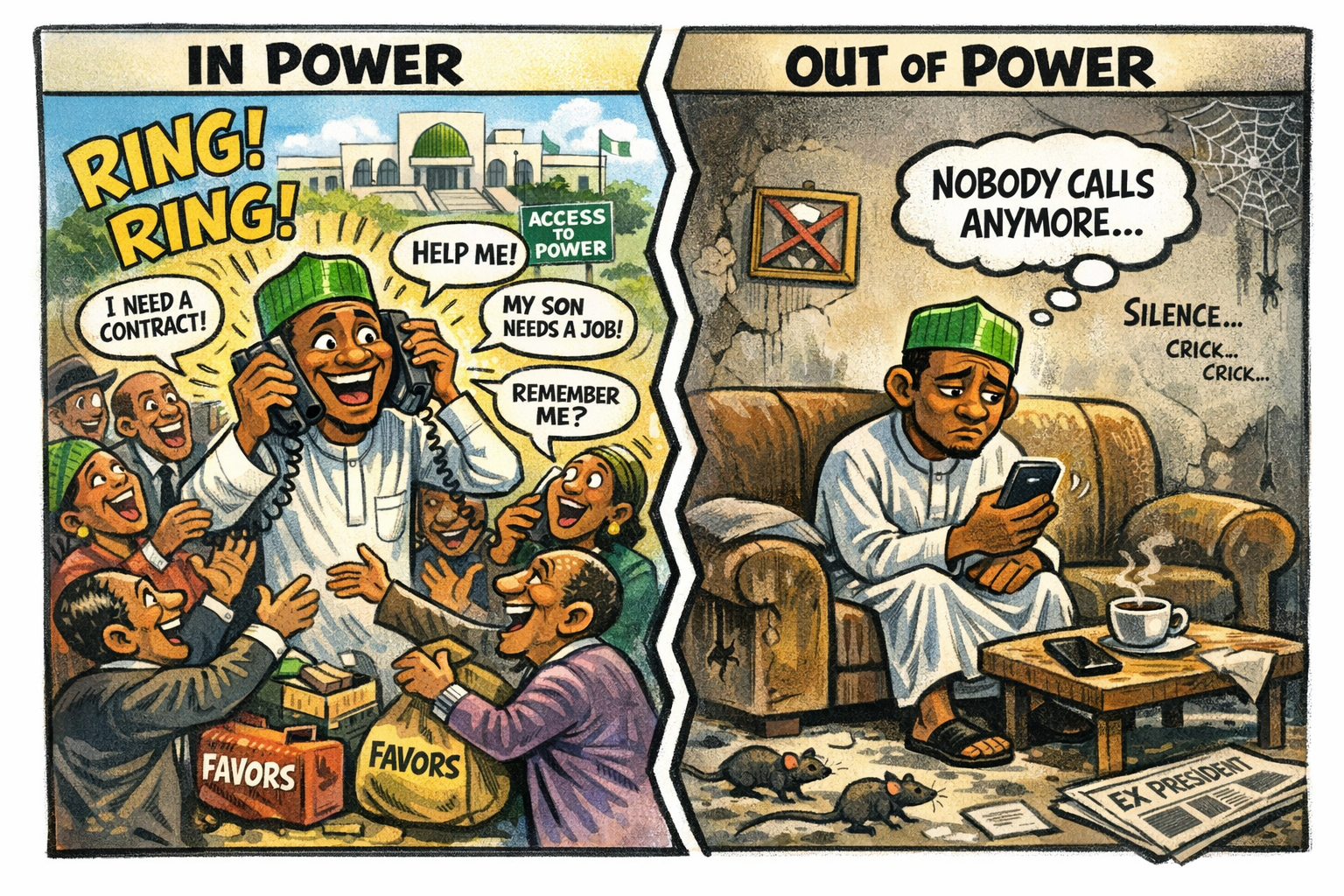

There are economic textbooks, there are IMF reports, and then there is the most accurate indicator of Nigeria’s political economy: the call log on the phone of a man close to power.
Yusuf Buhari, son of Nigeria’s late president, has accidentally written the clearest thesis on Nigeria’s rent economy without citing Adam Smith, Karl Marx, or the World Bank. His testimony is not just personal grief dressed as nostalgia; it is a diagnostic scan of how governance and survival work in Nigeria.
In his words, after Goodluck Jonathan made the courtesy call congratulating Muhammadu Buhari on his election victory, life changed instantly. Not because policy had been announced. Not because budgets had been passed. But because proximity to power had been activated.
Two thousand calls a day.
At 4 a.m., Nigerians were already awake—not to innovate, not to produce, not to build factories—but to dial. Old classmates suddenly rediscovered friendship. Distant relatives traced bloodlines with forensic enthusiasm. Former maids and household staff remembered long-lost loyalty. Even strangers with “untraceable explanations” emerged, armed with confidence and airtime.
This was not affection. It was alignment.
Nigeria, after all, is not a productivity-based economy; it is a relationship-based survival system. The fastest-growing industry is not technology or agriculture but access. The most valuable skill is not competence but closeness. Wealth does not flow from ideas, labour, or enterprise; it trickles down from power like holy water—if you are standing close enough to be splashed.
Then came the handover.
Buhari left office. Tinubu entered Aso Rock. And suddenly—like NEPA at peak hours—the calls disappeared.
From 2,000 to 100.
After burial rites, the final indignity arrived: 20 calls a day. Mostly siblings. A few business associates. The professional mourners of power had moved on. The phones no longer rang.
And that, right there, is Nigeria.
In a functioning economy, leaving office does not turn people into ghosts. Former leaders write memoirs, give lectures, chair boards, and influence ideas. In Nigeria, once you leave power, you don’t become an elder statesman; you become offline. Your importance expires with your access badge.
This is the tragedy of a rent economy: power is not a tool for governance but a feeding trough. People do not orbit institutions; they orbit individuals. Ministries don’t matter. Rules don’t matter. Systems don’t matter. What matters is who can “make a call” on your behalf—and whose phone is still ringing.
That is why elections feel like life-and-death struggles. That is why politics is militarised. That is why corruption is existential rather than incidental. Losing power in Nigeria is not just losing office; it is losing relevance, income, protection, and social oxygen.
When Yusuf Buhari says, “Nobody truly cares,” he is not describing emotional abandonment. He is describing the expiration of utility.
In Nigeria, care is conditional. Loyalty is leased. Friendship is transactional. When the rent source dries up, the tenants move out quietly, taking their SIM cards with them.
Until Nigeria builds an economy where dignity is not outsourced to political proximity—where success is not dependent on whose number you have saved—the phones will keep ringing in power and go silent in retirement.
And that silence, more than any policy failure, is the loudest indictment of Nigerian governance.
 Centre for Nigeria Progress