

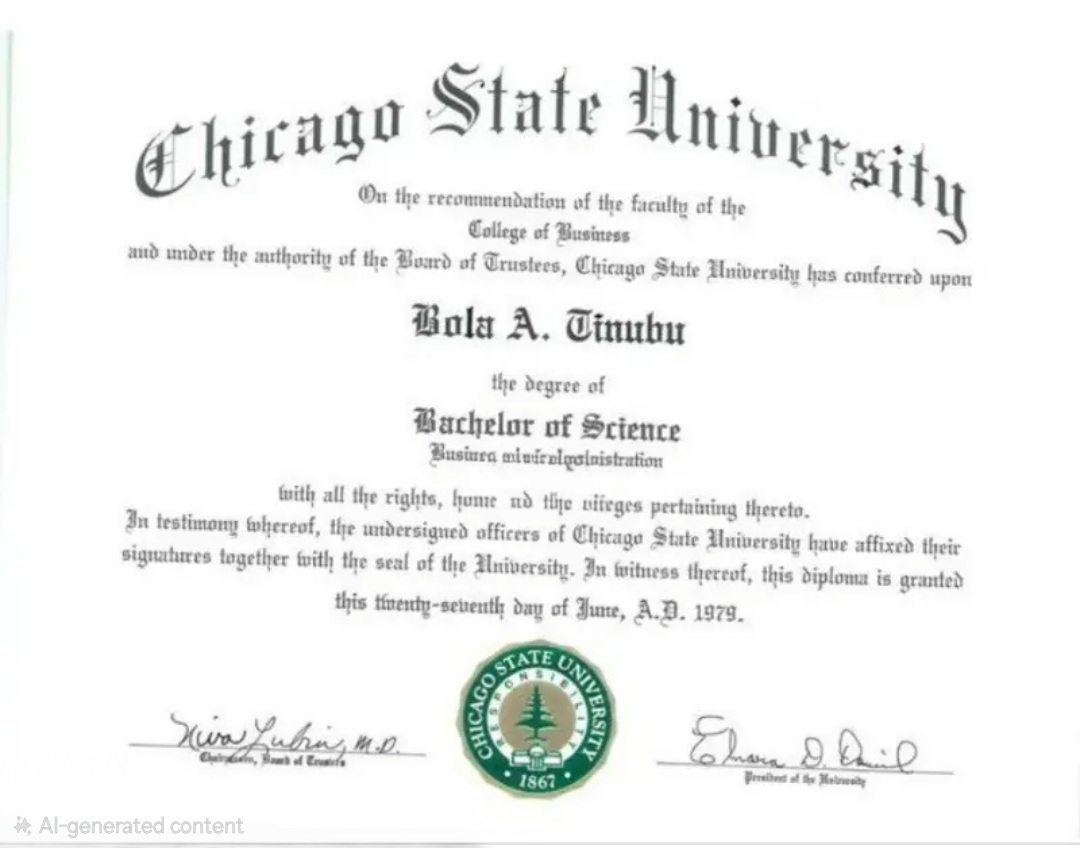
In Nigerian electoral politics, few rituals are as sacred or as tragicomic as the Post-Election Certificate Inquisition. Every four years, like clockwork, the campaign trails go quiet, the street rallies dismantle their loudspeakers, and political war rooms suddenly turn into amateur typography guilds.
Armed with high-resolution scanners, magnifying glasses, and a fresh grievance, politicians comb through the educational credentials of their opponents. They obsess over font kerning, faint seals, and misaligned margins, convinced that somewhere between a crooked signature and an unreadable stamp lies the ultimate prize: getting the Supreme Court to invalidate millions of votes before lunch.
It makes for breathless Twitter threads and thunderous press conferences. But when the dust settles in the courtroom, the legal reality is always the same cold splash of water.
The High Bar That Isn’t
The core misunderstanding begins with what the law actually asks of an aspirant. Under Section 131(d) of the 1999 Constitution (as amended), a candidate seeking the presidency must be educated up to at least “School Certificate level or its equivalent.”
For years, critics have treated this provision as an aspirational benchmark of technocratic genius. It is not. It is an intellectual subterranean baseline.
If you glance at the interpretation section under Section 318(1), the Constitution goes out of its way to define this requirement with almost comedic generosity. It doesn’t just mean acing your WAEC exams. It encompasses a Grade II Teacher’s Certificate, City and Guilds, proof of mere attendance at a secondary school without a passing slip, or a Primary School Leaving Certificate combined with relevant work experience and an ability to hold a conversation in English. In essence, the Nigerian Constitution demands far less formal paperwork to run a nuclear-aspirant economy of 220 million people than an entry-level bank teller needs to sit at a desk in Lagos.
If a candidate holds a recognized, accredited university degree—regardless of how messy the administrative paper trail looks decades later—they clear this constitutional ankle-hurdle by a mile. You cannot logically argue that a man lacks primary arithmetic because you cannot find his kindergarten report card, when he is brandishing a diploma from a higher institution.
The Forgery Mirage: When Civil Trials Chase Criminal Phantoms
“Ah,” the opposition says, “but what about the forged document submitted to INEC?”
Enter Section 137(1)(j) of the Constitution, which bars anyone who presents a forged certificate to the electoral commission. On paper, it sounds like an open-and-shut guillotine. In practice, it is a procedural minefield that claims the heads of those who attempt to walk through it without reading the Evidence Act.
Here is where the law becomes stubbornly unyielding. In Nigerian jurisprudence, an election petition is a civil contest. But the moment you whisper the word “forgery,” you are no longer arguing a breach of contract or an administrative oversight; you are alleging the commission of a crime.
The moment a crime is placed on the table, Section 135(1) of the Evidence Act, 2011 kicks in with ironclad force: it must be proved beyond reasonable doubt. You cannot point to a blurry photocopy, stage a press conference, and announce that the candidate must now prove his innocence. To do so turns the constitutional presumption of innocence (Section 36(5)) upside down. If I accuse a fellow citizen of being a bank robber, the burden does not instantly shift to him to bring twenty character witnesses and his deposit slips to prove he wasn’t at the vault; I must prove the heist myself.
Furthermore, the Supreme Court has made the evidentiary burden an Olympic steeplechase through its “Issuing Authority” doctrine. In APC v. Obaseki (2021), the apex court sent a blistering message to certificate hunters: discrepancies, font alterations, and clumsy administrative photocopies do not constitute forgery.
Unless the issuing institution—the actual registrar of the university or the examinations council—is subpoenaed to sit in the witness box, look the bench in the eye, and formally disown the candidate and the document, the allegation dies on arrival. You cannot subpoena your own outrage and call it expert evidence.
The Electoral Act and the Self-Inflicted Trap
Then comes the legislative irony that politicians hate discussing in public. Under the current electoral legal framework, the procedural windows for mounting an assault on candidate particulars have been deliberately narrowed.
Under Section 29(5) of the Electoral Act, the right to initiate a pre-election legal assault on submitted qualifications was strictly confined to an aspirant who actually participated in the same party’s primary election. Rival parties, civil society watchers, and everyday citizens were stripped of locus standi. If an internal party opponent failed to challenge those documents within the strict 14-day limitation window under Section 285(9) of the Constitution, the door was slammed and deadbolted.
Who drafted that reality? The distinguished lawmakers of the National Assembly. Members of every major political party sat on those committees, nodded at the readings, and approved the text. To snooze through legislative drafting and then weep before the cameras that the judiciary is refusing to rewrite the law retroactively is political theatre of the most tragic kind.
Stop Suing, Start Persuading
This is why mixing legal criminality with political suitability is fatal to an opposition’s strategy.
A candidate can comfortably survive a courtroom trial on technicalities, statutory limitations, and strict burdens of proof, while simultaneously failing the standard of governance. The courts are built to adjudicate the narrow confines of legality; they do not award certificates of impeccable moral hygiene.
If a candidate’s educational background reads like an espionage novel, if their institutional records require a small armada of Senior Advocates of Nigeria to contextualize, and if their public explanations test the limits of credulity, that is not an automatic criminal verdict. But it is an explosive political indictment.
The only viable path forward is to construct the political case:
- Demand a higher standard than the Constitution’s floor. The law may only require a Primary Six certificate and basic English, but the electorate has every right to demand intellectual agility, institutional transparency, and unassailable pedigree.
- Prosecute the character deficit. You do not need a beyond-reasonable-doubt standard to convince voters that evasion, secrecy, and legal gymnastics are poor traits for someone seeking custodianship of the public treasury.
- Stop leaning on the bench. When you run to the Supreme Court to do the work of political mobilization, you abandon the field. Judges will not save a democracy from candidates whose paperwork squeaks past statutory traps.
It is time to hang up the borrowed wigs, put away the magnifying glasses, and face the voters. If a leader has failed the litmus test of basic public trust, the remedy isn’t a writ of mandamus—it’s the ballot box.

