Crocodile Tears and Caliphate Dreams: The Selective Christianity of Washington’s Nigeria Policy By Lawson Akhigbe

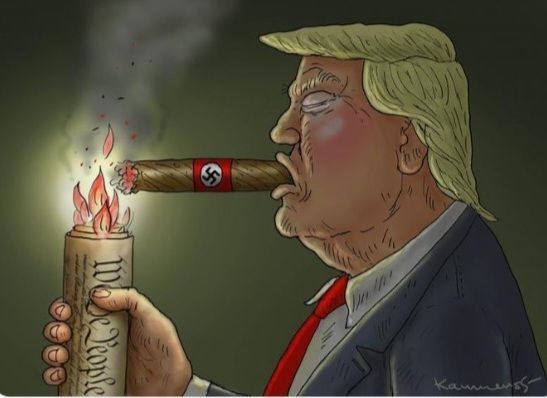
Let it be said plainly: Christians are dying in Nigeria's Middle Belt and northeast, in numbers that shame a government which has spent a quarter-century treating internal security as a procurement racket rather than a constitutional duty. That much is not in serious dispute, whatever Abuja's spokesmen protest on television. But sincerity and self-interest are not mutually exclusive states, and it takes a special sort of credulity to receive Donald Trump's sudden solicitude for Black Christians in the Sahel as anything other than what it plainly is a foreign policy improvised from a domestic culture war, deployed by an administration whose relationship with racial minorities at home has rarely troubled itself with tenderness. One does not have to admire

The Trump World by Lawson Akhigbe

There is a particular cruelty in a medical report. Unlike a political speech, a budget forecast, or an election manifesto all genres of creative literature to which democratic publics have made a resigned peace a medical report carries with it the residual authority of science. When a doctor speaks, we are conditioned, in some prelinguistic way, to believe them. Which is precisely why what has happened to American presidential medicine under Donald Trump is so arresting. The clinic has been converted into a theatre, the stethoscope swapped for a megaphone, and the diagnosis subordinated entirely to the demands of the narrative.

Schrödinger’s Immigrant: The Convenient Villain for Every Failure by Lawson Akhigbe

The immigrant today exists simultaneously as two incompatible creatures. On one hand, he is portrayed as a lazy welfare dependent draining public resources, crowding hospitals, filling council housing lists and surviving on benefits paid by hardworking natives. On the other hand, that same immigrant is somehow an unstoppable economic superhuman taking all the jobs, dominating industries, suppressing wages and outcompeting local workers in both skilled and unskilled sectors.

The Silence of Friday: How J.M. Coetzee Flipped the Script on Robinson Crusoe

In 1986, South African Nobel Laureate J.M. Coetzee looked at Crusoe’s island and saw something entirely different: the blueprint for colonial trauma.

Xenophobia as an Economy: How Violence Becomes a Political and Financial Instrument in South Africa by Lawson Akhigbe

The tragedy is not just that the poor are fighting each other. It is that, in doing so, they are unwitting participants in a system that depends on exactly that outcome.