


There is a curious place in the political geography of the modern far right.
It has no postcode. It does not appear on Google Maps. There are no street signs pointing towards it. Yet, whenever one of its inhabitants is caught saying something outrageous or doing something politically or legally questionable, suddenly we are told that the offending words or conduct belonged there.
It is called the safe place.
For Donald Trump, it was the locker room.
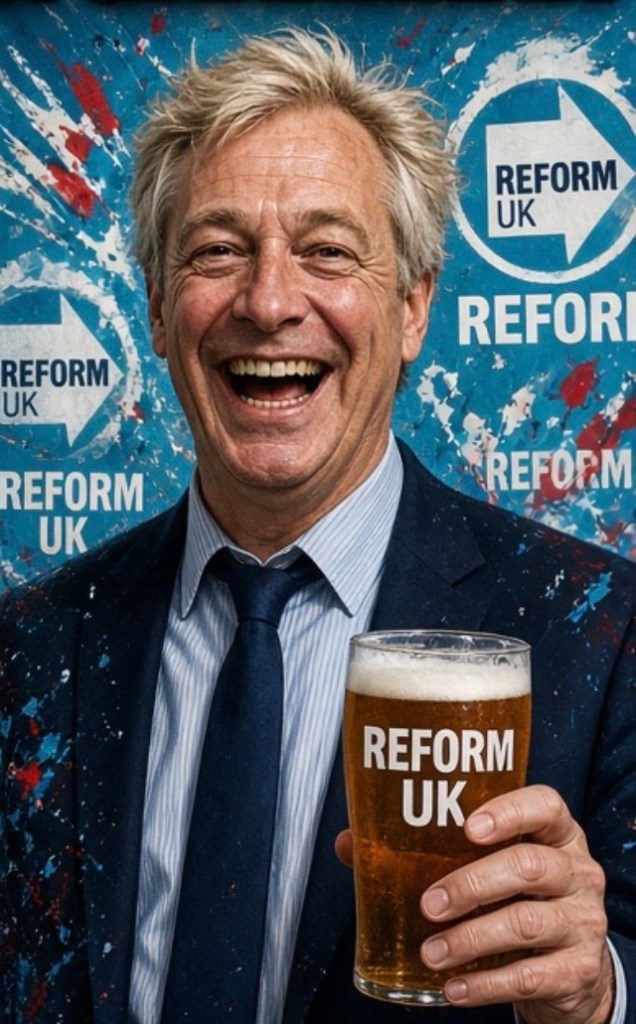
For Nigel Farage, it appears to be the pub.
And apparently, when the political right needs somewhere to park racism, sexism, dishonesty or potentially unlawful financial arrangements, there is always a convenient room available.
Trump’s infamous “grab them by the pussy” remarks to Billy Bush were never intended for public consumption. Unfortunately for him, they were consumed by the public.
The defence was revealing. Trump and his supporters effectively argued that the words belonged to the private world of locker-room talk. Yes, the language was wrong. Yes, the attitude was unpleasant. But this was supposedly a sanctuary of sorts, a place where men could say things they did not mean to be judged by.
The locker room became a moral jurisdiction of its own.
Normal rules of public character were apparently suspended at the door.
The argument was not really that the words were acceptable. It was that they were private.
That distinction matters.
Because it suggests that the real offence was not necessarily the misogyny, but the fact that somebody had allowed the public to hear it.
Now Britain has been offered a variation on the same theme.
Questions surrounding financial arrangements involving Reform UK and the legality of foreign financial support for British political parties were captured by undercover journalists. James Orr and Dan Jukes, two of the individuals at the centre of the arrangements subsequently resigned their positions within Reform UK Ltd.
And Nigel Farage, who was present when the deal was concluded, reportedly sought to diminish the significance of the conversations by characterising the origins of the arrangements as essentially pub talk.
There it is again.
The safe place.
The pub.
A drinking establishment where, apparently, serious conversations cease to be serious conversations because somebody has had a few drinks.
Racism becomes banter.
Sexism becomes banter.
Political extremism becomes banter.
And now potentially unlawful political finance becomes pub talk.
The pub has become the British equivalent of Trump’s locker room: a jurisdiction in which ordinary standards of accountability are temporarily suspended.
Except there is a rather large problem with this theory.
A pub is not a legal vacuum.
Neither is a locker room.
Nor is a private dinner.
Nor is a cigar room.
Nor is a WhatsApp group.
Nor is the back seat of a Range Rover.
Where something is said does not determine whether it is true, lawful or consequential.
If somebody conspires to commit a crime in a pub, the fact that they had a pint in their hand does not convert the conversation into comedy.
If somebody makes a racist statement in a pub, the alcohol does not magically turn racism into banter.
And if political money is discussed in circumstances which raise questions under electoral law, calling the conversation “pub talk” does not repeal the legislation.
The law has not traditionally recognised the Drunken Conversation Defence.
Perhaps Reform could propose it as the next item in its manifesto.
The real problem is not the room
There is something deeper connecting the Trump locker-room defence with the Farage pub defence.
Both depend upon the creation of a supposedly safe environment in which the unacceptable becomes acceptable.
The underlying proposition is remarkably simple:
We know this is wrong, but this is where we are allowed to say or do it.
That is the trick.
The problem is displaced from what was said or done to where it was said or done.
The locker room supposedly excuses the misogyny.
The pub supposedly excuses the language.
The private meeting supposedly excuses the financial arrangement.
The joke supposedly excuses the racism.
The banter supposedly excuses the bigotry.
And before long, the political movement becomes a washing machine into which every unpleasant thing can be thrown, provided it can first be labelled banter, pub talk, locker-room talk or some other euphemism.
Turn the machine on.
Add alcohol.
Wait ten minutes.
And apparently the stains disappear.
They don’t.
Character cannot be left outside the room
There is an even more uncomfortable truth.
People do not acquire a different character when they walk through the door of a pub.
Nor do they become different human beings when they enter a locker room.
The private self and the public self may not be identical, but they are not completely unrelated creatures either.
The man who believes women are objects does not suddenly become a feminist when he leaves the locker room.
The person who entertains racist ideas in private does not necessarily become an anti-racist when the television cameras arrive.
And the politician who participates in discussions about money does not make those discussions legally irrelevant simply because they occurred over drinks.
Character follows you into the room.
Indeed, sometimes the private room is precisely where character is most clearly revealed because the performance has stopped.
That is why these revelations matter.
They provide a glimpse behind the political curtain.
The far right’s peculiar safe harbour
There is a particularly disturbing feature of contemporary far-right politics.
It increasingly treats outrage not as something to avoid but as something to normalise.
Say something racist, then call it a joke.
Say something sexist, then call it banter.
Say something inflammatory, then call it free speech.
Propose something legally questionable, then call it pub talk.
When challenged, the explanation becomes more important than the conduct.
The words were taken out of context.
The conversation was private.
It was only banter.
It was only a joke.
It was only a discussion.
Nobody was supposed to hear it.
But politics does not operate on the basis of what people hoped nobody would hear.
It operates on consequences.
And democracy certainly cannot function on the principle that those seeking public power are entitled to one moral code in public and another in private.
The room is not the problem
Perhaps the most revealing aspect of all this is that the supposed safe places are not actually safe.
They are safe only for the person speaking.
The woman being objectified is not safe.
The minority being discussed is not safe.
The voter whose democracy is being manipulated is not safe.
The political system receiving potentially unlawful money is not safe.
The public being asked to trust these politicians is not safe.
The safe place is therefore not a sanctuary for society.
It is a sanctuary from accountability.
And that is an entirely different thing.
Trump and Farage have built political identities around the rejection of established norms, institutions and conventions when those norms become inconvenient to them.
Yet the irony is that they still want the protection provided by those very institutions when it suits them.
They want the power of public office but the privacy of the locker room.
They want the influence of politics but the accountability of the pub.
They want to be heard by millions but judged only by their friends.
That arrangement cannot work.
If you want to exercise public power, your conduct inevitably becomes a matter of public concern.
Perhaps we should send them back
There is a delicious irony in the idea of these supposed safe places.
Perhaps we should take the argument seriously.
If the locker room is where Trump belongs, perhaps he should remain there.
If the pub is where Farage’s political conversations belong, perhaps he should remain there too.
We could put a little sign outside each establishment:
PRIVATE POLITICAL SANCTUARY
No voters.
No journalists.
No minorities.
No women.
No electoral law.
No accountability.
And, most importantly:
No access to public office.
Because the rest of us would rather live in the real world, where what politicians say and do has consequences.
The central issue is not that these men have discovered places where people speak differently.
Of course they have.
The issue is that they appear to believe that the existence of such places gives them permission to escape responsibility for what those conversations reveal.
It doesn’t.
A pub is not a confessional.
A locker room is not a constitutional convention.
A private conversation is not automatically a harmless conversation.
And alcohol is not a solicitor.
The real safe place should be the society they are asking to govern: a society in which women, minorities, voters and institutions are protected from bigotry, manipulation and unlawful conduct.
If Trump and Farage insist that their politics requires a special room in which normal standards do not apply, perhaps there is only one sensible solution.
Give them the room.
Lock the door.
And let the rest of us get on with building a society in which the rules apply both inside and outside the pub.

