


For years after Brexit, the idea of Britain rejoining the European Union was treated in British politics like an embarrassing family WhatsApp message accidentally sent to the wrong group. Nobody serious wanted to discuss it publicly. Politicians tiptoed around the issue. Commentators spoke in euphemisms like “closer alignment” or “reset.”
The trauma of the 2016 referendum still hangs over British politics like a fog over the Thames. The political establishment understands one thing clearly: Britain cannot simply crash back into the European Union after spending a decade insisting it was finally “taking back control.”
Yet history has a wicked sense of humour.
The very geopolitical forces that helped energise Brexit nationalism may now be pushing Britain slowly back toward Europe. And among those forces, perhaps nobody has accelerated that shift more than Donald Trump.
The Club Britain Fought to Leave
One of the great ironies of Brexit is that joining the European project was never easy in the first place.
Britain was rejected twice in the 1960s by Charles de Gaulle, who famously distrusted British intentions and viewed the UK as too economically and culturally tied to the United States. Even after finally joining the European Economic Community in 1973, Britain maintained a permanently awkward relationship with Europe.
The UK negotiated opt-outs from the euro. Opt-outs from Schengen. Budget rebates. Special arrangements. Half-in, half-out membership became Britain’s preferred European posture.
Then came the 2016 referendum, and Britain left altogether.
But leaving a club is one thing. Rejoining it is another entirely.
The EU is unlikely to ever again offer Britain the exceptionally generous membership deal it once enjoyed. Brussels has little appetite for accommodating a country perceived to have spent years destabilising the union before dramatically storming out.
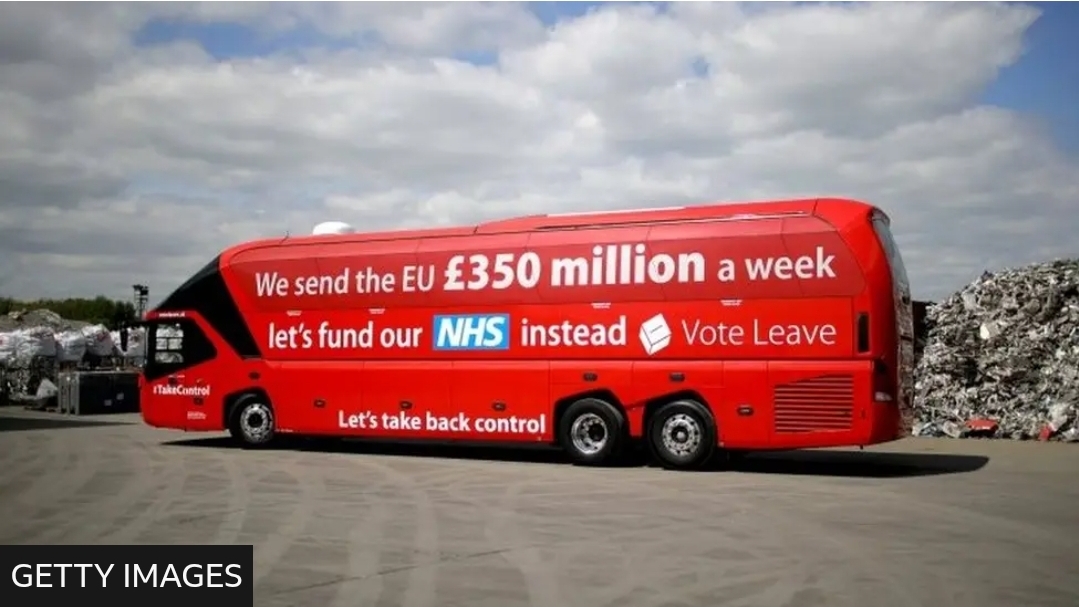
As David Miliband noted in his BBC Radio 4 interview, Europe would not tolerate Britain “flipping and flopping.” Any return would require a long-term national consensus, not another emotional referendum fought on slogans painted onto buses.
And therein lies the central problem.
Britain can only rejoin Europe politically if rejoining stops feeling like surrender.
Trump Changed the Global Calculation
This is where Trump enters the story.
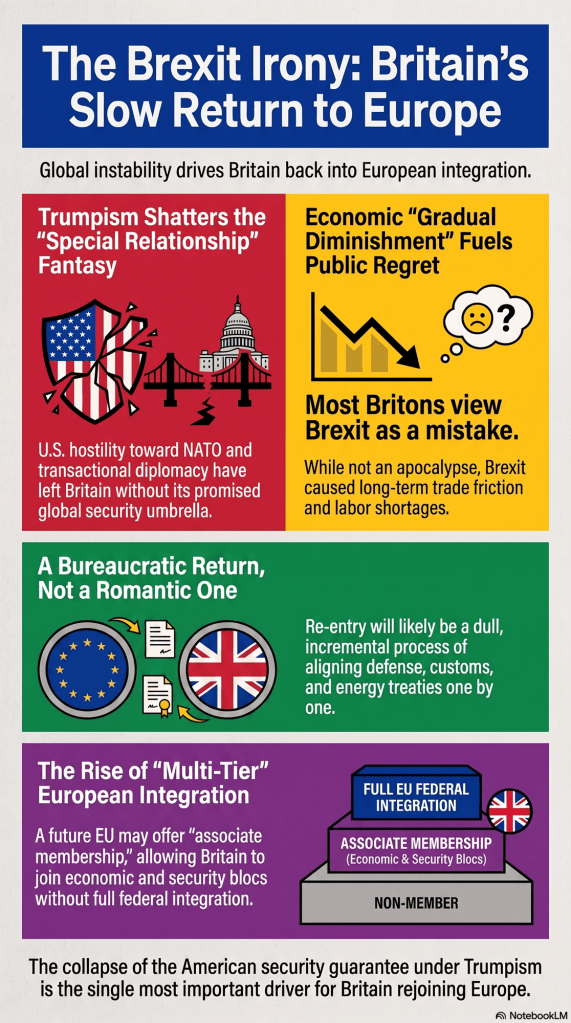
Brexit was sold partly on the fantasy that Britain could become a fully sovereign global trading power anchored by a “special relationship” with America. The assumption was simple: even outside Europe, Britain would remain protected under the umbrella of American-led Western stability.
That assumption no longer looks secure.
Trump’s repeated hostility toward NATO allies, his transactional worldview, and his admiration for authoritarian strongmen have deeply alarmed European governments. His rhetoric on Ukraine especially has shaken Europe’s confidence in long-term American security guarantees.
For decades, Europe outsourced much of its defence psychology to Washington. Trump effectively told Europe to grow up and defend itself.
Ironically, this may become the single greatest force driving Britain back toward deeper European integration.
Because geography is stubborn.
Russia’s invasion of Ukraine reminded Britain that European security is indivisible. A missile crisis in Eastern Europe affects London just as much as Warsaw or Berlin. Refugee flows, cyber warfare, energy instability, terrorism, economic shocks, none of these respect Brexit borders.
As Miliband argued, Britain’s defence is Europe’s defence and vice versa.
This is why conversations once considered politically radioactive are now returning through the back door under softer names:
- Defence coordination
- Customs alignment
- Youth mobility schemes
- Single market access
- Associate membership
- Tiered integration
The language changes. The destination quietly inches closer.
Europe Itself Is Changing
Another reason Britain may eventually find re-entry easier is because the EU Britain left in 2020 may not exist in the same form by the 2030s.
The potential accession of Ukraine is already forcing Brussels to rethink the structure of European membership itself. Discussions around multi-tier integration, associate membership, and variable geometry are becoming increasingly serious.
That matters enormously for Britain.
A future European Union may become less rigidly federal and more strategically layered:
- Core eurozone integration
- Associate economic membership
- Defence partnerships
- Security integration mechanisms
In essence, Europe may evolve into something Britain can politically tolerate.
Not a surrender of sovereignty, but a negotiated interdependence.
The Brexit debate was always poisoned by absolutism. One side pretended Britain could flourish entirely alone. The other sometimes pretended sovereignty itself was obsolete.
Reality has destroyed both illusions.
Economics Is Slowly Winning the Argument
The economic damage from Brexit is no longer seriously disputed outside ideological circles.
Business investment slowed. Trade frictions increased. Labour shortages emerged. Financial services partially migrated. Exporters encountered barriers that never previously existed.
The most striking part is that this happened despite Britain avoiding the absolute catastrophe predicted by some Remainers. Brexit did not produce apocalypse. It produced something politically more dangerous: gradual national diminishment.
A poorer Britain is harder to dramatise than a collapsing Britain. But over time, it changes public mood.
The younger generation especially views Brexit differently. For many under 35, Brexit increasingly resembles an older generation’s culture war whose economic costs they inherited without receiving its emotional satisfaction.
Polling trends increasingly suggest that a majority of Britons now believe Brexit was a mistake.
But wanting Brexit reversed and actually reversing it are vastly different matters.
Rejoining Will Not Be Romantic
If Britain eventually rejoins European structures, it will not happen through romantic idealism about “ever closer union.”
It will happen because the world became harsher.
Trumpism, Russian aggression, Chinese competition, energy insecurity, migration crises, and economic fragmentation are all teaching the same lesson: middle-sized powers survive better inside large blocs.
The age of splendid isolation is over.
Even Brexit’s strongest advocates quietly acknowledge this reality when they advocate trade agreements, defence partnerships, and strategic alliances. Sovereignty in the modern world increasingly means choosing which systems you depend upon.
Britain already depends heavily on Europe whether it admits it or not.
The question is whether future governments gradually formalise that dependence again.
The Political Humiliation Problem
The greatest barrier to rejoining the EU is not economic or institutional.
It is psychological.
Brexit became tied to national pride, identity, and sovereignty mythology. Reversing it requires political leaders willing to admit that the promises of Brexit were, at best, incomplete.
Few politicians enjoy campaigning on national regret.
That is why any path back will likely be incremental and deliberately ambiguous.
Britain will not wake up one morning and dramatically re-enter the EU to the sound of Beethoven’s Ninth Symphony.
Instead, the process may look bureaucratic and dull:
- Defence compacts
- Regulatory convergence
- Customs agreements
- Student mobility
- Shared procurement
- Judicial cooperation
- Energy integration
One treaty at a time.
One crisis at a time.
One concession to reality at a time.
Brexit May Ultimately Produce a More European Britain
And this is the deepest irony of all.
Brexit was meant to loosen Britain’s ties with continental Europe forever.
Instead, it may eventually force Britain into a more consciously negotiated, strategically dependent, and openly European future than at any point during its original membership.
Not because Brussels conquered Britain.
But because the world became too dangerous for illusions.
Trump did not create that reality alone. But he accelerated it dramatically by reminding Europeans, including the British, that America’s guarantees are no longer eternal, automatic, or unconditional.
In trying to restore absolute sovereignty, Brexit may ultimately teach Britain the oldest lesson in European history:
No European nation truly stands alone for very long.


Brexit was not a great move. I remember all the changes we made to our payment processing system when this happened. Trump can’t be trusted.
LikeLiked by 1 person
The UK is worse off
LikeLiked by 1 person