

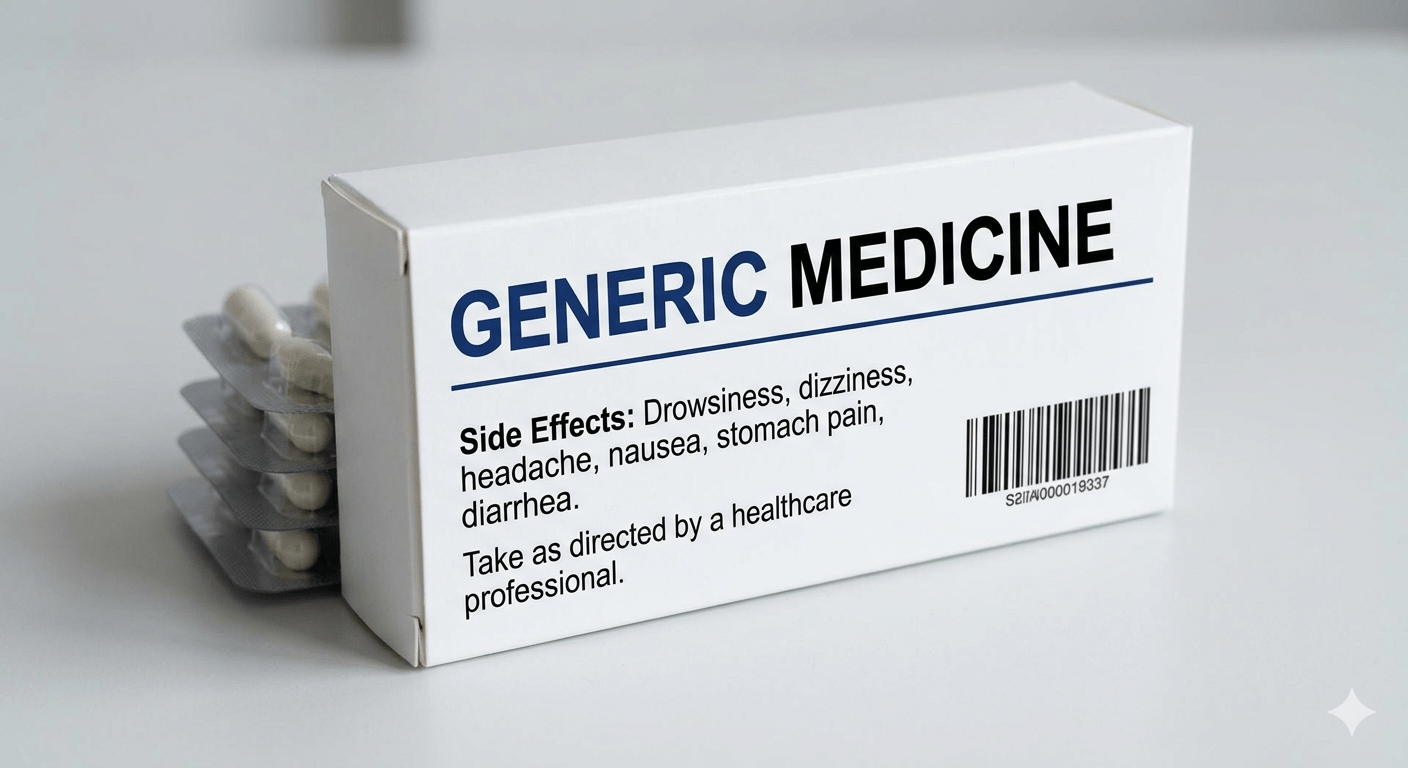

Pharmaceutical companies are required by law to disclose who their drugs help and who they might harm. Politicians face no such obligation. They should.
Pick up any medication from your local pharmacy and you will find, somewhere on the packaging, a remarkable document. It is a confession. In dense, small-print prose designed, one suspects, to be technically readable and practically ignored the manufacturer discloses that its wonder drug, while treating your high blood pressure, may also cause nausea, dizziness, fatigue, swelling of the ankles, and in rare but legally significant cases, thoughts of jumping off a bridge. The line between therapeutic benefit and adverse reaction is not always sharp, but the obligation to draw it at all represents one of modern regulation’s more honest achievements: the acknowledgement that to help some people, you may harm others.
It is a pity that no such requirement exists in politics.
When a politician stands before a crowd or more likely a ring-lit camera pointing at a kitchen to announce a transformative policy, they offer only the benefits. The drug is pure. The side effects are nowhere on the label. There is no small print. There is, instead, a promise that everyone wins: the worker, the pensioner, the business owner, the first-time buyer, the farmer, the fisherman, the northern left-behind town, and, mysteriously, also the City of London. The medication cures everything and harms no one. Which is to say, it is not medicine at all it is a placebo at best, and a controlled substance at worst.
To promise that a policy has no losers is not optimism. It is either economic illiteracy or deliberate deceit, and democratic societies have grown dangerously tolerant of both.
The pharmaceutical analogy is instructive precisely because it exposes what political communication is currently missing: not conviction, not vision, not even competence but candour about trade-offs.
The Regulatory Gap
The Medicines and Healthcare products Regulatory Agency in the United Kingdom, the Food and Drug Administration in the United States, and their equivalents across the world operate on a fundamental principle: the public has a right to know what they are consuming and what risks attach to it. Drug companies may market their products with enthusiasm, but they must also tell you the truth about adverse reactions. The law does not permit them to say, in effect, “this pill is excellent for everyone and nobody will feel worse for taking it.” That would be fraud.
Politics, however, operates under no equivalent discipline. A politician may announce a tax policy and describe only the relief it brings to hard-pressed families, without disclosing that the same policy effectively raises costs for small businesses. A government may promise to protect public services while simultaneously announcing spending frameworks that make such protection arithmetically impossible. In Nigeria, every administration since the return to democracy has promised to reduce poverty while presiding over conditions that reliably deepen it and has faced no statutory obligation to reconcile the two positions. The electorate consumes the promise, experiences the side effect, and is left to deduce on its own that the label was incomplete.
Patient Information Leaflet: For Political Use OnlyRead Before Voting
Austeritol® Extended Release
Indicated for: Reduction of public debt; restoration of market confidence; reassurance of bond-holders.
Common side effects (affecting many users):
- Significant reduction in public services
- Increased waiting times for healthcare
- Chronic underfunding of education
- Accelerated transfer of wealth upward
Rare but serious side effects:
- Social unrest
- Electoral collapse of the prescribing party
- Fifteen years of denial by former Treasury Ministers
⚠ WARNING: Do not administer alongside promises of “protecting the most vulnerable.” Severe cognitive dissonance may result.
The Losers Must Be Named
Every serious policy has beneficiaries and it has losers. This is not cynicism it is economics. A subsidy for electric vehicles benefits those who can afford them and is funded by those who cannot. A reduction in inheritance tax benefits wealthy estates and costs the Treasury revenue that would otherwise fund public goods. An immigration cap may satisfy certain cultural preferences while producing labour shortages in agriculture, hospitality, and the NHS. Nigeria’s constant tinkering with fuel subsidies has, over decades, simultaneously enriched oil importers, punished rural transporters, strained the federation’s finances, and from time to time produced queues at filling stations long enough to constitute a minor public health emergency.
None of this means the policies are wrong. A government is entitled to make choices that help some citizens more than others that is, in fact, exactly what governance is. The conservative instinct to protect accumulated wealth and the progressive instinct to redistribute it are both coherent political philosophies with honourable traditions. What is not honourable is to pursue either while pretending that you are doing the other. The attempt to claim that a policy has no losers that tax cuts also fund hospitals, that spending reductions also raise living standards, that tightening borders also grow the economy does not merely insult the intelligence of the electorate. It corrupts the terms of democratic discourse itself.
A government that knows its losers and refuses to name them is not a government making hard choices. It is a government making easy lies.
The paradox is that naming the losers, far from being politically fatal, may be the only durable form of political protection. A politician who says clearly, “this policy will benefit working families and will cost high earners more,” has established a covenant with their coalition. Those high earners may be aggrieved, but they cannot claim to have been deceived and the working families who benefit know precisely what they voted for and why. That clarity becomes a buffer against the inevitable political headwinds. The politician has a story to tell, a constituency to defend, and a philosophy to invoke when the attacks come.
By contrast, the politician who promises universal gain is perpetually defenceless. When the side effects emerge as they always do they have no explanation beyond bad luck, global headwinds, or the sabotage of unnamed enemies. Keir Starmer’s government in Britain has, within a year of taking office, discovered the peculiar vulnerability of a party elected on the promise of change without having specified what, precisely, would change for whom. The welfare cuts that caused a parliamentary rebellion, the pensioner fuel allowance stripped from those who had not been warned it was at risk, the general atmosphere of a government surprised by its own decisions these are not the hallmarks of a philosophy pursued with rigour. They are the side effects of a label that was never written.
Core Purpose as the Only Inoculation
The pharmaceutical parallel extends further than disclosure. A drug is not simply a compound that treats a symptom it has a mechanism of action, a biological logic that explains why it works on the conditions it treats. Remove the mechanism and you have not a medicine but a mystery. Political parties, similarly, require a coherent organising philosophy that runs through their individual policies like a spine. It is what allows a government to withstand criticism, because the criticism, however sharp, can be answered by reference to first principles.
Thatcher could be attacked for destroying communities, and was but she had a philosophy that gave her attack a consistent shape and gave her coalition a reason to hold. The Labour governments of Blair and Brown produced genuine improvements in public services, but without a philosophy sufficiently distinct from their predecessors, they could not survive the moment those improvements came under question. The current Conservative rump in Britain is philosophically incoherent it cannot explain who it is for, and so it cannot explain what it would do. Reform UK, meanwhile, offers a philosophy of sorts grievance but grievance is not governance, as Nigel Farage’s new local councillors are presently discovering, some of them apparently surprised to learn that councils have statutory responsibilities not easily discharged by posting videos on social media.
In Nigeria, the affliction is more structural. Political parties are not vehicles of ideology but of access. They do not disclose their losers because they have not identified their beneficiaries beyond the general category of “those with proximity to power.” The result is a polity in which every administration announces itself as the government of the common man and governs in the interest of a rather uncommon few, and the electorate sophisticated enough to know this has largely concluded that the label is decorative.
A Modest Regulatory Proposal
The author offers, without great optimism, the following suggestion. Before any major policy announcement, a political party should be required to publish what might be called a Political Impact Statement — a document modelled, loosely, on the pharmaceutical patient information leaflet. It should state the intended beneficiaries of the policy. It should identify, to the extent known, those who will bear additional costs or face reduced provision. It should disclose the philosophical basis for the trade-off why these beneficiaries and not those so that the electorate can assess whether it agrees with the underlying values. And it should carry, in bold, a mandatory warning: “This policy will not benefit everyone. No policy does.”
This would not eliminate spin. Politicians, like pharmaceutical marketing departments, would find ways to emphasise the benefits and minimise the disclosures. But the existence of a required disclosure creates at least the architecture of accountability. It establishes that a trade-off was made, that someone made it, and that someone can be asked to justify it. It restores to democratic politics the elementary dignity of treating the electorate as adults capable of weighing costs and benefits which is, in the end, the only thing voters are actually doing on election day, however imperfectly the information available to them allows it.
Until then, the political label will remain as it is: all efficacy, no side effects, no contraindications, and no warning that prolonged use may cause voter apathy, institutional erosion, and in severe cases, the election of people even worse than the ones being replaced.
Take as directed. Or don’t. Results may vary.

