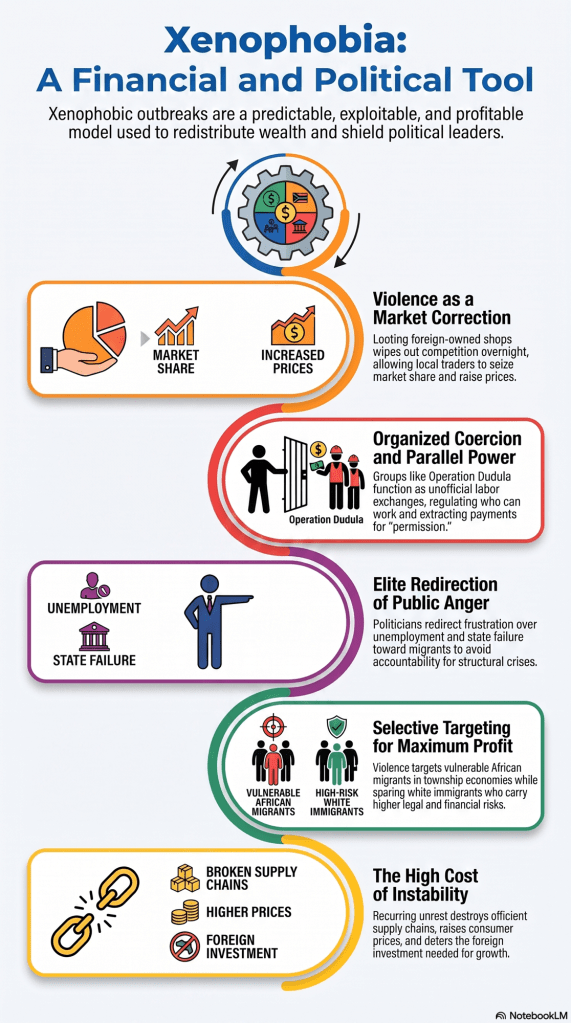
There is a persistent temptation to explain xenophobic violence in South Africa as spontaneous an eruption of anger from economically marginalised communities pushed to the brink. It is a comforting narrative because it absolves structure and intention. But a closer examination suggests something far less accidental and far more unsettling: that these outbreaks increasingly resemble a system predictable, exploitable, and, for some, profitable.
This is not chaos. It is a model.
The Street Economy of Violence
At the ground level, xenophobic riots often follow a recognisable economic logic. Foreign-owned spaza shops typically run with leaner supply chains, lower prices, and tighter margins pose stiff competition to local traders. When violence erupts, these shops are looted or destroyed, wiping out competition overnight.
What follows is not merely absence, but opportunity. Local businesses step into the vacuum, often raising prices in a now less competitive environment. The violence, therefore, operates as a crude but effective market correction mechanism one enforced not by regulation, but by intimidation and destruction.
This transforms xenophobia from prejudice into praxis: violence as a commercial strategy.
The Organisation of Anger
Anger, however, rarely organises itself. It requires structure, leadership, and direction. This is where movements like Operation Dudula enter the equation not merely as protest groups, but as intermediaries between grievance and power.
These organisations function with surprising institutional coherence. They regulate access to informal employment markets, determine who can operate businesses in certain areas, and in some cases extract payments for these “permissions.” In effect, they become parallel authorities unofficial labour exchanges with coercive enforcement mechanisms.
For politicians, such groups are useful. They mobilise voters, control narratives at the grassroots, and can be activated or restrained depending on political need. Anger is not eliminated; it is curated.
The Elite Deflection
South Africa’s structural challenges chronic unemployment, energy instability linked to Eskom, and systemic corruption have created fertile ground for public discontent. But directing that anger upward, toward political leadership, carries risks for those in power.
The more expedient strategy is lateral redirection.
Migrants become the visible “other,” an accessible scapegoat onto whom complex economic failures can be projected. The narrative is simple, emotionally resonant, and politically convenient: foreigners are taking jobs, overwhelming services, and undermining local prosperity.
It is a narrative that requires little empirical support only repetition and amplification.
The Selectivity of Violence: Why White Immigrants Are Rarely Targeted
If xenophobia were purely about hostility to “outsiders,” its application would be uniform. It is not. The pattern of violence in South Africa is strikingly selective: it overwhelmingly targets black African migrants Zimbabweans, Nigerians, Somalis, Ethiopians while largely sparing white immigrants.
This selectivity reveals the underlying logic.
First, visibility and proximity matter. Black African migrants are concentrated in township economies, particularly in the informal retail sector where competition is fiercest. White immigrants, by contrast, are more likely to operate in formal sectors, live in different neighbourhoods, and remain socially and economically insulated from the pressure points where violence is mobilised.
Second, the economic incentive is asymmetric. Looting a Somali-owned spaza shop yields immediate, distributable gains stock, space, and market share. Targeting a white-owned business in the formal economy carries higher risks, lower immediate payoff, and far greater likelihood of state response. In blunt terms, some targets are “profitable”; others are not.
Third, there is a layer of perceived power and consequence. White immigrants fairly or not are often associated with capital, legal recourse, and international attention. Attacking them risks escalation beyond the local arena. Violence, in this context, is not just emotional; it is calculated. Actors tend to select targets where retaliation is least likely and impunity most assured.
Finally, the political narrative itself is curated. The rhetoric of groups like Operation Dudula focuses heavily on undocumented African migrants as economic threats. This framing does not merely reflect public sentiment; it shapes it, directing hostility toward specific, strategically chosen groups.
The result is a form of xenophobia that is less about foreignness per se and more about vulnerability, accessibility, and economic utility.
The African Playbook
This strategy is not without precedent. Across the continent, leaders have historically deployed xenophobia as a tool of consolidation.
In 1972, Idi Amin expelled tens of thousands of Asians from Uganda, seizing businesses and redistributing assets under the guise of economic nationalism. A decade later, Nigeria’s 1983 “Ghana Must Go” expulsions saw mass deportations of West African migrants amid economic downturn and political instability.
In both cases, xenophobia served dual purposes: asset reallocation and political distraction. Economic failure was reframed as external sabotage; state weakness masked by decisive, if destructive, action.
South Africa’s contemporary dynamics echo this pattern less overtly state-led, but no less structurally familiar.
The Everyday Cost
While elites and intermediaries may extract short-term gains, the long-term consequences are borne by ordinary citizens.
The destruction of migrant-run businesses disrupts supply chains that often operate with greater efficiency than local alternatives. Prices rise. Product availability shrinks. Informal economies lifelines for the poor become less reliable.
At a macro level, recurring instability deters foreign direct investment. Investors are wary of environments where property rights appear contingent and social unrest is periodic. The result is a slow erosion of economic confidence, compounding the very hardships that fuel the violence in the first place.
It is a vicious cycle: economic decline breeds xenophobia; xenophobia accelerates economic decline.
Conclusion: Violence as a Financial Instrument
To understand xenophobia in South Africa purely as a social pathology is to miss its functional dimension. It operates, increasingly, as a financial and political instrument one that redistributes opportunity at the micro level while shielding accountability at the macro level.
Its selectivity particularly the relative insulation of white immigrants underscores that this is not indiscriminate hatred, but targeted action shaped by economics, risk, and political utility.
For those at the top, it is an efficient mechanism. It fractures potential opposition, redirects public anger, and preserves existing power structures. For those at the bottom, it is a trap one that converts legitimate grievance into self-defeating conflict.
The tragedy is not just that the poor are fighting each other. It is that, in doing so, they are unwitting participants in a system that depends on exactly that outcome.