


If the 18th-century French philosopher Baron de Montesquieu were alive today and observing Nigerian state politics, he would not write The Spirit of the Laws. He would write a sitcom.
Montesquieu gave the democratic world the doctrine of Separation of Powers: three distinct arms of government (the Executive, the Legislature, and the Judiciary) acting as checks and balances against tyranny. In theoretical Nigeria, this sacred tripartite system is enshrined in our 1999 Constitution.
In actual Nigeria, however, the script has been heavily revised. The Legislature does not check the Executive; it curtsies, takes notes, and asks the Executive what time it should pack its bags.
From Chief Legislator to Governor’s Press Secretary
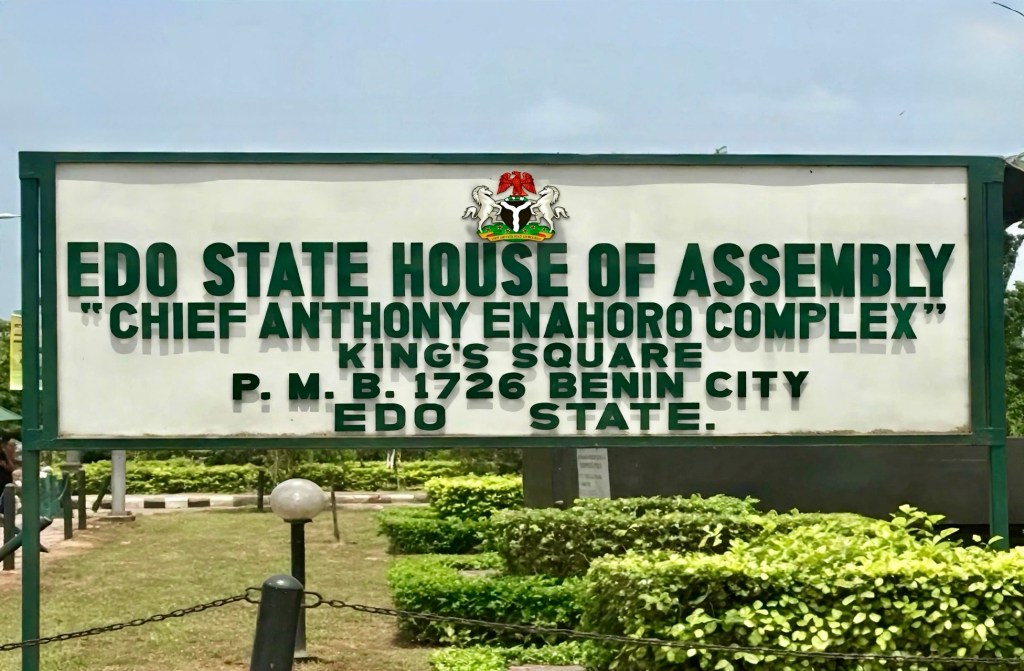
We previously raised eyebrows when the Speaker of the Edo State House of Assembly, Blessing Agbebaku, took on the curious side hustle of acting as the Governor’s personal town crier. In an address to his constituency regarding road projects, Agbebaku proudly announced that Governor Monday Okpebholo had generously “approved” the construction.
One had to pause and double-check the Constitution. Is the parliament not supposed to be the body that appropriates and approves state expenditures? When the head of the purse strings speaks like a grateful beneficiary receiving executive alms, the institutional compass has completely lost its bearing.
Yet, if you thought that was peak sycophancy, the latest performance in the Assembly chambers raised the bar to astronomical heights.
The Resignation: A “Hero” Takes His Bow
Addressing the floor during his exit, Blessing Agbebaku delivered a farewell address worthy of a theatrical tragedy, or an audition for Chief of Staff:
“I’ve been asked to resign… A time to be born, and a time to die. A time to start, and a time to last. I was not born to be a Speaker. I think today, I’m standing here as a hero… I also thank the Governor. Even in all odds, when things went tough, he stood by me to say, ‘You will be my Speaker.’ And if he has a decision contrary to give his government a peaceful train ride, I think I have no choice than to obey His Excellency…”
Let’s unpack this lyrical masterpiece:
- “You will be my Speaker”: Notice the possessive pronoun. Not the people’s Speaker. Not the Assembly’s Speaker. Governor Monday Okpebholo’s Speaker. An executive appliance installed in the legislative hall.
- “A peaceful train ride”: Because heaven forbid a parliament creates friction, demands accountability, or serves as a speed bump to executive whim. A legislature that actually legislates is apparently an intolerable derailment risk.
- “No choice than to obey”: The ultimate surrender. The head of an independent arm of government openly stating he is taking operational orders from another branch.
- “Standing here as a hero”: The classical definition of heroism: meekly stepping aside the moment your boss tells you your shift at the parliament is over.
The Master-Servant Farce
What makes this spectacle both hilarious and deeply tragic is the total absence of shame. There was no pretense of internal parliamentary disagreements, no cover story about party dynamics, and certainly no reference to the constituents who voted him into office. Just raw, unfiltered obedience to Governor Okpebholo.
The Nigerian Constitution envisioned three equal arms of government standing side-by-side to protect the citizen from arbitrary power. Instead, state assemblies across the federation have happily embraced a master-servant dynamic where the legislature exists primarily to approve budgets without reading them, rubber-stamp loans, and clear out whenever the Government House decides on a reshuffle.
When the head of an entire branch of government sees himself as an employee serving at the pleasure of the Executive, the joke is not just on Montesquieu. It is on the millions of citizens whose mandate has been reduced to a VIP ticket for the Governor’s “peaceful train ride.”

