

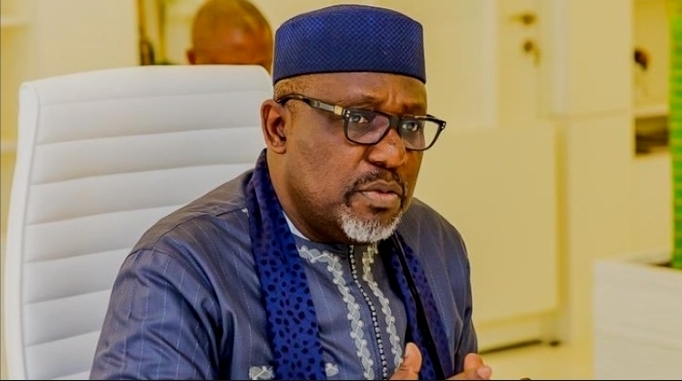
There is a particular Nigerian genius for building things that mean nothing, and calling it a legacy. Rochas Okorocha, who governed Imo State from 2011 to 2019 as though the office were a stage and the electorate a captive audience, remains the finest living exhibit of this genius. Eight years after he last held power, and years after the last echo of “Rochas the Liberator” faded from campaign jingles, his name now surfaces mostly in courtrooms, in denial statements issued by aides nobody asked for comment, and in the occasional bronze figure still standing in Owerri, weathering slowly in the rain like the promises that built it.
This is not, strictly, a story about corruption, though corruption features. It is a story about the difference between governing and performing governance, and about a man who mistook one for the other so completely that he appears never to have noticed the substitution.
THE UNVEILING
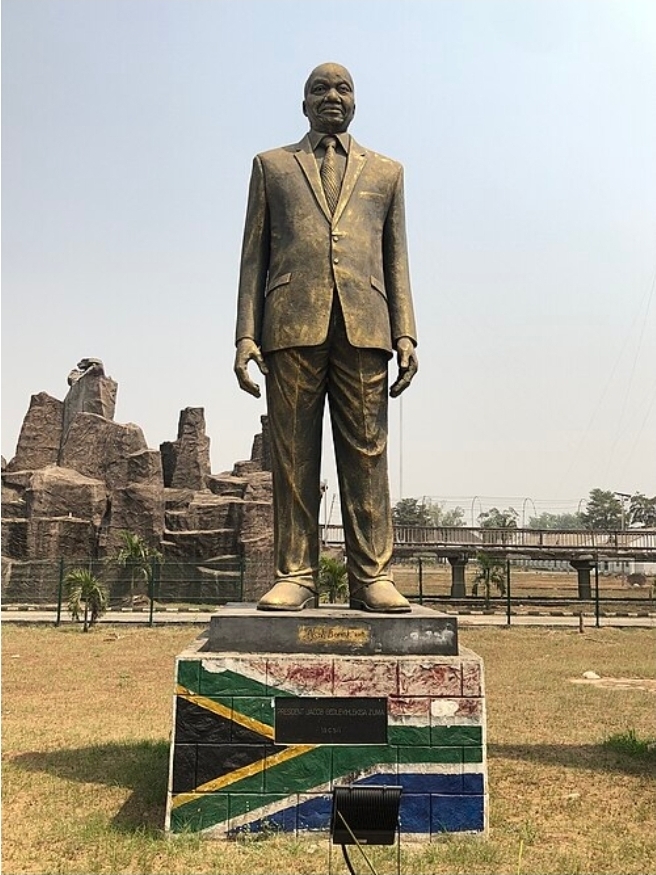
No episode captures the Okorocha method better than the matter of Jacob Zuma’s statue. In 2017, the outgoing South African president made a state visit to Owerri, and Okorocha marked the occasion the way a smaller mind marks any occasion: with a monument. A bronze statue of Zuma was erected, unveiled with Okorocha praising Zuma’s supposed commitment to education despite having been deprived of schooling in his own early life, and it reportedly cost around 520 million naira. A street was named after him. A chieftaincy title, Ochiagha Imo, was conferred, as if warlordship were a currency Imo State had to spare.
The reaction, at home and abroad, was immediate and unkind. Commentators struggled even to place Zuma’s eventual position in South African history, and noted that in the course of a two-day visit he received not only a chieftaincy title and a road but a full life-sized statue. One columnist called the honour, at that point in history, an unconscionable misjudgment. Nigerians pointed out that a man facing his own accumulating allegations of corruption in Pretoria was an odd choice of icon for a state that could not reliably pay workers’ salaries. Okorocha’s spokesman, undeterred, offered the defence that has since become the unofficial motto of Nigerian performative governance: if statues attract patronage, then more statues shall be erected, and no apology is owed to anyone.
Angry youths eventually settled the argument themselves, pulling the statue down on the grounds that the state belonged to its people and not to the governor who had spent their money on it. It has since been a recurring national pastime, watching Imo State residents periodically rediscover and dismantle a monument to a foreign president most of them never asked for, while the man who built it insisted, when pressed on why it should remain, that it had been erected while Zuma was still in office as though the tense of Zuma’s presidency were the relevant legal or moral question, rather than the 520 million naira that left the state treasury for a piece of decorative bronze.
This was Okorocha’s governing philosophy in miniature: identify a photograph opportunity, commission a monument to it, and call the resulting spectacle “opening the doors of Imo to the world.” The doors, as it turned out, opened mainly onto ridicule.
THE PERFORMANCE AND THE ARREST
If the statues were governance as theatre, the events of 2022 were theatre eating governance alive. When the Economic and Financial Crimes Commission moved to arrest Okorocha over an alleged multi-billion-naira fraud, he did not slip quietly into custody, nor did he retain the composure his many senior advocates might have counselled. Instead, by multiple accounts, he barricaded himself inside his Abuja residence and turned the standoff into a live-streamed spectacle, complete with prayer, prostration, and an audience of supporters supplying the emotional soundtrack. One columnist, reviewing the whole affair afterward, observed drily that by the time the arrest drama concluded, both Okorocha and the EFCC seemed to deserve each other, and noted that operatives ultimately gained entry by breaking through the ceiling a detail that belongs less in a corruption case file than in a farce.
The same commentator, sparing no sentiment, suggested that a man who could afford a dozen senior advocates hardly deserved public pity, and questioned why anyone should waste sympathy on a former governor whose own constituents seemed unmoved by his troubles. It is worth dwelling on that judgment, because it captures something the statues had already told us: Okorocha’s talent was never for winning affection through service, only for manufacturing spectacle and hoping the noise would be mistaken for substance.
The legal record since has been, characteristically, inconclusive. Courts have both detained him pending bail conditions running into hundreds of millions of naira and, on other occasions, dismissed the EFCC’s charges against him as an abuse of process. Money laundering allegations running into billions of naira have been filed, contested, and left to wander the docket. None of it has produced the clean verdict Nigerians might reasonably expect after eight years of governing one of the country’s most consequential states. In this respect Okorocha is not exceptional; he is simply typical, another entry in the long ledger of Nigerian ex-governors whose accountability has been endlessly deferred rather than delivered.
THE FAMILY BUSINESS
No fiefdom is complete without a royal household to staff it, and Okorocha assembled his with a candour that made the word “cabinet” feel almost quaint. Among the twenty-eight commissioners he swore in during one reshuffle was his own biological sister, Ogechi Ololo, appointed Commissioner for Happiness and Couples’ Fulfilment later hastily rebranded, after the predictable derision, as the Ministry of Happiness and Purpose Fulfilment, on the improbable defence that “Couples” had been a typographical error. The appointment came only months after the Zuma statue furore, and Ololo herself defended the new ministry to the BBC as a policy-driven effort to cultivate positive attitudes among Imo people. A columnist at the time put the more pressing arithmetic bluntly: Imo State was carrying tens of millions of dollars in external debt, and Nigerians wanted to know what sin the state’s people had committed to deserve a Ministry of Happiness as the answer to it.
Meanwhile, the operational heart of government sat with his son-in-law. Uche Nwosu, married to Okorocha’s daughter Uloma, had been made Deputy Chief of Staff for Operations in Okorocha’s first term, then Commissioner for Lands, and finally Chief of Staff in the second term the aide with his hand on the levers of the state while his father-in-law posed for photographs beside bronze statues. It was, as one newspaper put it at the time, a form of familiocracy for which the dictionary had no ready word: a governor’s sister overseeing citizens’ happiness, and a governor’s son-in-law overseeing the machinery of government itself.
The arrangement only made sense as the prelude to something larger, and it was. Term limits meant Okorocha could not run again in 2019, but nothing in the constitution, as he seemed to read it, prevented him from simply appointing his own continuation. He made clear he intended to do everything possible to install Nwosu as his successor once his own eight years ended, and when the APC’s national leadership instead recognised Hope Uzodinma as its candidate, Okorocha’s fury at being denied his chosen heir led him to effectively declare war on his own party’s leadership. He had Nwosu decamp to the little-known Action Alliance, was himself suspended by the APC for backing his son-in-law over the party’s official candidate, and watched the Action Alliance’s own state chapter publicly disown both men, insisting neither had any real standing in the party they were now trying to use as a vehicle. Even the party Okorocha tried to hijack for his succession plan wanted nothing to do with him.
The succession, unsurprisingly, collapsed. Nwosu lost the governorship to the PDP’s Emeka Ihedioha, and the aftermath was its own small morality tale: a columnist later described him as a man who had briefly, brilliantly lit up the political sky before fading into relative nothingness, noting that Okorocha, having handpicked him as successor, offered only lip service once the loss came and Nwosu was left largely alone, gnashing his teeth in private. A man who had run a state as though it were a household appointment scheme discovered, in the end, that neither the party nor the electorate was obliged to honour his choice of heir. Dynasty, it turned out, is not a constitutional office.
What the happiness ministry and the aborted succession share is the same underlying delusion: that the state was Okorocha’s personal estate, to be staffed by relatives and bequeathed to family, rather than a public trust with its own rules of succession that no single governor, however energetic his self-regard, gets to overwrite. He governed, in other words, as though his tenure had no natural end and was visibly startled to discover, in 2019, that it did.
THE QUICKSAND
And now, the man who once filled Owerri’s skyline with monuments to himself and his foreign guests has receded into something closer to background noise. His most recent public exertions have not been about roads, schools, or hospitals, but about denying that he is leaving the APC. In mid-2025, a statement issued through his media adviser insisted he remained a committed member of the ruling party, dismissing as fabrication a report that he had described the APC as desperate to hijack power, and noting that a founding member of the party could hardly say such a thing. He went further, framing the entire episode as the work of detractors threatened by his continued political presence, and reminding whoever was listening that he had been the only sitting South-East governor to join the APC in its infancy.
There is something almost poignant in the insistence. A man once so certain of his own centrality that he commissioned bronze to commemorate a two-day visit from a foreign head of state is now reduced to press statements confirming that he still belongs to a political party. The theatre has not stopped; only the audience has thinned, and the stage has shrunk to the size of a WhatsApp forward that someone felt compelled to deny.
This is the quicksand his own loud protestations of progress have been swallowed by. It was never really the EFCC, nor his political rivals, nor the ungrateful public he so often complained about. It was the arithmetic of performative governance itself: spectacle depreciates faster than infrastructure, and a legacy built on unveiling ceremonies has no foundation to stand on once the cameras and the crowds move elsewhere.
THE LESSON, HALF TOLD
Why call this a tale of one half? Because Okorocha’s governorship was always exactly that one half of a story, the half concerned with appearing to govern, delivered with tremendous energy and no companion half of actually doing so. The statues, the chieftaincy titles, the declarations of Imo’s imminent global relevance, were the visible half. The other half durable institutions, functioning civil service, infrastructure that outlives its ribbon-cutting was left conspicuously unwritten, a black hole into which the state’s resources are alleged, still in litigation, to have quietly disappeared.
The lesson for Nigerian governance is not really about Okorocha the individual, who is by now a settled character rather than a live threat. It is about the durability of the model he perfected: that a governor can substitute spectacle for service, monument for maintenance, and press statement for policy, and survive politically for the better part of a decade before the substitution is even widely named. Imo State’s roads did not build themselves in the years since; nor did its hospitals staff themselves, nor its schools equip themselves. What did happen, reliably, was the unveiling of things designed to be photographed.
Okorocha’s current ignominy is not a punishment imposed on him. It is simply what remains when the performance ends and no one is left applauding. The statues, those that survive the periodic attentions of angry youths, stand in Owerri still monuments not to Jacob Zuma’s presidency, nor even really to Okorocha’s, but to the particular Nigerian tragedy of mistaking the ceremony for the state.

