

There is something more dangerous to democracy than a bad government.
It is a government that no longer feels it has to listen to the people.
That distinction matters.
A government can be unpopular and still be politically vulnerable. It can be defeated at the next election. It can lose legislators. It can face hostile voters, an organised opposition and the daily embarrassment of knowing that the people can remove it.
But when the electoral process itself becomes sufficiently opaque that citizens cease to believe their votes determine political power, something fundamental changes.
The ballot remains.
The ballot box remains.
The returning officer remains.
INEC remains.
The politicians still wave at cameras.
But the electoral connection between the citizen and the government begins to disappear.
And when that connection disappears, accountability begins to disappear with it.
Rivers State offers a particularly instructive case study.
The Rivers question
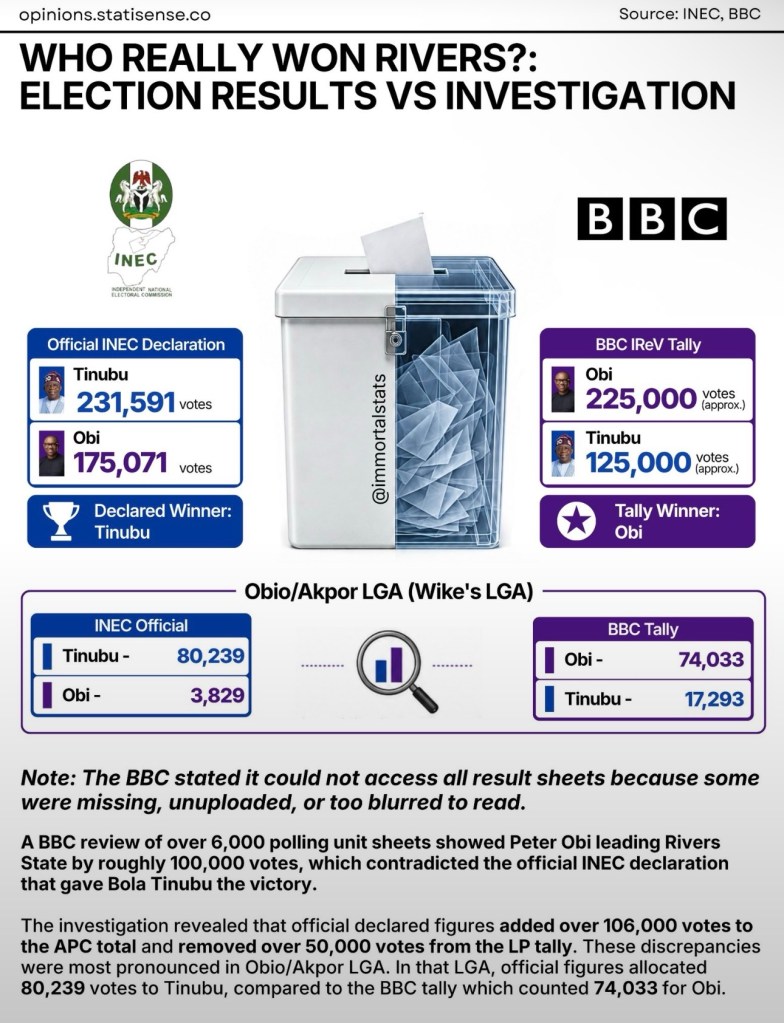
The graphic accompanying this article raises a question that should concern every Nigerian, regardless of political party: what happens when the figures announced at the end of an election appear materially different from the figures contained on the polling-unit result sheets?
INEC officially declared Bola Tinubu the winner of the 2023 presidential election in Rivers State with 231,591 votes, against Peter Obi’s 175,071 and Atiku Abubakar’s 88,468.
That is the official record.
But subsequent examinations of the underlying result sheets produced a profoundly different picture.
The BBC reviewed results from more than 6,000 polling stations in Rivers State. Its investigation found that the polling-unit figures it could obtain suggested that Obi had won the state by a substantial margin. The BBC also reported that Tinubu’s official declared total was more than 106,000 votes higher than its polling-station tally, while Obi’s official figure was more than 50,000 lower.
The BBC was careful to acknowledge an important limitation: it could not obtain or read every result sheet. Some were missing, some had not been uploaded and others were too blurred to decipher. That qualification is important. An investigation based on available documents is not itself a judicial declaration that an election was rigged.
But neither should the discrepancies be waved away as political gossip.
They demand explanation.
And that is precisely where democracy becomes uncomfortable.
Obio/Akpor: where the numbers become extraordinary
The most striking example was Obio/Akpor Local Government Area.
INEC’s declared figures gave Tinubu 80,239 votes and Obi 3,829.
A review of 1,116 of the LGA’s 1,211 polling units by Premium Times produced a radically different tally: 73,311 votes for Obi and 17,158 for Tinubu. The reviewed polling units represented approximately 94 per cent of those in the LGA.
There is nothing subtle about that discrepancy.
It is not a matter of whether somebody counted 100 votes instead of 103.
It is a difference of political planets.
And it becomes even more significant because, according to the Premium Times reconstruction, Obi was leading Tinubu across Rivers before the Obio/Akpor figures were incorporated. With results from 21 of the state’s 23 LGAs, the newspaper calculated Obi at 169,414 and Tinubu at 148,979.
Then came Obio/Akpor.
The official figures dramatically changed the trajectory of the state’s result.
That is precisely why transparent electoral systems are built around something rather boring but enormously important:
the ability to trace the final number back to the original vote.
INEC itself describes collation as the tabulation or summation of votes cast and says the final declaration should accurately reflect the votes. Its published description of the process runs from polling unit, to ward, to LGA, to state and ultimately, for a presidential election, to the national collation.
The chain of custody matters.
If the numbers change as they travel up the chain, somebody must be able to explain why.
An election is not merely the announcement
This is where Nigeria’s electoral conversation often becomes confused.
There is a tendency to treat the declaration of a result as the beginning and end of the matter.
It is not.
A declaration is the conclusion of a process.
The legitimacy of that declaration depends upon the credibility of the process that produced it.
INEC itself recognises this. It states that failure to complete collation and transmission in a quick, transparent and accurate manner can jeopardise public confidence and affect whether candidates and political parties accept the final results.
That is not the language of an electoral commission merely counting pieces of paper.
It is the language of democratic legitimacy.
And legitimacy is larger than legality.
The courts may ultimately uphold an election because the petitioner has failed to satisfy the evidential burden imposed by election law.
That does not necessarily answer every political question about the credibility of the electoral process.
Indeed, the Supreme Court itself acknowledged in the 2023 presidential litigation that the failure of the IReV system could reduce public confidence in the electoral process, while holding that such failure, standing alone, was not sufficient to nullify the election.
That distinction is crucial.
A court can uphold a result while citizens remain entitled to ask whether the electoral system is sufficiently transparent.
The courtroom and the court of public confidence
There is another uncomfortable fact.
The Presidential Election Petition Court dismissed the challenges brought by Peter Obi, Atiku Abubakar and their parties, and the Supreme Court subsequently affirmed Tinubu’s victory.
So it would be inaccurate to write this article as though a court has declared the 2023 presidential election in Rivers State fraudulent.
It has not.
But it would be equally inaccurate to suggest that judicial confirmation magically makes every discrepancy disappear.
The courts operate according to pleadings, admissibility rules, burdens of proof, statutory timelines and evidential standards.
Democracy operates on something broader:
public confidence.
A citizen should not need a Supreme Court judgment before being entitled to ask:
How did 3,829 votes become 80,239?
And:
How did a candidate who appeared to have tens of thousands of votes at polling-unit level end up with a dramatically smaller official total?
Those are not necessarily allegations of criminality.
They are questions of electoral accountability.
And they deserve answers.
The great danger: elected without electoral pressure
This brings us to the larger Nigerian problem.
Elections perform two functions.
The first is selection.
The people choose who will govern.
The second is discipline.
The people retain the power to remove those who govern badly.
The second function is frequently overlooked.
A politician who knows that voters can remove him has a reason to listen to them.
A governor who knows that his policies can cost him an election has an incentive to explain himself.
A president who understands that voters can punish his party has a reason to worry about the consequences of unpopular decisions.
That is the democratic pressure valve.
But if citizens believe that elections are won or lost somewhere between the polling unit and the declaration centre, that mechanism begins to fail.
The politician no longer fears the voter.
The politician fears the electoral machine.
And those are two very different things.
From long convoys to lonely citizens
This is where the Nigerian spectacle becomes almost comic, if it were not so serious.
The people queue for hours.
The politicians travel in convoys long enough to have their own postcode.
The people complain about electricity.
The convoy passes.
The people complain about roads.
The convoy passes.
The people complain about insecurity.
The convoy passes.
The people complain about inflation.
The convoy passes.
The people complain about unemployment.
The convoy passes.
Eventually the convoy becomes a moving metaphor for the distance between government and governed.
And somewhere inside it sits the political class, surrounded by security personnel, aides, sirens, SUVs and increasingly elaborate explanations for why the citizens should be patient.
But patience is not the constitutional currency of democracy.
Accountability is.
The Wike phenomenon
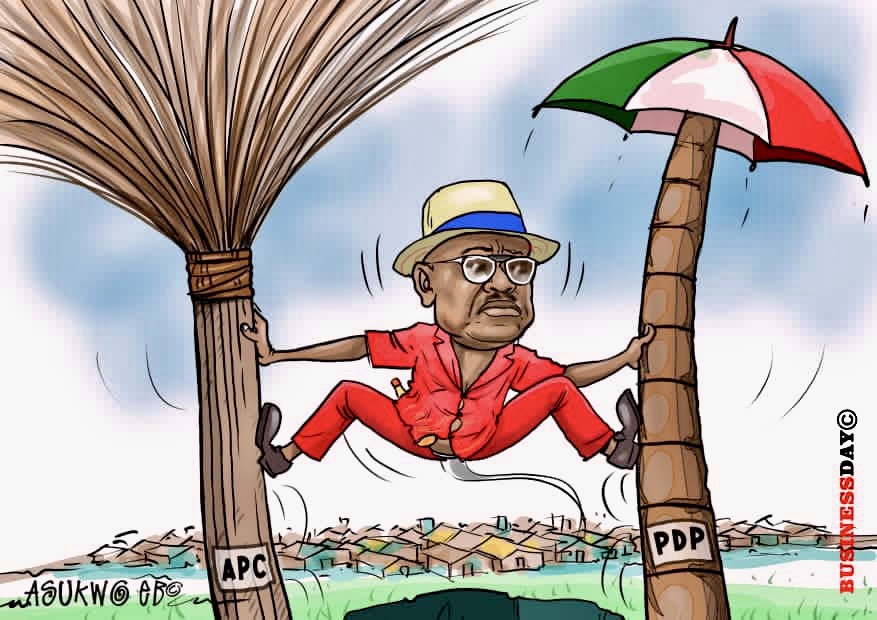
This is also why figures such as Nyesom Wike have become larger than the individual office they occupy.
Wike is not merely a former governor of Rivers State or the current Minister of the Federal Capital Territory.
He represents, for better or worse, a particular form of Nigerian political power: the politician whose influence travels beyond the formal boundaries of the office he presently holds.
His political career demonstrates the extraordinary importance of political structures, networks and electoral machinery in Nigeria.
But the broader issue is not Wike personally.
It is the political ecosystem that makes the Wike phenomenon possible.
A democracy should not be organised around the assumption that one political actor can determine who wins, who loses, who receives political protection and who is invited into the governing arrangement.
The Constitution does not establish a Ministry of Political Godfatherism.
Nor does it provide for a Department of Strategic Allocation of Democracy.
The Nigerian state is supposed to belong to the people.
Section 14 of the Constitution declares that sovereignty belongs to the people of Nigeria, from whom government derives its powers and authority. The Constitution’s broader purpose is to promote good government and the welfare of citizens.
That is the constitutional architecture.
The political practice can sometimes look like something designed by the passengers rather than the architects.
The constitutional danger
The most dangerous consequence of defective elections is not merely that the wrong person occupies an office.
It is that the constitutional relationship between citizen and state begins to deteriorate.
Once people conclude that elections are performative rather than determinative, three things can happen.
First, voter apathy.
Why vote if the vote is unlikely to determine the outcome?
Second, political cynicism.
Why obey political institutions that citizens believe do not obey the rules themselves?
Third, extra-constitutional thinking.
And this is where the matter becomes genuinely dangerous.
When constitutional mechanisms for changing government are perceived to be closed, some citizens may begin looking outside the Constitution for an escape route.
Nigeria has experienced that history before.
The country has had coups in 1966, 1975, 1983, 1985 and 1993.
Military intervention did not solve Nigeria’s democratic problem.
It compounded it.
A coup is not the democratic escape hatch.
It is the demolition of the building because the front door is jammed.
The lesson of Nigerian history should therefore be the opposite:
When democracy fails, repair the democratic mechanism. Do not abolish democracy.
The real emergency is legitimacy
Nigeria does not merely need elections.
It needs elections whose results can be audited, reconstructed and believed.
That means every polling-unit result should be accessible.
Every alteration should be traceable.
Every collation should be independently verifiable.
Every discrepancy should have an explanation.
Every electoral official should understand that a result sheet is not a piece of bureaucratic stationery. It is the documentary embodiment of a citizen’s vote.
And political parties should not merely mobilise voters on election day. They should maintain their own parallel records and insist upon transparent reconciliation at every level.
The technology already exists.
What is frequently missing is something much older than technology:
institutional integrity.
Rivers is therefore more than Rivers
The Rivers controversy should not be reduced to a quarrel between Tinubu and Obi.
It should not even be reduced to a quarrel between APC and Labour Party.
The question is larger:
Can a Nigerian citizen trace his or her vote from the polling unit to the final declaration?
If the answer is yes, democracy has an audit trail.
If the answer is no, democracy has a faith problem.
And a republic cannot survive indefinitely on faith in the arithmetic.
The 2023 Rivers figures have been challenged by independent reviews of available polling-unit sheets, while the courts ultimately upheld the presidential election nationally. Those two facts can coexist.
The appropriate response is therefore neither blind acceptance nor automatic declaration of fraud.
It is transparency.
Publish the evidence.
Reconcile the numbers.
Explain the discrepancies.
Let Nigerians see the chain from ballot to declaration.
That is how confidence is restored.
Democracy needs an escape valve
The ballot box is supposed to be the peaceful escape valve of democracy.
If government becomes unpopular, the voter removes it.
If a political party loses touch with the public, voters replace it.
If politicians become arrogant, voters remind them that political office is temporary.
If that mechanism works, the politician looks over his shoulder and sees the electorate.
If it does not work, the politician may look over his shoulder and see only the political machine.
That is when democracy becomes dangerously insulated from the people.
And that is why the long convoy matters.
The convoy is not the disease.
It is the symptom.
The disease is a political system in which power can become sufficiently insulated from the citizen that the citizen’s vote ceases to exert meaningful pressure on the person who exercises power.
That is the anatomy of electoral dysfunction.
And Rivers provides a case study that Nigeria should examine without partisan spectacles.
Because ultimately this is not about whether Tinubu won Rivers or Obi won Rivers.
It is about whether Nigerians can be shown, transparently and convincingly, how Rivers was counted.
A republic should never ask its citizens to choose between believing the ballot box and believing the declaration.
It should be able to show them that they are the same thing.

