

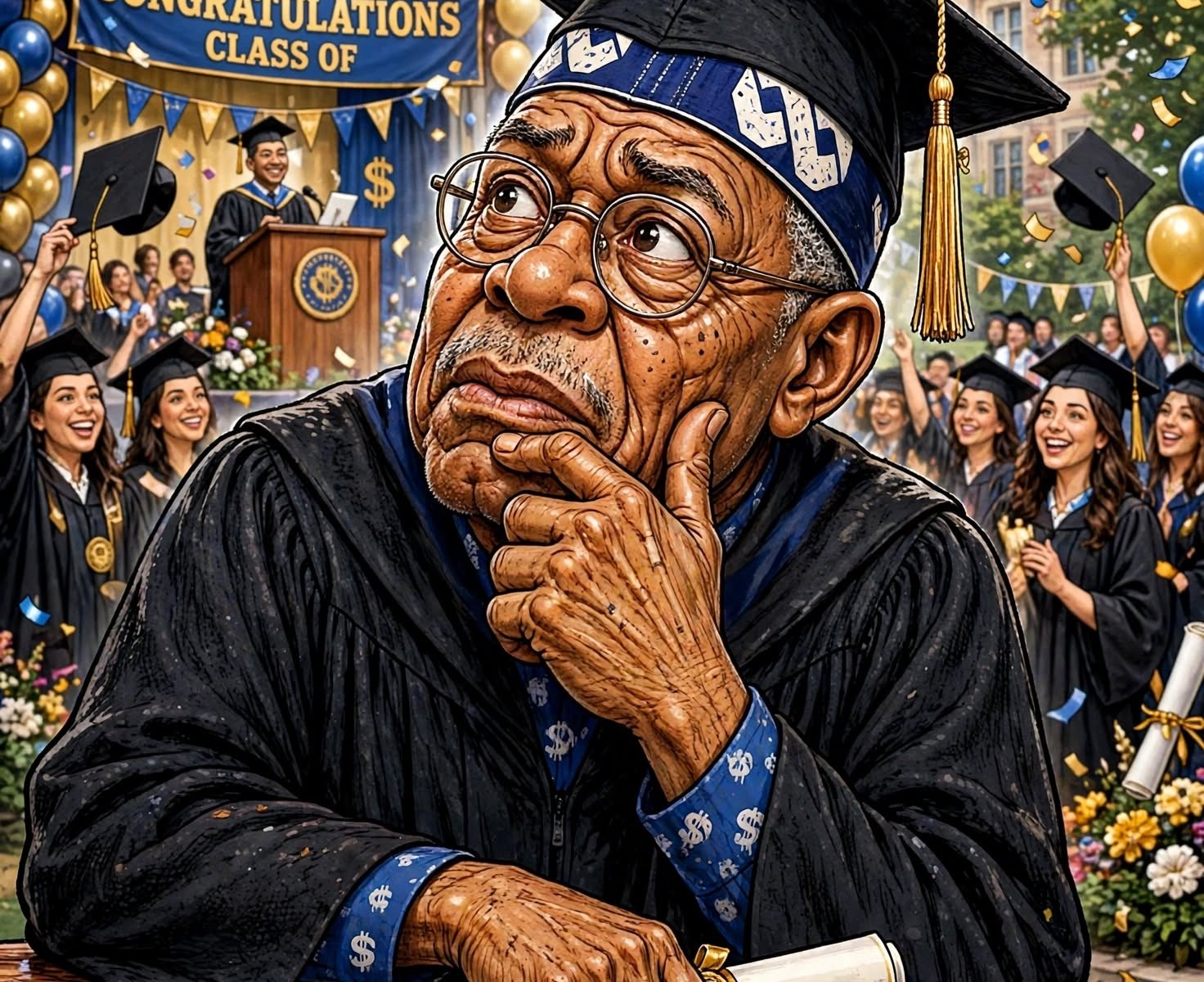
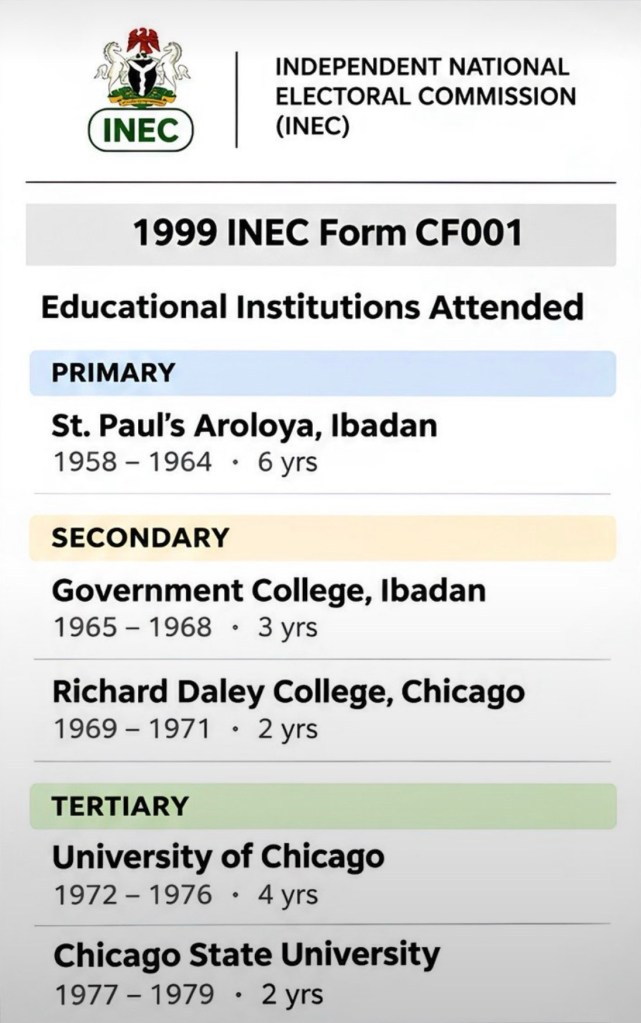
There is a peculiar Nigerian genius for turning what should be a straightforward question of paper into a multi-year soap opera complete with American depositions, competing affidavits, and enough footnotes to sink a small ship. President Bola Ahmed Tinubu’s educational records have now achieved that rare status: they are both officially confirmed and permanently suspicious, legally sufficient and politically radioactive. The latest round of scrutiny, sparked by a resurfaced 1999 INEC form listing everything from St. Paul’s Aroloya to the University of Chicago, has once again forced the country to confront an uncomfortable truth. We have a president whose degree is real, whose pre-university claims are porous, and whose certificate format has generated more heat than light.
Let us begin with what is no longer seriously contested. Chicago State University has, under court order and in sworn testimony, confirmed that a Bola A. Tinubu attended the institution between 1977 and 1979 and graduated with a Bachelor of Science in Business Administration. That is the foundation. The university still stands by the degree. Nigerian courts, when the matter was litigated after the 2023 election, declined to treat the broader forgery allegations as proven to the criminal standard required for disqualification. The BBC’s examination of the documents reached a similar conclusion: no clear evidence that the diploma submitted to INEC was a pure fabrication.
What was different was the physical document itself. The certificate Tinubu presented did not match the style, seals, and signatures of the diplomas CSU issued in 1979. It looked like the replacements the university (or its vendors) produced in later years. Here the process matters. CSU’s practice, as clarified in the deposition, is that a re-issued diploma follows the template current at the time of the request, not the year of graduation. Once that bureaucratic detail is absorbed, the strongest visual argument for outright forgery loses its force. What remains is a real degree in a later-era wrapper. Not elegant. Not ideal. But not the open-and-shut counterfeit some had hoped for.
Then there is the rest of the educational autobiography. The 1999 form listed St. Paul’s Aroloya for primary school, Government College Ibadan, Richard Daley College in Chicago, and a stretch at the University of Chicago before CSU. Later filings to INEC simply left the primary and secondary sections blank. More troubling were the claims made on the original CSU admission paperwork, including a reference to graduating from Government College Lagos in 1970 — a school that did not exist until 1974. These are not forged certificates. They are false statements. And false statements, however embarrassing or politically useful, do not automatically trigger the constitutional disqualification in Section 137(1)(j), which specifically targets the presentation of a forged certificate to INEC.
This is the distinction that matters. Forgery is a crime that requires a document. Inaccurate autobiography, even under oath, may be perjury or simple political theatre, but it is not the same offence. The Constitution’s educational threshold for the presidency remains extraordinarily low — school certificate level or its equivalent. A confirmed American bachelor’s degree clears it. The residual questions of candour, consistency, and historical accuracy do not. They produce, instead, the side-eye: that permanent, knowing glance Nigerians reserve for situations that are not quite illegal enough to prosecute and not quite clean enough to ignore.
And so we arrive at the familiar destination. The legal silver bullet has receded. What is left is a political and moral cloud that refuses to disperse. Supporters will continue to insist that the university confirmed the degree and the courts declined to disqualify. Critics will continue to point to the blank spaces, the shifting school names, and the curious preference for self-help over official channels. Both sides will be partially right. Neither will be satisfied.
This is, in the end, a thoroughly Nigerian resolution. We have elevated the art of converting potential constitutional crises into permanent side-eyes. The certificate has been examined, litigated, deposed, fact-checked, and memed. It has survived. The questions around the man who presented it have not gone away. They have merely settled into the background noise of our politics — always available, never quite decisive, and guaranteed to return the next time someone needs a convenient controversy.
In a country that still treats the minimum educational requirement for its highest office as a suggestion rather than a standard, perhaps that is the only outcome we were ever going to get. The paper is real enough. The story around it remains, as ever, a work in progress.

