

There is an extraordinary political conversation buried inside the 1978 film The Wild Geese. It is easy to watch the film as an old-fashioned mercenary adventure: guns, helicopters, bush warfare, soldiers of fortune and a doomed rescue mission in an unnamed African country.
But beneath the explosions is something much more interesting.
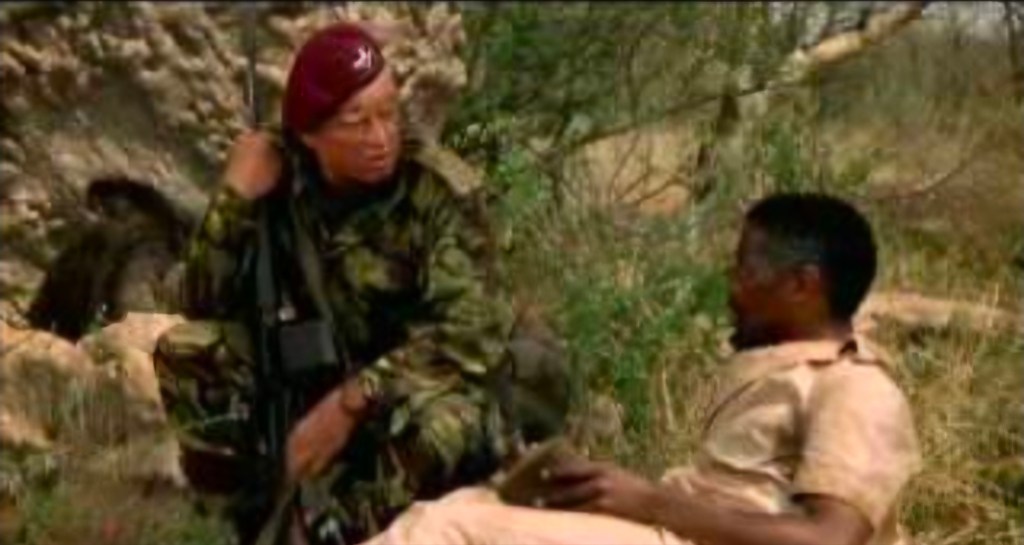
The film stages an argument about Africa, colonialism, race, power and the meaning of being African. And, remarkably, the most important part of that argument takes place between a white South African mercenary, Lieutenant Pieter Coetzee, and the black African president he has been hired to rescue.
Coetzee begins the journey carrying the ideological baggage of white minority rule in southern Africa. He sees himself as the bearer of civilisation and the African as its beneficiary. Limbani, in his eyes, is another example of Africans who supposedly received countries from Europeans only to mismanage them.
Then something happens.
The African he regards with contempt starts dismantling his entire worldview.
And the transformation that follows is one of the film’s most powerful political metaphors.
“We’ve carried you people on our backs”
Coetzee’s opening position is unmistakable.
He complains to President Limbani that:
“We whites have carried you people on our backs ever since we came to this country.”
There, in one sentence, is the essence of colonial paternalism.
The colonial project presents itself not as conquest but as charity.
The conqueror becomes the benefactor. The dispossessor becomes the builder. The exploited becomes the dependent.
It is the familiar argument that Europeans built Africa, introduced civilisation, constructed institutions and created modern states, and that Africans subsequently inherited the infrastructure of civilisation without possessing the capacity to maintain it.
Coetzee pushes the argument further.
He complains that whites built African countries only to be expelled from them; that Africans live on foreign aid, steal from their own people and blame outsiders while killing one another.
It is an argument that has survived long beyond the end of formal colonialism.
Indeed, versions of it can still be heard today.
Africa’s problems, according to this argument, are essentially African problems.
Corruption is African.
Bad government is African.
Civil war is African.
Economic failure is African.
Ethnic conflict is African.
The West merely watches, occasionally sends aid and wonders why Africans cannot get their house in order.
Limbani’s response is devastating precisely because he refuses to accept the premise.
Who actually built the house?
Limbani does not deny that Africans have made terrible political mistakes.
Instead, he asks a much more uncomfortable question:
Who benefits from Africa remaining politically weak and economically dependent?
The president points towards the international interests operating behind African instability.
The wars are not necessarily spontaneous.
The coups are not always merely the consequence of African political incompetence.
The corruption does not exist in an international vacuum.
The resources being fought over are precisely what make the continent strategically valuable.
Copper, oil, minerals and other raw materials attract foreign governments and corporations whose interests do not necessarily coincide with those of the African people.
And this is where Limbani turns Coetzee’s argument inside out.
If Africa is permanently unstable, somebody benefits.
If African governments are weak, somebody benefits.
If African leaders are corrupt and dependent, somebody benefits.
If Africans fight one another while foreign companies extract the continent’s resources, somebody benefits.
The question therefore cannot simply be:
“Why are Africans incapable of governing themselves?”
It must also be:
“Who has an interest in ensuring that Africans never become capable of governing themselves?”
That is a very different question.
The cleverest part of Limbani’s argument
But Limbani does something even more interesting.
He does not reject Coetzee’s assertion that white South Africans are Africans.
He accepts it.
And then he turns it against him.
If the white South African is African, then the black African is not his enemy.
They are both inhabitants of the same continent.
They therefore share something more profound than skin colour: a common destiny.
This is where The Wild Geese moves beyond the usual anti-colonial argument.
Limbani isn’t simply saying:
“Africa belongs to black people.”
He is saying something considerably more radical:
Africa belongs to Africans.
Black and white.
And if white Africans and black Africans remain permanently divided by race, they create the perfect conditions for external powers to manipulate both.
The division becomes the weapon.
The continent becomes the prize.
The great deception of racial superiority
Coetzee initially believes that political competence is somehow attached to skin colour.
The white man is presumed competent.
The black man must prove himself.
Limbani challenges that assumption by introducing a much more sensible standard:
Judge a leader by what he does, not by the colour of his skin.
Is he competent?
Is he honest?
Does he possess vision?
Does he serve his people?
Can he build institutions?
Can he resist corruption?
Can he protect his country’s sovereignty?
Those questions apply equally to black and white leaders.
And therein lies the uncomfortable lesson.
Racial superiority is intellectually lazy because it allows people to avoid judging individuals on their actual merits.
A corrupt white leader does not become competent because he is white.
A competent black leader does not become incompetent because he is black.
Politics requires a single human standard.
That principle remains remarkably relevant.
The extraordinary reversal
The genius of the film is that it doesn’t merely allow Limbani to win the argument intellectually.
It makes Coetzee physically enact the destruction of his own argument.
At the beginning, Coetzee complains that white people have carried Africans on their backs.
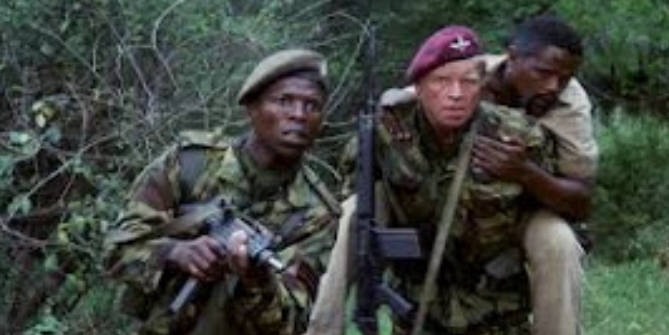
Later, as Limbani becomes sick and exhausted during the trek, Coetzee carries Limbani on his own back.
The symbolism could hardly be more obvious.
The white mercenary who once regarded carrying Africans as evidence of white superiority now carries a black African leader because he has come to recognise his humanity.
The back that once represented paternalism becomes an expression of solidarity.
The burden has changed.
Coetzee is no longer carrying an inferior.
He is carrying a fellow African.
A fellow human being.
And, increasingly, a leader whom he respects.
From mercenary to brother
There is another transformation taking place.
Coetzee was originally motivated by money.
Limbani was a contract.
A job.
A “miserable black life” whose rescue had been purchased.
But somewhere in the African bush, the transaction becomes something else.
Coetzee begins to see the man rather than the colour.
He sees Limbani’s courage.
He sees his political vision.
He sees his willingness to forgive.
Most importantly, he discovers that Limbani does not hate him simply because he is white.
That becomes crucial.
Because hatred would have allowed Coetzee to preserve his racial mythology.
Instead, Limbani offers him something far more dangerous:
respect.
Forgiveness as political weapon
Limbani’s greatest weapon is not a rifle.
It is forgiveness.
He understands that Africa cannot permanently remain trapped in the psychology of historical revenge.
That does not mean forgetting colonialism.
It does not mean pretending that oppression did not happen.
It means recognising that history can become either a foundation for reconciliation or an endless justification for another generation of conflict.
Limbani chooses reconciliation.
He is even prepared to die if his death can help bridge the gulf between black and white Africans.
That is an extraordinary position for a deposed African leader to take.
And it ultimately transforms Coetzee.
The final reversal
At the airfield, the political argument becomes physical.
The mercenaries are overwhelmed.
Limbani is exposed to enemy fire.
Coetzee has a choice.
The man he once regarded as an inferior African is now standing between him and everything he had previously believed.
Coetzee chooses Limbani.
He uses his own body as a shield.
The former white supremacist takes the bullet meant for the black African president.
And the symbolism becomes complete.
The man who once complained that whites had carried Africans on their backs eventually dies protecting the African whose life he once regarded as barely worth rescuing.
Coetzee’s transformation is not expressed in another speech.
It is expressed in sacrifice.
He dies in Limbani’s arms.
The white man and the black man who began their journey separated by an enormous ideological gulf end it bound together by something much stronger than race.
Humanity.
But there is a warning here too
There is a temptation to read The Wild Geese as simply an argument that colonialism was wrong.
It is more complicated than that.
The film also raises an uncomfortable question about the role of foreign mercenaries in Africa.
Coetzee and his colleagues are themselves outsiders operating in an African conflict for money.
Their involvement is connected to international interests seeking access to African resources.
The mercenary therefore becomes both participant and instrument in the larger political economy of post-colonial Africa.
That makes the film particularly interesting.
The soldiers may think they are fighting a war.
Behind the war may be somebody else’s balance sheet.
Behind the rhetoric of civilisation may be mineral rights.
Behind political instability may be commercial interests.
Behind the gunfire may be the global economy.
Africa’s tragedy has often been that the people holding the guns are not necessarily the people deciding why the guns are being fired.
And that brings us home
For Africans, the conversation between Limbani and Coetzee remains uncomfortable because neither side of the argument can simply be dismissed.
Yes, post-colonial African governments have produced corruption, authoritarianism, ethnic manipulation and economic mismanagement.
But acknowledging those failures does not require accepting the colonial proposition that Africans are inherently incapable of governing themselves.
Equally, blaming every African failure on foreign conspiracies is another form of intellectual laziness.
The mature position lies somewhere more demanding.
Africa must accept responsibility for its failures without surrendering responsibility for its destiny.
Foreign powers have interests.
African elites have interests.
Corporations have interests.
Military establishments have interests.
Political parties have interests.
And ordinary Africans have interests.
The job of political leadership is to make the interests of ordinary Africans the organising principle of the state.
That requires institutions, accountability, competent government and an ideology of national development.
Not racial mythology.
Not colonial nostalgia.
Not empty nationalism.
And certainly not the politics of perpetual victimhood.
The back of Coetzee tells the story
Perhaps that is why the image of Coetzee carrying Limbani is more powerful than all the speeches.
At the beginning, Coetzee says whites have carried Africans on their backs.
By the end, he literally carries the African president.
But the meaning has changed completely.
The first was paternalism.
The second is solidarity.
The first says:
“I carry you because you cannot stand without me.”
The second says:
“I carry you because you are my brother.”
And when Coetzee finally places his body between Limbani and the bullets, the transformation is complete.
The white man who began the journey believing that Africans owed him their existence ends the journey giving his own life for an African.
That is the great irony of The Wild Geese.
The man who believed he was carrying Africa discovers that Africa was carrying him towards a different understanding of himself.
Perhaps the film’s deepest message is therefore neither black nor white.
It is African.
The continent does not need one race to carry another.
It needs its peoples to stop allowing race, ethnicity, religion and manufactured divisions to make them instruments in somebody else’s game.
Because the ultimate question is not who carries whom.
It is who owns the future.
And that, unlike copper, oil or diamonds, cannot be extracted from Africa and shipped overseas.

