

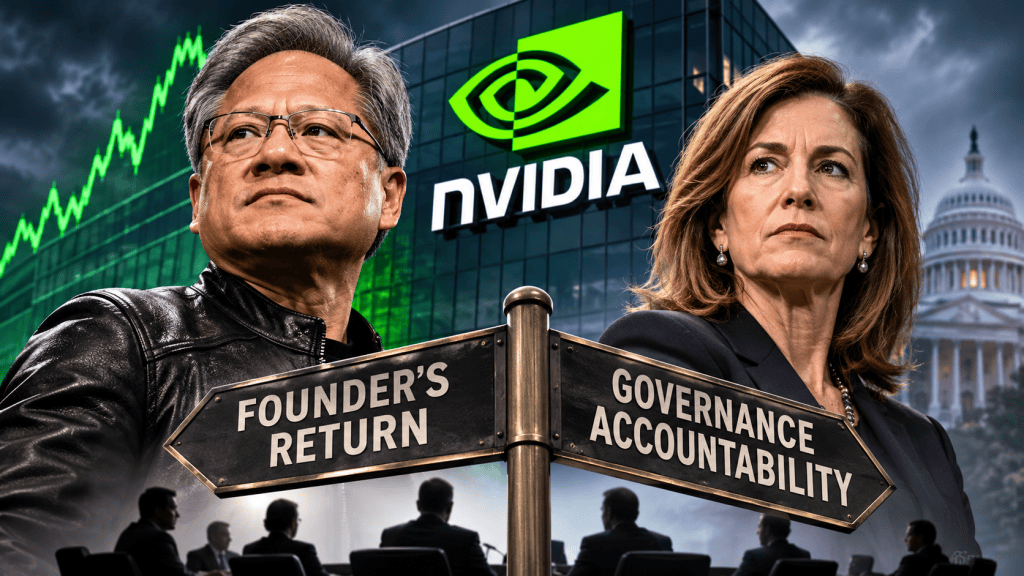
There is something deeply revealing about the drama unfolding at Nvidia. A company that has become the symbol of artificial intelligence, technological supremacy and extraordinary shareholder wealth has just demonstrated how fragile corporate governance can become when an individual acquires an almost mythical status within an institution.
On 12 November 2026, Jensen Huang resigned as President and Chief Executive Officer of Nvidia. The company’s board appointed its long-serving Chief Financial Officer, Colette Kress, as interim CEO while it searched for a permanent successor.
Barely eleven days later, on 23 November, the same board reversed its position and reinstated Huang.
The reversal was extraordinary, not least because the board had publicly declared only days earlier that it did not intend to reinstate him. It had even engaged an executive search firm to identify a permanent successor.
What changed?
According to Nvidia’s announcement, the board had conducted further discussions with Huang, received assurances concerning his candour and ability to lead, and obtained input from senior levels of the United States government regarding national security concerns.
President Donald Trump subsequently acknowledged his involvement in encouraging the board to restore Huang.
Nvidia’s shares surged following the announcement. The market appeared to have delivered its verdict: the return of the founder was worth celebrating.
But markets are not constitutional courts. A rising share price does not necessarily establish that a decision is institutionally sound.
And therein lies the problem.
1. The triumph of the individual over the institution
There is an old principle of corporate governance that no individual should be bigger than the institution.
It is a principle frequently celebrated in corporate annual reports, boardroom presentations and management textbooks. Unfortunately, the real world has a habit of testing the credibility of principles whenever substantial money is involved.
Jensen Huang is not an ordinary chief executive. He co-founded Nvidia in 1993 and transformed it from a graphics-processing company into arguably the most strategically important technology company of the artificial intelligence age.
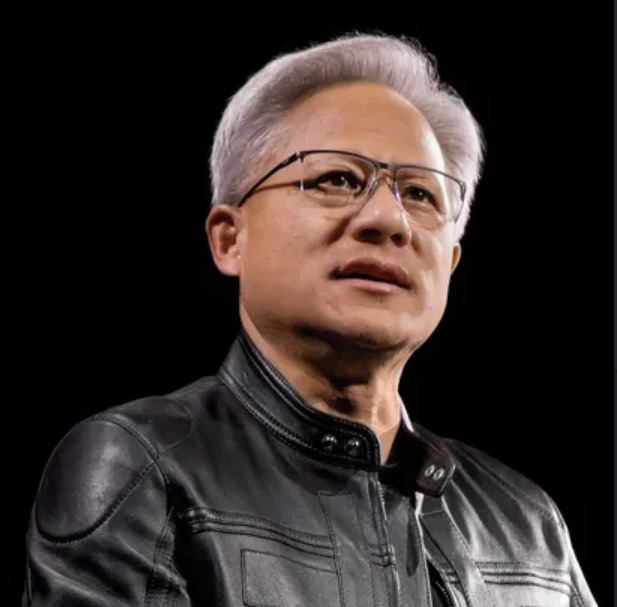
His leather jacket has become almost as recognisable as the company’s products. His public appearances move markets, his pronouncements influence technology investment and his strategic decisions affect the direction of an entire industry.
That is precisely why his departure presented Nvidia with an institutional challenge.
Could the company survive without the individual who had become so closely associated with its success?
The board initially appeared to answer that question in the affirmative. Its appointment of Colette Kress suggested that it was prepared to separate the institution from its founder.
Its subsequent reversal suggests that the separation was either too difficult, commercially inconvenient or politically uncomfortable.
This is the founder’s paradox: the individual who builds an institution can eventually become its greatest governance challenge.
2. Colette Kress and the uncomfortable question of accountability
Colette Kress’s brief elevation to the position of interim CEO was significant.
She had served as Nvidia’s CFO since 2013, overseeing the company’s finances during its transformation into a technological and financial giant.
Reuters reported that Kress had previously challenged some of Huang’s ambitious financial commitments, particularly the company’s multibillion-dollar investment arrangements connected with the artificial intelligence ecosystem.
These concerns matter.
A CFO is not simply the person who counts the money after the CEO has finished spending it. The position is central to financial reporting, internal controls, risk management and the relationship between corporate management, shareholders and regulators.
Under the Sarbanes-Oxley Act 2002, the CEO and CFO of a US-listed company have important personal certification responsibilities concerning financial reporting and internal controls.
The CFO therefore occupies a particularly sensitive position when corporate strategy begins to create financial or regulatory risks.
There is no verified public statement from Kress condemning Huang’s reinstatement in the dramatic language circulating online. But the questions surrounding her earlier reservations should not be dismissed simply because the founder has returned.
Indeed, her position presents an interesting governance question.
Can a CFO who has previously challenged the financial assumptions of a powerful CEO continue to exercise independent professional judgement when that CEO returns with renewed authority?
The question is not whether Kress likes Huang. Corporate governance is not a popularity contest.
It is whether the company’s financial controls and risk-management processes remain independent of the personality occupying the chief executive’s office.
3. The board’s independence and the Trump intervention
Perhaps the most troubling aspect of this episode is the reported involvement of the American President.
Trump acknowledged speaking with Huang and encouraging his return. He also indicated that his administration had reassured Nvidia about national security concerns.
Following the reinstatement, Trump said his administration had effectively persuaded the board to make the decision.
This raises a fundamental question about the independence of corporate boards.
A board of directors owes its responsibilities to the company and its shareholders. Its decisions should be informed by the company’s interests, applicable law and the proper exercise of independent judgement.
Government engagement on national security matters is legitimate, particularly where a company supplies strategically important technology.
However, there is a distinction between government providing relevant national security information and government influencing the composition of corporate leadership.
If a president can publicly claim credit for determining who leads one of America’s most important technology companies, the implications extend beyond Nvidia.
It raises questions about the relationship between political authority, private enterprise and corporate independence.
The issue is particularly sensitive because Nvidia’s technology has national security implications. Its advanced chips are central to artificial intelligence, military applications and the international competition between the United States and China.
This is no longer merely a question of corporate succession.
It is a question of who exercises influence over the institutions controlling strategically important technology.
4. The unfinished investigation
Nvidia’s announcement of Huang’s reinstatement did not bring every outstanding matter to an end.
The company confirmed that an investigation by an independent committee of directors would continue. It had been established following reports concerning a foreign intelligence effort targeting Huang.
The company also announced a National Security and Export Control Committee and plans to appoint a Chief Compliance Officer.
These are significant developments.
The reinstatement of a chief executive is not the same thing as the conclusion of an investigation. Nor does a board’s confidence in an executive establish that every allegation has been disproved.
The distinction is fundamental.
A company cannot substitute commercial performance for regulatory compliance, just as a government cannot substitute popularity for constitutional accountability.
Nvidia must therefore explain how its governance arrangements will protect the company while the outstanding investigations continue.
The board has restored Huang’s authority. It has not abolished the need for scrutiny.
5. The Steve Jobs precedent and the mythology of the indispensable founder
There is a familiar historical precedent.
In 1985, Steve Jobs was forced out of Apple following a struggle with the company’s board and professional management. He subsequently established NeXT, pursuing a different technological direction.
Apple eventually acquired NeXT in 1997, bringing Jobs back into the company and acquiring technology that would become foundational to its subsequent operating systems.
The popular interpretation is that Apple had to bring back its genius because the institution could not survive without him.
But that interpretation misses an important point.
Jobs returned to a company that had undergone a period of institutional and commercial difficulty. His return was not simply an endorsement of personal greatness. It was a commercial decision supported by a particular technological and strategic opportunity.
The lesson is not that founders should always be brought back.
It is that institutions must be capable of surviving the departure of their founders while remaining sufficiently flexible to recognise when their return makes commercial sense.
There is a difference between institutional continuity and personal indispensability.
Nvidia should understand that distinction.
6. Could Jensen Huang build another Nvidia?
The second drama surrounding Huang is the rumour circulating on social media that he could establish a new semiconductor company, potentially attracting tens of billions of dollars in investment.
There is no credible confirmation that Huang is actually planning such a venture or has secured the suggested funding.
Nevertheless, the speculation raises an interesting question: how difficult would it be for the man who built Nvidia to create a competitor?
Raising money would probably be the least difficult part.
Huang has relationships across the technology industry, access to investors and a reputation that would attract considerable attention.
But Nvidia is not simply a company that designs graphics processing units.
Its competitive advantage rests on an interconnected technological ecosystem.
CUDA, developed since 2006, has created a software environment upon which millions of developers and numerous artificial intelligence applications depend.
Its networking technologies, including NVLink and its high-speed networking infrastructure, enable large numbers of processors to operate as interconnected computing systems.
Then there is the manufacturing challenge.
Nvidia depends on advanced semiconductor manufacturing and packaging capacity, particularly through TSMC. Access to cutting-edge production capacity cannot simply be secured by making a telephone call to an old business acquaintance.
Manufacturing schedules, engineering capacity, intellectual property, supply agreements and software compatibility all matter.
Even $30 billion would not instantly reproduce the ecosystem Nvidia has spent decades developing.
The more interesting possibility is that Huang could pursue a different technological direction rather than attempt to build another Nvidia.
But that remains speculation, not an established business plan.
7. Nvidia’s real vulnerability: key-man risk
The most important lesson from this extraordinary sequence of events is the danger of key-man risk.
A company becomes vulnerable when its strategic direction, commercial relationships, market reputation and investor confidence become excessively dependent on one individual.
Microsoft has undergone leadership transitions. Apple survived the death of Steve Jobs. Other technology companies have demonstrated that institutions can outlive their founders.
Nvidia must eventually demonstrate the same institutional maturity.
Its extraordinary success is not in dispute. Neither is Huang’s contribution.
But a company valued in trillions of dollars cannot reasonably expect its long-term institutional stability to depend on the continued presence of one individual.
Investors should be asking a different question from whether Jensen Huang is the best person to lead Nvidia today.
They should be asking whether Nvidia has built an organisation capable of remaining successful when Jensen Huang is no longer there.
That is the difference between a successful entrepreneur and a successful institution.
Conclusion: Who owns the institution?
The return of Jensen Huang may well prove commercially beneficial to Nvidia. The market’s enthusiastic reaction suggests that investors welcomed the restoration of familiar leadership.
But there is a distinction between what shareholders celebrate and what corporate governance requires.
A board must be capable of exercising independent judgement, even when the individual under consideration is responsible for creating extraordinary shareholder wealth.
A CEO must remain accountable, even when the market treats him as indispensable.
And a CFO must be able to exercise professional independence, even when the chief executive has become the public face of the company.
The irony is that Nvidia’s technological achievement has made its governance challenge more difficult.
The greater Huang’s contribution, the harder it becomes for the institution to distinguish between the interests of its founder and the interests of the company.
That is a dangerous position for any corporation.
Perhaps the most important question is not whether Jensen Huang deserves another opportunity to lead Nvidia.
It is whether Nvidia’s board has demonstrated that it is capable of governing the company independently of Jensen Huang.
Because if the answer is no, then Nvidia may have built the most powerful technological ecosystem of the AI age without building an equally powerful system of corporate accountability.
And that would be a rather expensive contradiction.

