
Britain did not suddenly lose its European bearings in 2016. The political rebellion against its place in Europe had been gathering momentum for decades. On 13 November 1990, Sir Geoffrey Howe delivered one of the most consequential resignation speeches in modern British political history. It was more than an act of political defiance. In retrospect, it reads like an early warning of Brexit and an attempt to save Britain from the consequences of its own political delusions.
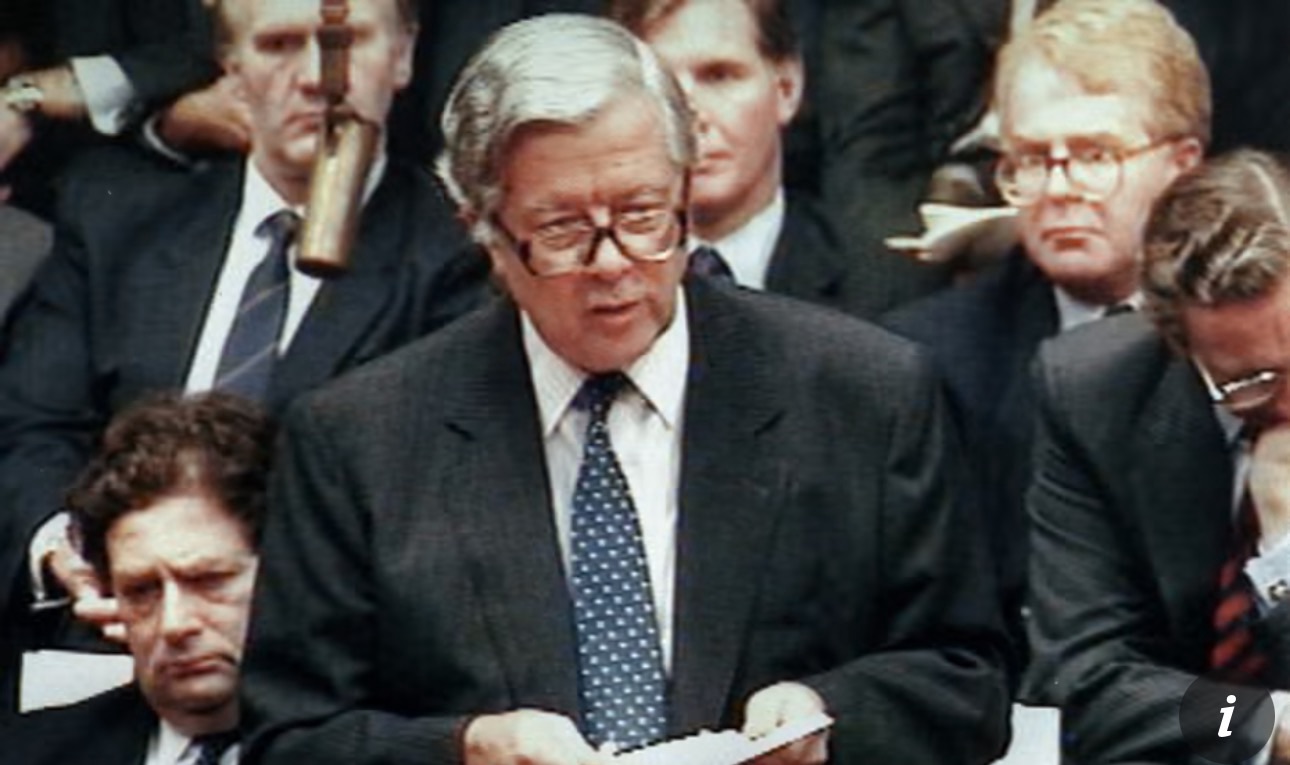
There are political speeches that announce the death of a government, and there are speeches that expose the intellectual bankruptcy of an entire political movement. Sir Geoffrey Howe’s resignation speech in the House of Commons on 13 November 1990 managed to do both.
Howe was not an ordinary political dissident. He was Margaret Thatcher’s longest-serving Cabinet minister, a former Chancellor of the Exchequer, Foreign Secretary and Deputy Prime Minister. He had been one of the principal architects of Thatcherism. If there was anyone entitled to claim ownership of the political project that transformed Britain during the 1980s, Howe was among them.
Yet he resigned because he could no longer reconcile his responsibilities as a senior minister with the direction in which Thatcher was taking Britain, particularly over Europe.
His speech was devastating precisely because it was delivered without the theatrics of a political insurgent. There was no shouting, no grandstanding and no attempt to manufacture a moment for television. Instead, there was the measured disappointment of a man who had concluded that the Prime Minister he had served was putting the country at risk.
And the irony is that Britain would spend the next quarter of a century moving towards the very political destination against which Howe was warning.
The European question that would not go away
To understand Howe’s resignation, one must understand the political argument over Britain’s relationship with Europe.
Britain joined the European Economic Community in 1973 under Edward Heath. The decision was subsequently endorsed in the 1975 referendum, when the electorate voted overwhelmingly to remain.
The European project was not simply an arrangement for trading goods. It was an evolving political and economic partnership intended to prevent the recurrence of the destructive rivalries that had devastated the continent twice in the twentieth century.
Britain’s relationship with Europe was never entirely comfortable. Its political establishment frequently wanted the economic benefits of membership without accepting the political obligations and institutional compromises that accompanied it.
Margaret Thatcher was herself instrumental in negotiating the 1986 Single European Act, which advanced the creation of the European single market. Yet her attitude towards European political integration became increasingly hostile.
Her 1988 Bruges speech articulated her objection to a centralised European superstate. That argument was not inherently unreasonable. The European Union, like every political institution, was entitled to scrutiny and criticism.
The problem was the gradual transformation of legitimate disagreement about European integration into a political doctrine that treated European cooperation itself as a threat to British sovereignty.
Howe understood the distinction.
The broken batsman and the captain who would not listen
The most memorable passage in Howe’s speech was his cricketing analogy.
He described the absurdity of sending opening batsmen to the crease only for them to discover that their bats had already been broken by their own captain before the game began.
It was a devastating metaphor for the predicament of British ministers attempting to negotiate Britain’s future in Europe while their Prime Minister publicly undermined the very negotiations they were conducting.
The message was straightforward: Britain could not expect to exercise influence in Europe while its own leadership was actively cultivating hostility towards European cooperation.
Howe identified something fundamental about international politics that would later become central to the Brexit debate.
Influence is not the same thing as sovereignty, and possessing the legal right to make decisions does not necessarily mean possessing the practical power to shape the circumstances in which those decisions are made.
A country can retain every formal attribute of sovereignty and still become strategically irrelevant.
Howe was particularly concerned about the European Exchange Rate Mechanism and the emerging debate over monetary union. He believed Britain should participate in shaping Europe’s economic future rather than stand outside and complain about decisions made by others.
His warning was not that Britain must surrender its identity or blindly accept every European proposal. It was that Britain should not confuse engagement with surrender.
He rejected the artificial choice between independent sovereign states and a centralised European superstate. There was, he argued, a middle ground in which Britain could protect its interests while participating constructively in the European project.
That was the intellectual sophistication missing from much of the political debate that followed.
The intellectual origins of Brexit
Brexit did not begin with Nigel Farage, Boris Johnson or the referendum campaign of 2016.
Its political foundations were laid much earlier, within a Conservative Party increasingly divided over Britain’s European future.
Thatcher’s confrontation with Europe helped establish a political vocabulary in which Brussels became the convenient explanation for domestic frustrations. European institutions were increasingly presented as foreign interference rather than institutions in which Britain had voluntarily participated and could exercise influence.
The distinction matters.
Criticising the European Commission, challenging European legislation or resisting further political integration are legitimate democratic positions. Indeed, they are necessary elements of a healthy political system.
But the Brexit movement gradually moved beyond criticism of particular European policies. It cultivated the proposition that Britain’s problems were substantially attributable to its European membership and that national prosperity, democratic accountability and political independence could be restored simply by leaving.
This was a political simplification of extraordinary proportions.
It treated sovereignty as though it were a possession that could be recovered from a foreign warehouse, rather than a complicated relationship between political authority, economic power, international obligations and practical influence.
Howe had already identified the danger.
In his speech, he warned:
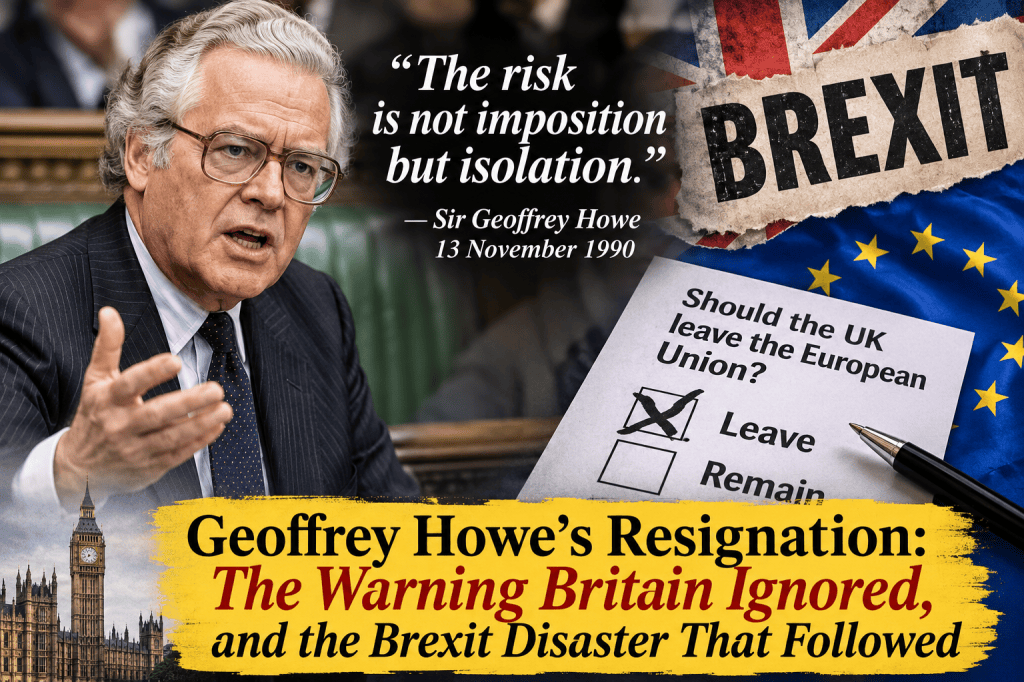
“The risk is not imposition but isolation.”
That sentence deserves to be regarded as one of the most prophetic observations in modern British political history.
The European Union did not need to force Britain into accepting every development. The other member states could simply proceed without Britain, leaving it to negotiate from a weaker position.
And that is precisely the strategic problem Brexit would eventually create.
The fall of Thatcher and the triumph of a warning
Howe’s resignation speech had immediate political consequences.
On 14 November 1990, Michael Heseltine announced his challenge to Thatcher’s leadership. The first ballot took place on 20 November. Thatcher failed to secure the required majority and subsequently withdrew from the contest.
John Major succeeded her.
The irony was that Thatcher’s political downfall was not principally caused by the Labour opposition. It was precipitated by a rebellion within her own party, with Europe at its centre.
Howe had effectively told his colleagues that loyalty to a political leader should not take precedence over loyalty to the country.
His closing remarks were particularly powerful because they exposed the conflict between personal loyalty and public duty.
He explained that his loyalty to Thatcher, whom he had served for two decades, could no longer be reconciled with what he believed to be the national interest.
That is an important constitutional principle, even though it was expressed through a personal political decision.
Ministers are not employed to provide unconditional personal loyalty to Prime Ministers. They are appointed to serve the public interest through the institutions of government.
The Prime Minister is not the state. The Cabinet is not a private corporation, and government is not a personal possession.
Howe understood that distinction.
Brexit: The warning became reality
Fast-forward to 2016.
Britain was presented with a referendum in which the electorate was asked to decide whether the country should remain in or leave the European Union.
The campaign was dominated by arguments about sovereignty, immigration, money sent to Brussels, national identity and the supposed recovery of parliamentary control.
The Leave campaign promised that Britain could regain control of its borders, laws and money while retaining the economic advantages of its European relationships.
The political slogan was compelling. The practical arrangements were considerably less straightforward.
Britain voted to leave.
But leaving the European Union did not abolish geography, economic interdependence or the need for international cooperation. Neither did it remove Britain’s dependence on European markets, investment, security relationships and diplomatic engagement.
Instead, Britain had to negotiate a new relationship with an economic and political bloc from which it had voluntarily withdrawn.
Howe’s warning about isolation became particularly relevant.
A member state has a seat at the table when European rules are discussed and negotiated. A non-member may retain considerable economic and diplomatic influence, but it no longer participates in the EU’s decision-making institutions on the same basis.
That is not an argument that every decision made in Brussels is necessarily good for Britain. It is an argument about the price of abandoning influence.
There is a difference between being unhappy with the rules of a club and leaving the club only to discover that the club continues to operate, its members continue to trade, and you still need to do business with them.
Britain did not escape Europe. It changed its position within Europe’s political and economic arrangements.
And that distinction is precisely what the more enthusiastic Brexit campaigners struggled to explain.
The tragedy of political nostalgia
There was something deeply contradictory about Brexit.
A country that had once exercised extraordinary influence across Europe convinced itself that its greatness could be restored by withdrawing from the institutions through which much of that influence was exercised.
It was an exercise in political nostalgia.
The British Empire had disappeared. The Commonwealth had evolved. The United States had become the dominant Western power. Europe had developed into a major economic and political bloc. Yet sections of the British political establishment continued to behave as though Britain could dictate international terms simply by invoking its historical importance.
The world had changed, but the political imagination of some British politicians had not.
Brexit exploited that nostalgia. It offered an emotional reconstruction of an imagined Britain in which national independence automatically translated into international power.
But history does not operate on sentiment.
A sovereign country can be economically vulnerable, diplomatically isolated and strategically diminished. Independence is valuable, but it is not a substitute for influence, competence or sound economic policy.
This is perhaps the greatest lesson of Howe’s intervention.
He was not arguing that Britain should abandon its national interests to Europe. He was arguing that Britain’s interests were best served by active participation, intelligent negotiation and a willingness to compromise where necessary.
That is what responsible international leadership looks like.
Britain needed another Geoffrey Howe
The tragedy is not simply that Britain voted for Brexit. It is that the political culture which made Brexit possible had been developing for decades, while those who understood its dangers increasingly found themselves marginalised.
Howe’s speech was an early assault on the intellectual foundations of that political culture.
He challenged the idea that sovereignty was an end in itself, that compromise was weakness, that engagement was surrender and that Britain could secure its future by standing apart from its neighbours.
He understood that the national interest is not always served by giving the electorate the most emotionally satisfying answer.
Sometimes leadership requires telling the country something it does not particularly want to hear.
That is the difference between a politician who seeks applause and a statesman who accepts responsibility.
There is also an uncomfortable lesson for today’s Conservative Party. The party that once produced politicians capable of making the case for Britain’s European engagement eventually became so consumed by its internal European divisions that it allowed the national question to become an instrument of party survival.
David Cameron called the referendum partly to settle his party’s internal dispute. He lost the referendum and resigned. Theresa May inherited the consequences. Boris Johnson turned Brexit into a vehicle for political advancement and eventually became Prime Minister.
The country was left to live with the consequences of a political argument that had begun as an internal Conservative family dispute.
A rather expensive family disagreement, one might observe.
Conclusion: The speech that Britain should have remembered
On 13 November 1990, Geoffrey Howe gave Britain a warning.
He said that the danger was not that Europe would impose its will upon Britain, but that Britain would isolate itself and surrender its opportunity to influence the future.
Thirty-six years later, his words remain remarkably relevant.
His resignation speech was not literally a prediction of Brexit. It concerned Britain’s participation in European monetary and political developments, particularly the Exchange Rate Mechanism and the emerging monetary union. But its underlying argument anticipated the central strategic mistake of Brexit: confusing the exercise of formal sovereignty with the possession of practical influence.
Howe understood that national power is not measured merely by the freedom to say no. It is also measured by the ability to influence what happens after everyone else has moved on.
Britain could have been a leading voice in shaping Europe’s future. Instead, it chose to negotiate its relationship with Europe from outside.
The lesson extends beyond Britain. It applies to every country whose political class mistakes isolation for independence and nationalist rhetoric for national strategy.
Sometimes the greatest threat to a country does not come from its enemies. It comes from politicians who persuade its people that the country is stronger than it really is, that compromise is humiliation and that the past can be recovered by reversing the present.
Geoffrey Howe saw that danger coming.
Britain chose not to listen.
And the bill for that decision is still being calculated.
Historical reference: Sir Geoffrey Howe’s resignation statement to the House of Commons, 13 November 1990, Hansard, Volume 180, columns 461–465. UK Parliament API +1
Further reading: Lawson Akhigbe, on political accountability, democratic institutions and the consequences of political leadership.

