


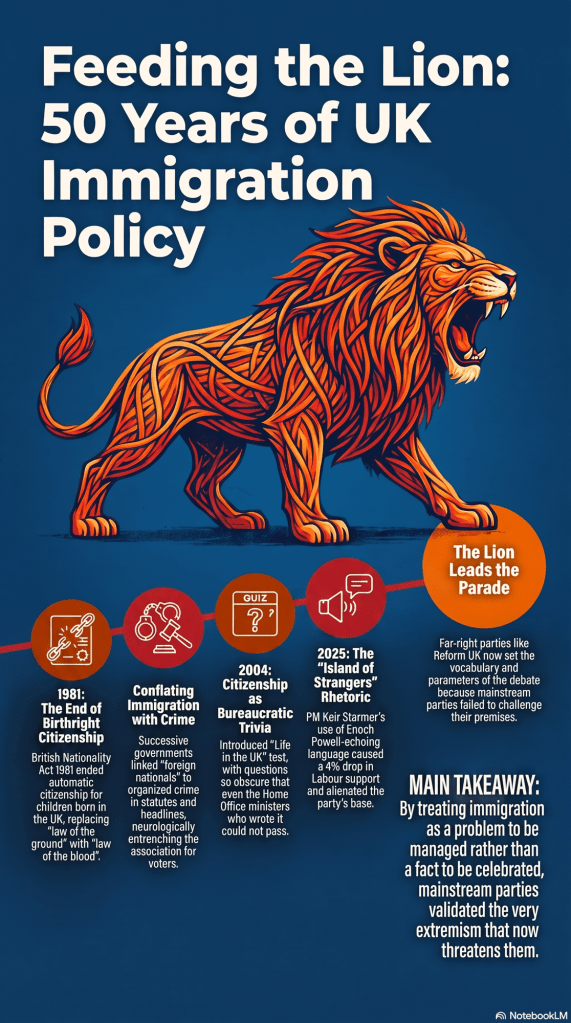
How Britain’s political establishment spent fifty years feeding an anti-immigrant lion and why it is now very much eating them
There is an old proverb, beloved of zoologists, fabulists, and occasionally political scientists, that warns against feeding wild animals: not because generosity is wrong, but because the animal will, in time, consume you. The British political establishment has spent the better part of fifty years feeding a lion. The lion is now running for Parliament — and winning.
The story begins not with a roar but with a dog whistle. From the late 1970s, a groundswell of anti-foreigner sentiment had been building in Britain with the quiet, determined energy of damp mould spreading behind a wall. It was not new Enoch Powell had done the dramatic overture in 1968, but it was acquiring institutional respectability. The question for ambitious politicians was not whether to acknowledge it, but how elegantly to do so while keeping one’s hands apparently clean.
Margaret Thatcher was many things, but subtle was not among them. She gave the sentiment its first significant legislative monument in the British Nationality Act 1981, which came into force on the 1st of January 1983. The target was jus soli the ancient common law principle that a child born on British soil was, by that fact alone, British. To Thatcher, this was an open door that needed closing, a juridical welcome mat for what was then euphemistically called the “immigrant problem.” The Act duly abolished automatic birthright citizenship. Henceforth, a child born in the United Kingdom to foreign parents would not be British merely by the accident of geography. Britain’s centuries-old law of the ground was replaced by something colder: a law of the blood.
A child born in a hospital in Birmingham to Nigerian parents was, before 1983, British by the oldest legal logic England possessed. After 1983, that child was a question mark with a birth certificate.— The quiet violence of legislative precision
Crime and Immigration: A Marriage of Convenience
Having established the ideological template, successive Conservative governments refined the method. The trick, perfected across the Thatcher, Major, and later Blair-era heritages, was conflation the seamless stitching together of crime and immigration in public discourse, statute, and tabloid headline until the average voter could no longer distinguish between the two. Home Office papers spoke of controlling “foreign nationals” in the same breath as controlling organised crime. Immigration officers and police officers attended the same briefings. Crime-and-immigration bills were presented as a single unified threat to public order, and the press dutifully reported them as such.
The genius of conflation is that it requires no evidence. You do not need to demonstrate that immigrants commit more crime. You need only use the same vocabulary for both categories until the association is neurologically entrenched. British governments of the right proved exquisitely skilled at this. The results were predictable: a steady coarsening of public debate, a growing conviction among sections of the electorate that foreigners were, at best, a tolerated imposition and, at worst, a criminal conspiracy with suitcases.
Enter New Labour, Exit Principle
Then came Tony Blair and New Labour in 1997 and the great hope that the baton might finally be set down. It was not. The baton was collected, polished, and run with equal vigour in the same direction. Blair’s Labour government did not dismantle the architecture of immigration restriction; it renovated it, added a conservatory, and moved in with evident comfort. The party that had positioned itself as the friend of multicultural Britain proceeded to govern as though multiculturalism were a problem requiring management rather than a fact requiring celebration.
The apogee of this triangulation came courtesy of David Blunkett, Home Secretary from 2001 to 2004, a man of sincere convictions who occasionally found those convictions pointing in awkward directions. Blunkett introduced the Life in the UK test, a formal examination that prospective British citizens must pass to demonstrate their fitness to belong. The stated aim was integration. The actual effect was to install a bureaucratic moat around citizenship and fill it with quiz questions. HM HOME OFFICE Life in the United Kingdom Official Citizenship Test · Section 4 · British Landmarks and Heritage Q What is the approximate height of the London Eye observation wheel in metres? A. 75 metres B. 120 metres C. 135 metres ✓ Correct answer D. 200 metres PARLIAMENTARY NOTE A Labour Home Office minister, asked this very question before a House of Commons Select Committee, could not provide the answer. He was British. His government wrote the test. He had failed it. lawakhigbe.com · satirical illustration The Life in the UK test: designed to measure belonging, accomplished chiefly in measuring bureaucratic absurdity
The Examination of Belonging
The Life in the UK test, since its introduction and various subsequent revisions, has become a monument to the peculiarly British talent for confusing trivia with identity. Among its questions: the height of the London Eye tourist attraction. The weight of Big Ben’s bell (affectionately known as “Big Ben” itself, though pedants will note that name technically refers to the bell, not the tower a fact the test possibly examines). The precise dates of Viking invasions. Questions that, as successive surveys and studies have confirmed, a substantial majority of people born and raised in Britain could not answer correctly on a Tuesday morning without revision.
The absurdity became spectacular theatre when, in a House of Commons Select Committee hearing, a Labour Home Office minister was asked a question drawn directly from the current iteration of the test. The question concerned, in its magnificent anti-climax, the height of the London Eye. The minister, British by birth, British by upbringing, British by parliamentary salary could not answer it. He was, by the standards of the examination his own government had designed, unqualified for the citizenship he already possessed.
The minister could not answer a question from the citizenship test his own government wrote. Had he been a Nigerian nurse or a Pakistani engineer, he would have been sent home. The quiet poetry of unintended consequences
One could be uncharitable and describe this episode as scandalous. One could be charitable and describe it as clarifying. The Life in the UK test was never really about life in the United Kingdom. It was about feeding a certain constituency, those whose sense of national identity is most secure when a bureaucratic mechanism exists to separate the acceptably British from the presumptuously British. The questions, as Blunkett’s ministry designed them, were a form of red meat: substantively meaningless, symbolically satisfying. That a British minister could not answer them was not, ultimately, the failure of the minister. It was the revelation of the enterprise.
An Island of Strangers: The Phrase That Ate Its Author
Fast forward to the 12th of May 2025. Keir Starmer, human rights lawyer, former Director of Public Prosecutions, leader of a government elected on the promise of national renewal, stood at a Downing Street press conference to launch his Immigration White Paper. The paper extended the residency period required for permanent settlement from five years to ten. It tightened skill thresholds for migrant workers. It raised English language requirements. It proposed, in sum, a comprehensive tightening of every seam through which a foreign person might pass into British life.
And then came the phrase. Without fair immigration rules, Starmer told the nation, “we risk becoming an island of strangers, not a nation that walks forward together.” An island of strangers. The echo was not subtle to anyone with even a passing familiarity with modern British political history. Enoch Powell, in the speech that ended his ministerial career in 1968, had warned that the indigenous British risked becoming “strangers in their own country.” Starmer had, whether by careless speechwriting or deliberate triangulation, reached into the same rhetorical drawer and pulled out a variation on the same phrase.
The backlash from within his own party was swift. Several Labour MPs publicly objected that the Prime Minister had borrowed the vocabulary, if not the explicit racism, of the far right. New Statesman research drawn from the British Election Study, tracking over 30,000 respondents before and after the speech, found that Labour lost four percentage points of support among its own former voters following the remarks, while gaining none elsewhere. The speech had managed the remarkable feat of alienating Labour’s base without appeasing its opponents. Starmer subsequently let it be known that he regretted the phrase. The polling, by that point, suggested regret was the appropriate emotion.
The Stranger in the Room
There is an irony so large it has become structural. The language of “strangers” — the implication that non-white British citizens are guests rather than inhabitants, visitors rather than belongers, proceeded from the mouth of a Prime Minister whose immediate predecessor was Rishi Sunak: a man of Indian heritage, born in Southampton, who rose to lead the Conservative Party and occupy 10 Downing Street. If the United Kingdom is to be characterised as a nation at risk of being overwhelmed by strangers, then the previous Prime Minister, by the logic of the very discourse Starmer had borrowed, was among those strangers.
This is not merely a rhetorical point. It is a constitutional one. Sunak is British. He was elected, in the first instance, by his party. His presence at the pinnacle of British politics was, in its way, an argument, however one might assess his governance, against the premise that Britishness is a racial category. Starmer’s phrase, inadvertently or otherwise, undermined that argument. The strangers, it seemed, included a former Prime Minister. One presumes he was not meant to take it personally.
The Arithmetic of Irony
Research published after Starmer’s speech noted that over 68% of people who applied for asylum in the United Kingdom in the preceding year came from countries directly affected by British colonial rule. In several cases, Afghanistan being among the most conspicuous, those countries were also recent theatres of British military intervention.
Britain, in other words, has spent considerable portions of its modern history travelling to other people’s countries, reshaping their governance, extracting their resources, training their armies, and on occasion bombing their infrastructure, and is now surprised that some of those people subsequently appear at its borders. The island of strangers, it turns out, invited many of its visitors.
Labour’s Fifty-Year Intellectual Failure
Here is the charge that history will record, and that no spin doctor can fully launder: the Labour Party, which exists in theory as the political champion of working people regardless of their origin, has spent fifty years declining to make the affirmative case for immigration. Not the defensive case, not the “yes but immigrants contribute economically” case, though that case is true and well-evidenced, but the moral and political case. The case that a country which built an empire by moving freely across the world cannot coherently object to the world moving freely across it. The case that the NHS, which successive Labour governments built and defended, would not survive a fortnight without its Nigerian nurses, its Filipino midwives, its Romanian porters. The case that the Life in the UK test is not integration policy but humiliation theatre. That case was never, substantively, made.
Instead, Labour competed. Each time a Conservative government proposed a new restriction, Labour’s instinct was to offer a slightly softer version of the same restriction, to demonstrate its own seriousness on the matter, to prove it was not soft, to feed the same lion with a slightly smaller cut of meat. The cumulative effect of this strategy, repeated across five decades, has been to validate the premise that immigration is, in essence, a problem. That the only respectable debate is not whether to restrict but how severely. That people who arrive from elsewhere are, by default, a burden requiring justification rather than human beings requiring welcome.
The intellectual failure is enormous. It is, without serious competition, the largest single failure of progressive politics in postwar Britain. More consequential than any individual policy error. More damaging than any single lost election. It is the failure to hold a line, to say, clearly and repeatedly, that what is being sold to the British public as a defence of national identity is, in fact, the slow administrative dismantling of what makes national life worth defending.
The Lion Leads the Parade
The Conservative Party, meanwhile, believed it had found the perfect arrangement: feed the lion, keep it in a cage marked electoral strategy, and deploy it at general elections for controlled effect. The calculation was elegant in conception and catastrophic in execution. The lion, as lions tend to, noticed the cage had a door. Reform UK, the party of Nigel Farage, an institution whose primary product is grievance and whose secondary product is polling data, has spent the past several years not feeding from the Conservative table but building its own. It now frames the immigration debate with a confidence that comes from having been proven right by everyone else’s capitulation.
Reform did not create this moment. Thatcher created this moment. Blunkett created this moment. Blair’s triangulation created this moment. Starmer’s island of strangers created this moment. Reform simply arrived at the feast that others had laid, sat down, and picked up the knife. The Conservatives, who thought they could put lipstick on a pig and call it a manifesto, have discovered that the pig has opinions of its own and a better social media operation.
The lion they fed is now leading the debate. It sets the vocabulary. It establishes the parameters within which other parties must respond. It decides what counts as reasonable and what counts as extreme, and it has done so precisely because, for fifty years, the parties that should have challenged its premises chose instead to accommodate them. You cannot spend half a century treating the anti-immigrant argument as a political reality to be managed, rather than a moral failure to be contested, and then express surprise when the argument wins.
You do not defeat a lion by feeding it politely. You defeat it by refusing, at considerable personal risk, to feed it at all. The political lesson that arrived fifty years too late
An Island, Examined
Britain is an island. This is geographically accurate. It is also, apparently, a political aspiration: an island sealed against the world, its citizenship guarded by trivia questions about tourist attractions, its identity defended by politicians who cannot themselves pass the tests they impose on others.
Keir Starmer, a man who built his reputation on the rule of law and the rights of the individual, stands now as the author of a phrase that Enoch Powell would have recognised, and probably appreciated. The Labour Party, which in theory exists to advance the interests of working people, has advanced instead the interests of a discourse that has spent fifty years telling working people that their misfortunes are the fault of people who look different from them.
The strangers were never the problem. The strangers built the NHS. The strangers drove the buses. The strangers cleaned the hospitals and stacked the shelves and in the case of Rishi Sunak, delivered a budget. The strangers, as it happens, have been rather busy being British while the political class debated whether to let them.
The British Nationality Act 1981 eliminated birthright citizenship. The Life in the UK test eliminated dignity. The “island of strangers” speech eliminated the last pretence that Labour represents a substantively different answer to the question of who belongs. What remains is a competition between parties about how severely to restrict the movement of human beings who have, in most cases, perfectly ordinary reasons for wanting to live in a country they have often already served.
The lion, meanwhile, is having an excellent decade.
 Centre for Nigeria Progress