

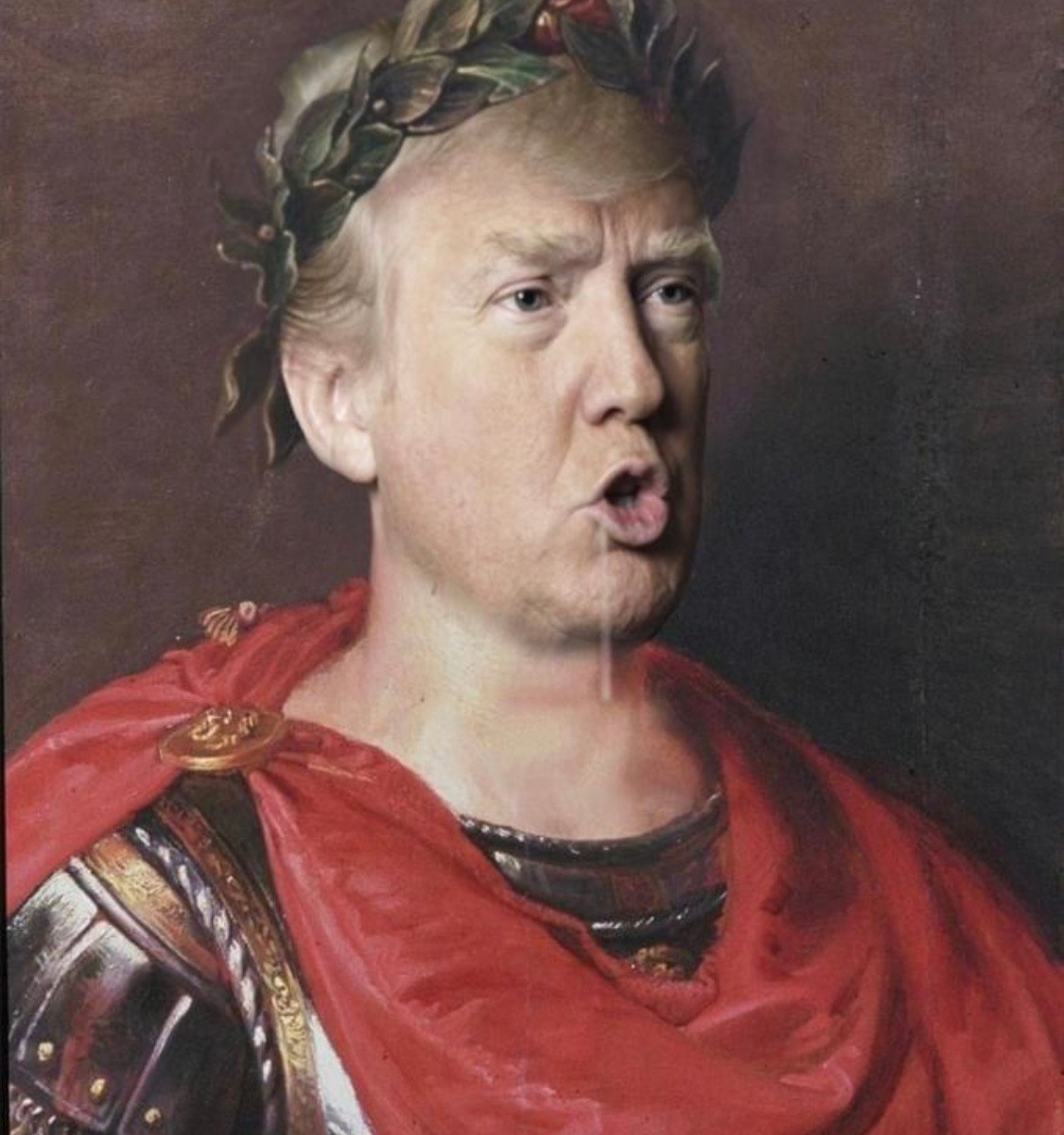
As America celebrates 250 years of independence, one is reminded of the remarkable durability of the American experiment.
For two and a half centuries, the United States has survived wars, depressions, impeachments, scandals, insurrections, recessions, political charlatans, and even reality television. Through it all, the republic has continued to stagger forward like an ageing but stubborn marathon runner refusing to collapse.
The secret of that endurance is simple.
America was never designed to depend on one man.
The Founding Fathers had just fought a war to rid themselves of a monarch. They were not about to spend months drafting a Constitution only to recreate a king with an elected title.
The presidency was intended to be an office, not a personality cult.
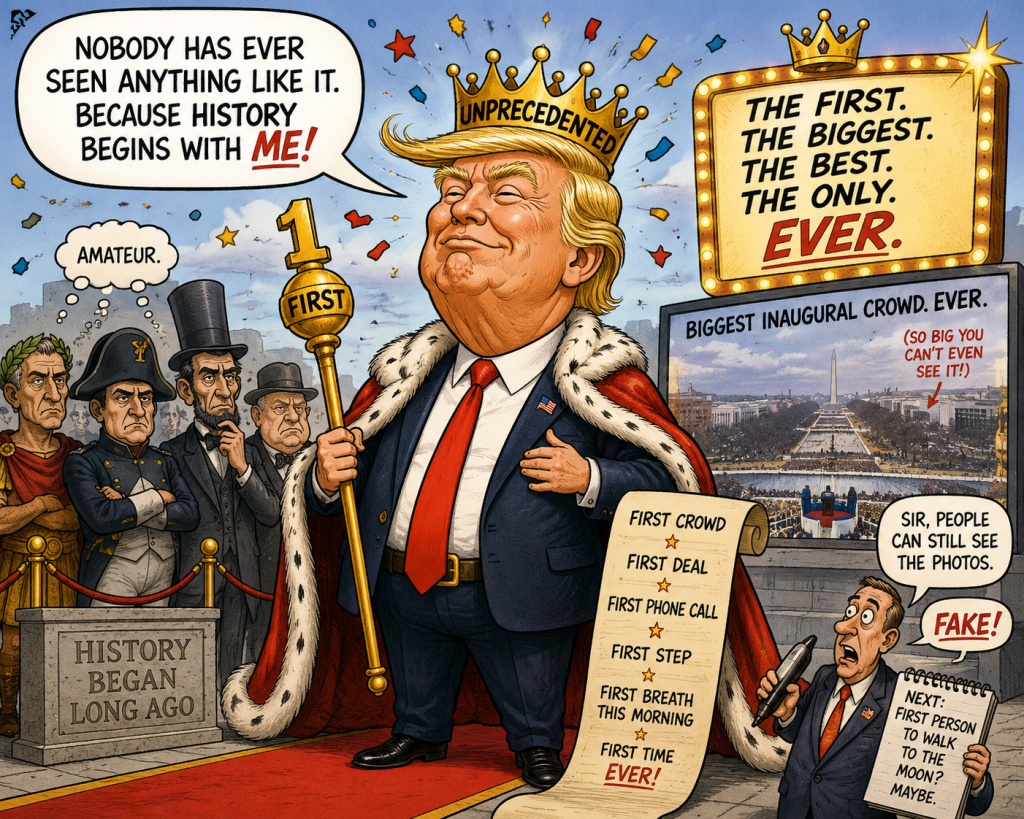
Donald Trump, however, appears to have arrived at a different constitutional interpretation.
Most presidents see themselves as a chapter in America’s story. Trump appears to see himself as the entire book.
Not merely the author.
Not merely the editor.
Not merely the publisher.
He appears to regard himself as the library.
In Trump’s universe, American history is divided into two eras: Before Trump and The Golden Age of Trump. George Washington crossed the Delaware so Trump could cross social media. Abraham Lincoln preserved the Union so Trump could preserve his television ratings. The moon landing was merely a rehearsal for the launch of Truth Social.
The Founding Fathers would probably find this interpretation fascinating, if only because it would be the first time a man confused a campaign rally with the Constitutional Convention.
America’s strength has always been its institutions.
Trump’s strength has always been convincing people that institutions are unnecessary provided they have enough faith in him.
Courts are admirable when they agree with him.
Elections are flawless when he wins them.
The media is free when it praises him.
The Constitution is sacred when it is useful and suspicious when it is not.
It is a remarkably flexible philosophy, not unlike a yoga instructor made entirely of political expediency.
The most amusing part is that Trump’s supporters often speak of him as though he personally invented America.
One sometimes gets the impression they believe the Declaration of Independence originally read:
“We hold these truths to be self-evident, that all men are created equal, except the fake news media.”
Yet history offers a useful corrective to such grandiosity.
Every generation produces politicians who believe they are indispensable.
History eventually introduces them to reality.
Napoleon thought Europe revolved around him.
It did not.
Mussolini believed he was the future.
He was not.
Richard Nixon imagined he could bend institutions to his will.
The institutions had other ideas.
The graveyards of history are crowded with men who believed themselves to be giants.
Most turned out to be ordinary mortals standing on very tall soapboxes.
Trump belongs in a particularly interesting category.
He is a political Lilliputian armed with a magnifying glass, convinced he is Gulliver.
The magnifying glass is composed of partisan media, social media algorithms, billionaire donors, political sycophants and a movement that often mistakes volume for wisdom.
Looking through it, every achievement becomes world-changing.
Every criticism becomes persecution.
Every legal setback becomes a conspiracy.
Every electoral defeat becomes impossible.
Every personal grievance becomes a national emergency.
The result is a distorted reflection in which a man of entirely normal dimensions appears convinced he is carrying the republic on his shoulders.
The reality is less dramatic.
America existed before Donald Trump.
America will exist after Donald Trump.
The Constitution is older than him.
The Republic is bigger than him.
The flag is not his property.
The presidency is not a family heirloom.
And the nation itself is not a stage set constructed for the performance of a single man’s ego.
As America reaches the age of 250, its greatest achievement is not military power, economic wealth or technological innovation.
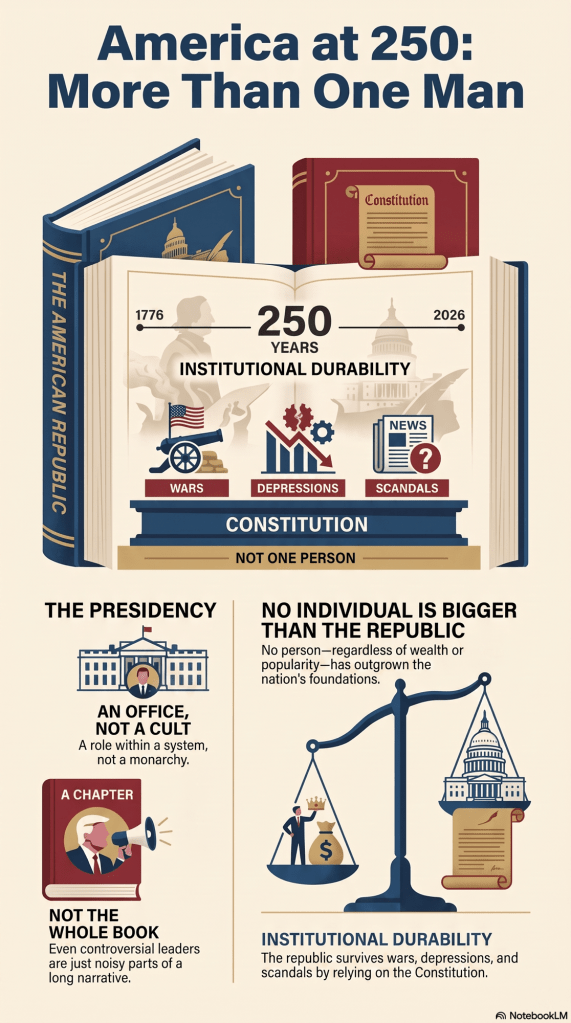
Its greatest achievement is that no individual, however wealthy, popular, loud or self-obsessed, has yet succeeded in becoming bigger than the republic itself.
That must be a particularly frustrating fact for a man who has spent years confusing applause with immortality.
When historians eventually write the chapter on Trump, they will place him where all presidents belong: as one character among many in a story that began long before him and will continue long after him.
America is the book.
Trump is merely a chapter.
A noisy chapter.
A controversial chapter.
A chapter with an unusual number of exclamation marks and references to itself.
But a chapter nonetheless.
 Centre for Nigeria Progress