

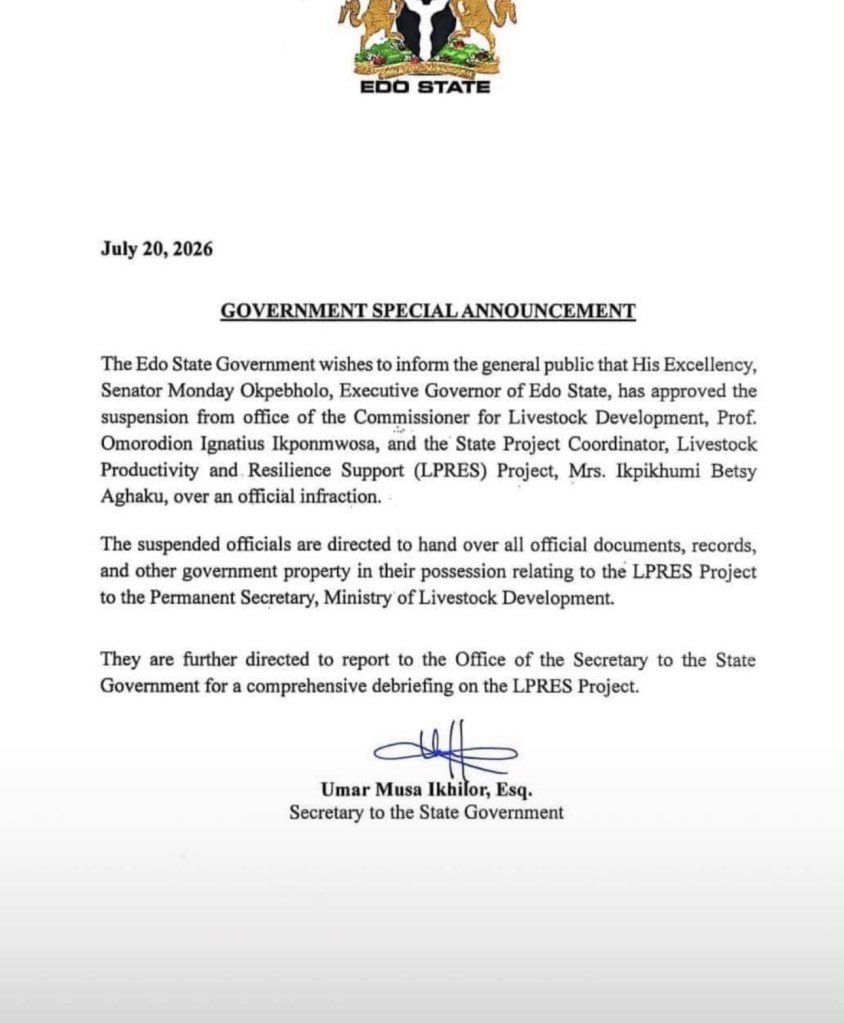
There is a peculiar dignity to Nigerian political office that the current government of Edo State appears determined to unlearn. In eighteen months, Governor Monday Okpebholo has suspended two commissioners his Attorney-General, and, most recently, his Commissioner for Livestock Development placing them on the same disciplinary footing as a clerk caught napping at his desk. It is a small administrative habit with an outsized constitutional problem sitting underneath it, and it deserves more scrutiny than the passing news cycle it has received.
A CATEGORY ERROR
Section 192 of the 1999 Constitution creates the office of Commissioner; it does not create a species of civil servant. The two are, in fact, constitutionally quarantined from each other. The State Civil Service, established under Section 206, is the permanent bureaucracy the people who survive elections, serve whichever government arrives, and are protected precisely because they are not political. Commissioners are the opposite of that. They are appointed by the Governor, confirmed by the House of Assembly, and removed at the Governor’s pleasure a hire-and-fire arrangement, yes, but a political one, exercised through dismissal, not through the quasi-judicial choreography of suspension, investigation panels, and indefinite limbo that properly belongs to a disciplinary code for salaried officers.
Suspension is a civil service instrument. It exists to protect an officer’s rights while an allegation is tested, precisely because civil servants have due process protections built around tenure and pension.
Commissioners have no such tenure to protect, because they were never promised any. Subjecting them to the ritual of suspension does not protect them it borrows the aesthetics of bureaucratic discipline and drapes them over an office that was never meant to carry that indignity.
If a Governor no longer trusts a Commissioner, the Constitution gives him a clean instrument for that: he removes him. What it does not contemplate is parking a political appointee in public disgrace pending an inquiry into himself, as though he were a Permanent Secretary who forgot to reconcile a ledger.
THE GEOGRAPHY BENEATH THE APPOINTMENT
There is a further wrinkle worth being precise about. Section 14(4) of the Constitution a directive principle, and therefore not the kind of provision a court will enforce against a Governor, but a stated constitutional value nonetheless requires that the composition of a State government recognise the diversity of its people and promote a sense of belonging across it.
In practice, across all thirty-six states, this has hardened into convention rather than justiciable law: a Commissioner is rarely just a technocrat, but a local government area’s seat at the executive table. His appointment carries a political constituency behind it, however informal, and his public suspension does not humiliate him alone it is felt, in some diffuse but real way, by the area he was understood to represent.
This is the deeper argument for treating Commissioners as political actors rather than staff. A Governor who cannot work with one is not managing an underperforming employee; he is managing a coalition.
The correct response to a coalition partner who has become unworkable is to let him go with whatever grace the relationship still permits not to strip him in public first and ask questions in a probe panel afterward.
THE ARITHMETIC OF INSTABILITY
Set against the record of Governor Okpebholo’s two immediate predecessors, the picture becomes starker still. Adams Oshiomhole and Godwin Obaseki both sacked commissioners sometimes in batches, once famously eight at a time but neither, on the available record, resorted to suspension. They removed. It was blunt, occasionally political theatre in its own right, but it respected the underlying logic of the office: you are here at my pleasure, and my pleasure has ended.
Two suspensions in a term not yet at its midpoint is not, by itself, a scandal. But it is an admission. Either the vetting process that produced these appointments was inadequate, or the political management of the cabinet since has been careless, or both. A Governor who selects with more discipline than he currently exercises would not find himself running an internal affairs bureau for his own cabinet eighteen months in.
THE DIGNITY DEFICIT
There is a version of this story with a better ending, and it involves the two men themselves.
Samson Osagie, the suspended Attorney-General, although roughly a month later after his suspension, the investigative panel completely exonerated him of all financial infractions and corruption charges.
Governor Okpebholo subsequently lifted the suspension and recalled him to resume his duties as Attorney-General effective March 12, 2025.
He ultimately left the government his reputation marked, but the episode closed when Governor Okpebholo quietly dropped him from the cabinet when announcing a reshuffled executive council list, effectively ending his stint as Attorney-General. No official reasons were publicly disclosed for his replacement.
These set of facts could not apply to a civil servant who is cleared but still let go. This would resulted in a claim of constructive dismissal. But not applicable to a political appointee who has suffered the consequences of a civil servant but dismissed as a politician.
It is difficult to imagine a cleaner response to public suspension than resignation: it returns to the appointee the one thing suspension was designed to take from him, which is the choice in the matter.
Whether Professor Omorodion Ikponmwosa, the suspended Commissioner for Livestock Development, will do the same remains to be seen.
If the pattern that governs so much of Nigerian political life holds, the answer is probably not. Public office here has developed a remarkable tolerance for public humiliation, so long as the title survives it. But a Commissioner who is asked to endure suspension without shame is not demonstrating resilience. He is demonstrating exactly what the Governor mistook him for in the first place an employee, waiting to be told he can come back to work.
 Centre for Nigeria Progress