

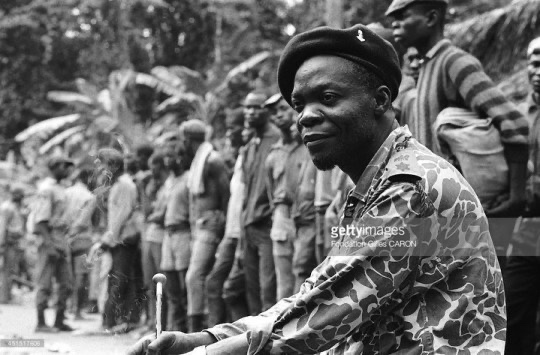
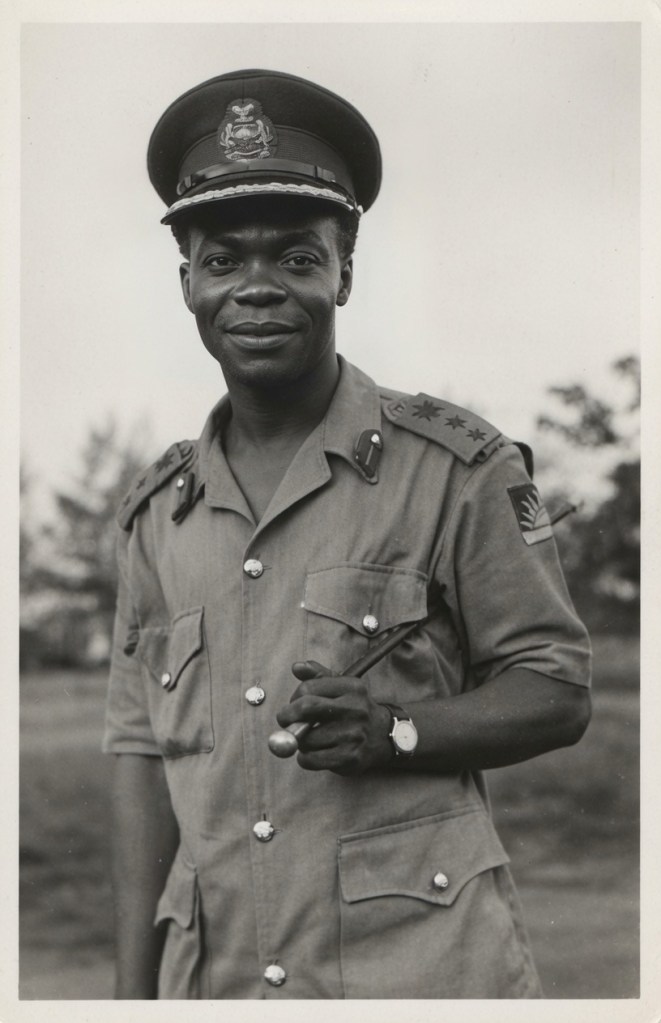
If you ask a veteran of the Nigerian Civil War about Colonel Joe Oseloka Governor Achuzia, you will get two entirely different stories depending on who is talking.
To the rank-and-file Biafran soldiers and civilians, he was “Hannibal” a fearless, bulletproof folk hero who rushed toward the frontlines when trained officers hesitated. To the regular Biafran High Command men who had formal military training in the Nigerian Army before the 1967 secession he was a loose cannon, a publicity hound, and an absolute nightmare of a disciplinarian.
Achuzia was unique. He was the only major Biafran commander who wasn’t a professional soldier before 1967. Yet, he engineered some of the most daring, unorthodox, and bloody operations of the entire war.
So, who was the real “Hannibal” a military genius, or a chaotic force of nature?
From civilian militia to “Air Raid”
Achuzia, an Asaba native, had reportedly served in the British military during the Korean War, though his official entry into the Biafran struggle began as a civilian militia leader.
His legend was born during his very first major battle in October 1967. The Nigerian 2nd Division had shelled Onitsha for over a week before launching a 10-boat armada across the Niger River. After landing, the federal troops made a critical tactical error: instead of pursuing the retreating Biafrans, they stopped to loot and burn the famous Onitsha market. Achuzia seized the moment, launched a fierce counter-attack, and routed the troops at Dennis Memorial Grammar School, driving many back into the Niger River.
Impressed, Major General Alexander Madiebo approved Achuzia’s formal commission into the Biafran Army as a Major. It was a decision Madiebo would later dryly call “the greatest mistake of my military career.”
Civilians loved Achuzia because he gave them drama, hope, and victory speeches. After an interview with foreign journalists in Ogidi, the press christened him “Hannibal” on the spot. Within Biafra, he acquired another, more terrifying nickname: “Air Raid.”
Why “Air Raid”? Because whenever Biafran soldiers saw his jeep speeding toward the frontlines, they didn’t wait to ask questions they dived straight into the bushes. To fail in an attack under Achuzia meant facing his infamous “killer instinct.”
Setting the record straight: The Abagana Ambush
No discussion of Achuzia is complete without clearing up the most famous myth of the Biafran War: The Abagana Ambush of March 31, 1968.
For decades, popular legend has credited Achuzia as the mastermind who destroyed Nigeria’s 2nd Division convoy, blowing up over 90 vehicles and killing hundreds of federal troops in a massive fireball.
While Achuzia certainly took the credit (and brought journalists to the scene), military history tells a more nuanced story. The field commander who actually ambushed and destroyed that convoy was Major Jonathan Uchendu. While some military historians argue Achuzia planned the broader division-level strategy, regular army officers like General Madiebo were perpetually amused and annoyed that Achuzia snatched the headlines while Uchendu did the tactical heavy lifting.
Clash of the Titans: Achuzia vs. The High Command
Achuzia wasn’t just fighting the Nigerian Army; he was in a constant cold war with Biafra’s regular military brass.
He bypassed Army Headquarters entirely, taking direct orders from Head of State Chukwuemeka Odumegwu Ojukwu. This gave him immense power, which he used with ruthless efficiency:
- Fuel Hijacking: When assigned to stop illegal oil refining, Achuzia casually ambushed Army HQ’s own fuel trucks and seized the crude, ignoring Madiebo’s frantic complaints to Ojukwu.
- The Pistol Duel: During the bloody campaign to retake Owerri in 1969, Achuzia’s relentless “push at all costs” strategy resulted in massive casualties for the elite “S” Brigade. When Achuzia demanded more troops, the legendary Colonel Tim Onwuatuegwu was so enraged by the loss of his men that both commanders drew pistols on each other. Madiebo had to personally step between them before Ojukwu eventually intervened.
To officers like Lt. Col. Ben Gbulie, Achuzia was a “feared martinet” who accused regular officers of sabotage and treason. Madiebo even admitted he couldn’t visit certain frontlines without risking an ambush from Achuzia’s overzealous boys.
Yet, despite his terrifying reputation, Achuzia showed unexpected restraint when it counted. When his troops captured 18 foreign oil workers in the Kwale oil field who had opened fire on them, Achuzia followed orders and delivered them completely unharmed to headquarters.
The chaotic final act
When the war collapsed in January 1970 and Ojukwu fled into exile, Major General Philip Efiong took over to arrange the surrender. Achuzia was right beside him—and immediately caused a stir.
He informally promoted himself to Brigadier, strutting around to negotiate with Nigerian forces. He then promptly slapped an absolute flight embargo on the Uga airfield, ordering his men to shoot down any plane attempting to take off. He claimed he was preserving authority, but fleeing Biafran officers including Ben Gbulie believed Achuzia was actively trying to trap them so they couldn’t escape into self-exile.
When Gbulie confronted him, Achuzia calmly declared that he had taken control of the army, navy, and air force. Gbulie later wrote that he thought Achuzia had “taken leave of his senses.”
The aftermath
Achuzia accompanied Efiong to meet Nigerian Colonel Olusegun Obasanjo on January 14, 1970, to formally end the war.
However, his war was far from over. Following a post-war Board of Inquiry on Biafran officers, Achuzia was singled out and detained by the Nigerian Military Government for “sadistic behavior” during the conflict. He served five years in prison before his release.
After his release, the feared “Air Raid” retired quietly to his hometown of Asaba, transforming into a respected traditional chief and elder statesman for the Igbo people. He lived a long life, finally passing away at the age of 91 on February 26, 2018.
Love him or hate him, Joe Achuzia was a force of nature. He was a civilian who threw himself into the fire of war, rewrote the rules of engagement, and carved his name permanently into West African military history.

