

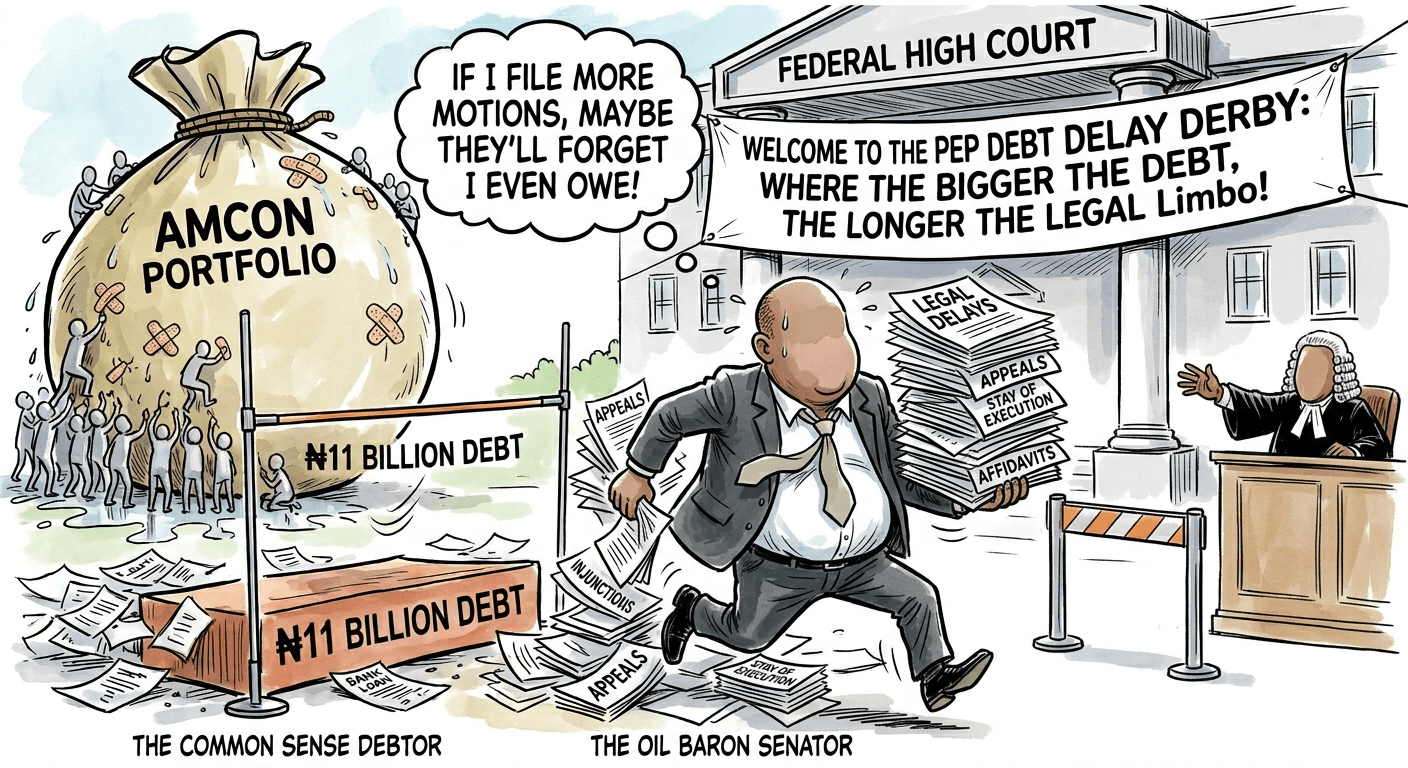

Here is a detailed exploration of high-profile politicians involved in AMCON debt enforcement cases, integrated into the broader history of AMCON’s recovery efforts. This builds on AMCON’s evolution from a stabilization tool (post-2008/2009 banking crisis) to an entity wielding enhanced statutory powers after the 2015 and 2019 amendments. Enforcement against politically exposed persons (PEPs) often highlights tensions between aggressive recovery, protracted litigation, political connections, and perceptions of selective or “elastic” application.
AMCON has repeatedly noted that a small number of high-profile obligors (often 300–400 individuals/entities) account for 70–80% of its outstanding portfolio (peaking around ₦4.5–5 trillion in various reports). Many of these involve politicians or their allied companies, where debts originated from pre-AMCON bank loans (e.g., Union Bank, Skye Bank facilities) that turned non-performing due to factors like margin lending, poor governance, or economic shocks.
Key Examples of High-Profile Politicians and Their AMCON Cases
1. Senator Ben Murray-Bruce (Silverbird Group) – ₦10–11 billion
- Background: Debt traced to facilities from Union Bank in 2005–2007 for Silverbird Productions Ltd, Silverbird Showtime Ltd, and Silverbird Galleria Ltd. AMCON acquired the non-performing loans.
- Enforcement Actions: In June 2016, the Federal High Court (Lagos) granted an interim injunction appointing M.A. Banire SAN as receiver over fixed and floating assets in Lagos, Abuja, and Port Harcourt. The court restrained Murray-Bruce, his brothers (Guy and Roy), and family members from interfering. Silverbird Galleria (Abuja) and other properties were affected, with public takeovers and sealing reported.
- Developments and Nuances: The case involved protracted negotiations. As recently as 2025, AMCON listed the Silverbird Entertainment Centre (Abuja mall) for sale to recover part of the debt. Murray-Bruce, a former PDP senator (Bayelsa East, 2015–2019) known for his “Common Sense” critiques, later defected to the APC. Critics and analysts have highlighted this as an example of the “Defection Doctrine,” where enforcement urgency appeared to fluctuate with political alignment, though the underlying obligation persisted. The case underscores AMCON’s use of receivership rather than outright liquidation, aiming to realize value while facing debtor resistance and public scrutiny.18
2. Senator Ifeanyi Ubah (Capital Oil & Gas Industries Ltd) – Over ₦115 billion (up to ₦135 billion in some claims)
- Background: One of the largest single exposures on AMCON’s 2018–2019 debtors’ lists. Debt linked to oil and gas facilities.
- Enforcement Actions: AMCON pursued aggressive recovery, including attempts to sell assets like a Banana Island property in Lagos. Criminal charges were filed in 2019 alleging false claims and obstruction of recovery. Ubah (Anambra South Senator) and his company faced summons.
- Developments and Nuances: A Federal High Court struck out the criminal case in 2023. The matter dragged through litigation for years, illustrating how high-profile debtors use multiplicity of suits and appeals to delay realization. Ubah’s political prominence (as a serving senator) amplified debates about whether enforcement was influenced by connections or timing. This case exemplifies concentrated risk: a handful of obligors dominating AMCON’s portfolio.2
3. Senator Jimoh Ibrahim (Global Fleet Group) – ₦69.4 billion
- Background: Debt acquired from Union Bank; Ibrahim is a prominent businessman and politician (senator-elect in some reports).
- Enforcement Actions: In 2020, the Federal High Court authorized AMCON to seize 12 assets and freeze accounts. AMCON appointed receivers to take over properties.
- Developments and Nuances: Ibrahim challenged the seizure through appeals. The Court of Appeal in Lagos dismissed his appeal in December 2021, upholding the takeover. This represents a relative success for AMCON in higher courts, yet it highlights the lengthy judicial process (often spanning years) even with special AMCON Act powers. Ibrahim’s political stature adds to perceptions of challenges in enforcing against PEPs.4
4. Former Senator Buruji Kashamu – ₦13.015 billion
- Background: Listed among top debtors in AMCON’s 2018 public disclosure.
- Enforcement Actions: Included in the high-profile list released to pressure recovery. AMCON pursued standard tools like receivership and asset tracing.
- Nuances: Kashamu, a controversial PDP figure, passed away in 2020, but the case illustrates how debts tied to politicians often involve complex corporate structures and ongoing litigation even after the individual’s death or reduced visibility. His inclusion fueled public discourse on elite debtors.
5. Former Governor Chimaroke Nnamani (Enugu) – ₦42 billion
- Background: Debts linked to companies such as Iorna Global Resources, Sammy Beth Interbiz, Camden Resources, Riverside Logistics, and Rainbownet.
- Enforcement Actions: Featured prominently on the 2018 AMCON debtors’ list. Recovery efforts involved asset identification and potential receivership.
- Nuances: As a former governor and PDP senatorial candidate, Nnamani’s case exemplifies how political figures’ business interests intersect with public debt burdens. Enforcement here, like many others, faced delays due to legal challenges.
6. Former Governor Joshua Dariye (Plateau) – ₦6.8–7 billion
- Background: Debt listed while he was serving a 14-year jail term for separate corruption charges.
- Enforcement Actions: Publicly named in AMCON’s 2018 list of 105 debtors.
- Nuances: This edge case shows AMCON pursuing debts independently of other legal issues (e.g., EFCC convictions). It raises questions about asset tracing when debtors are incarcerated or politically sidelined.
7. Former Governor Donald Duke (Cross River) – ₦36–537 million (Tinapa project-related)
- Background: Linked to the state’s tourism resort project (Tinapa).
- Enforcement Actions: AMCON pursued recovery; reports indicate a ₦537 million component was settled in one instance, with asset recovery (e.g., a house) mentioned.
- Nuances: State-linked debts add layers of complexity involving public vs. private obligations. Settlement here contrasts with prolonged fights in other cases, showing variability in outcomes.7
Other Notable Mentions:
- Wale Babalakin (Bi-Courtney Ltd / MMA2): Often listed in top debtors (airport concession-related); involved significant litigation, with some Supreme Court or appeal outcomes favoring or challenging AMCON.
- Former Governor of Enugu and others: Broader lists included figures like Usman Nafada (₦400+ million) and various senators/governors’ allies.
- Politicians or their proxies frequently appear in AMCON’s “top 20–105” disclosures, with AMCON’s former MD Ahmed Kuru publicly noting that many high-profile debtors include serving/past senators, ministers, and party chieftains.
Broader Context, Challenges, and Implications in AMCON Enforcement History
AMCON’s post-2015/2019 amendments granted stronger tools (e.g., easier receiver appointments, asset tracing, limits on delaying injunctions), enabling more visible actions against PEPs from 2016 onward. However, enforcement against politicians reveals recurring nuances:
- Litigation as a Shield: Multiplicity of suits, appeals, and interlocutory applications often stall progress. Even with court wins (e.g., receiverships), actual asset realization can take years due to stays or challenges.
- Political Dimensions: Cases like Murray-Bruce’s coincide with defection timelines, prompting analyses of “elastic enforcement” or the “Defection Doctrine.” AMCON has denied political bias, emphasizing uniform application, yet public perception persists that alignment or connections can influence urgency or negotiation outcomes. AMCON has considered or used “name and shame” tactics specifically for PEPs to counter this.
- Moral Hazard and Elite Capture: Critics argue that lending to PEPs pre-crisis (with weak due diligence) created systemic risks, and AMCON’s backstop sometimes enabled delays. Concentrated debts among a few “big men” distort recovery statistics—overall rates are cited as 70–87% in some metrics, but absolute trillions remain outstanding.
- Edge Cases and Variability: Outcomes range from full takeovers and auctions (Silverbird listings), partial settlements (Duke), struck-out charges (Ubah), to upheld seizures after appeals (Ibrahim). Bankruptcy or debt-for-equity swaps remain underused due to cultural/legal frictions. Third-party claims or complex ownership structures complicate tracing.
- Judicial and Institutional Support: AMCON has collaborated with the judiciary for specialized fast-track handling, yet bottlenecks persist. Recent pushes (2024–2026) for wind-down include Senate mediation and intensified drives, with government directives for a time-bound exit strategy.
- Economic and Governance Implications: These cases burden public finances (via CBN/FG support for AMCON’s bonds/levies) and erode credit culture. They highlight deeper issues: weak collateral enforcement, insider abuses in banking, and the intersection of politics with business in Nigeria. Successful recoveries recycle capital; failures amplify fiscal costs and perceptions of impunity.
In summary, while AMCON has demonstrated capacity for decisive actions against high-profile politicians—through court-ordered receiverships, asset seizures, and public listings—enforcement remains uneven due to legal delays, political sensitivities, and structural challenges. The Murray-Bruce case, in particular, ties directly into ongoing debates about accountability versus affiliation. For the latest resolutions, official AMCON reports, court judgments, or disclosures provide the most authoritative updates, as individual cases continue to evolve through negotiations or further appeals.
This pattern underscores why broader reforms—in banking oversight, judicial efficiency, and political accountability—are essential alongside AMCON’s tools to prevent recurring crises.
 Centre for Nigeria Progress
Nice
LikeLiked by 1 person