


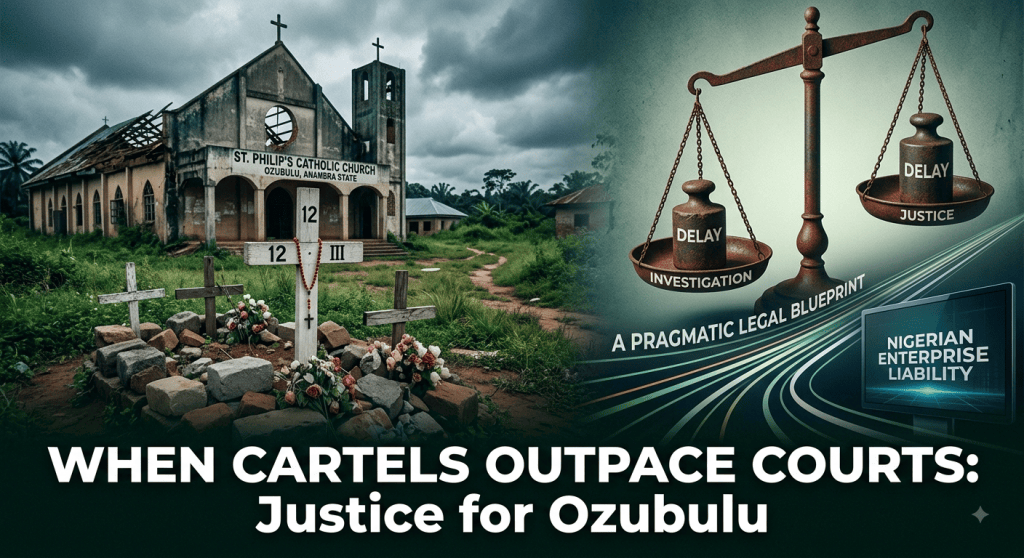
On the morning of August 6, 2017, gunmen stormed St. Philip’s Catholic Church in Ozubulu, Anambra State. When the gunfire ceased, at least a dozen worshippers lay dead on the pews, including the elderly father of the intended target.
It was a tragedy that shocked the nation, but the real narrative that emerged was far more sinister: this was not a sectarian attack or bandit raid, but a bloody spillover of a transnational drug turf war waged between Johannesburg and rural Anambra. The target was a wealthy community benefactor known locally as “Bishop.” The assailants didn’t find him, so they shot everyone else instead.
Nearly a decade later, if you ask where the convictions are, the room falls silent.
The Ozubulu tragedy is not merely a grim anniversary; it is an indictment of a criminal justice architecture designed for village livestock disputes being forced to process 21st-century syndicated crime.
The Anatomy of an Investigative Collapse
When the initial outrage cooled, the standard Nigerian criminal justice playbook took over. Four local suspects were rounded up and slapped with a 25-count charge at the Anambra State High Court in Nnewi.
Then reality set in:
- Forensics in Absentia: Ballistic evidence that could tie specific firearms to specific shooters was virtually non-existent.
- The Peril of Testimony: In an environment where the state cannot guarantee the safety of an eyewitness, key prosecution witnesses did what anyone with a survival instinct does. They recanted statements, gave conflicting accounts, or disappeared into the woodwork.
- The Transnational Impasse: The alleged masterminds who ordered the hit were sitting comfortably inside South African prisons, serving sentences for unrelated gang warfare. Nigeria’s extradition machinery clashed with foreign legal barriers, diplomatic red tape, and bureaucratic paralysis.
The local trial dragged across years of endless adjournments, while the actual masterminds remained out of reach. It was a complete procedural stall.
Fighting Drones with Bows and Arrows
Nigeria’s criminal investigation structure suffers from an evidential burden that assumes an idealized world: a pristine crime scene, cooperative witnesses, and localized crime.
On one side sits a 19th-century system that relies almost entirely on eyewitness memory, fragile paper-trail evidence, and local police station limits. On the other side sits 21st-century crime: cross-border cartel logistics, heavily armed syndicates, and systematic witness intimidation.
When criminal enterprise evolves from local burglary to multi-million-dollar transnational cartels, expecting poorly funded state police commands to build an airtight case using 19th-century evidentiary rules is an exercise in futility.
How the West Squared the Circle: Special Rules for Special Crimes
Nigeria often looks to Western jurisprudence as a model of procedural purity, conveniently ignoring how Western nations adapted their own rulebooks when reality outpaced their courts.
When organized crime tore through the United States in the mid-20th century, the traditional rules of evidence failed to touch the kingpins insulated by layers of underlings. The response? RICO (Racketeer Influenced and Corrupt Organizations Act). The law redefined culpability, allowing prosecutors to convict bosses not for pulling the trigger, but for operating the enterprise.
When the UK and the wider West confronted modern terrorism, they did not stubbornly pretend normal criminal burdens would suffice. They enacted:
- Specialized anti-terror legislation with expanded detention windows for complex investigations.
- Special Advocate procedures and closed material proceedings to handle sensitive intelligence without exposing vulnerable sources.
- Statutory inferences and lower evidential thresholds for cross-border financial and conspiracy charges.
They recognized a fundamental truth: When crime mutates, the machinery of justice must mutate with it.
Squaring the Circle: A Pragmatic Blueprint for Nigeria
Nigeria’s legal system cannot simply wait for forensic labs to materialize across all 774 Local Government Areas. It needs a pragmatic legal framework that accounts for the country’s actual capabilities and vulnerabilities:
- Nigerian Enterprise Liability Law: The current system requires a direct link to the physical crime scene. Nigeria needs enterprise liability legislation to allow conspiracy convictions based on financial tracking and communications metadata, holding bosses liable for gang actions without needing an eyewitness to the trigger pull.
- Anonymized and Remote Testimony: Open-court testimony without state protection guarantees witness silence. Statutory frameworks permitting pre-recorded depositions and identity-shielded digital cross-examinations are essential for cartel trials.
- Bilateral Fast-Track Treaties: Instead of endless diplomatic red tape and dormant extradition files, Nigeria needs direct bilateral treaties with key hubs like South Africa to permit specialized virtual cross-border trials or joint prosecutorial task forces.
- Specialized Organized Crime Tribunals: To prevent trials from languishing for years through routine adjournments, specialized fast-track courts should be instituted with strict statutory limits on trial duration and adjournments.
The Cost of Inaction
Justice for Ozubulu, and countless other tragedies like it, did not fail because police officers didn’t care; it failed because our judicial apparatus is fundamentally misaligned with the nature of modern organized crime.
If the Nigerian state insists on running modern criminal syndicates through a system that relies on terrified eyewitnesses and sluggish paper filings, the outcome will remain unchanged: sensational headlines, symbolic arraignments, and zero convictions.
It is time to square the circle. Modern crime demands a modern legal architecture.

