

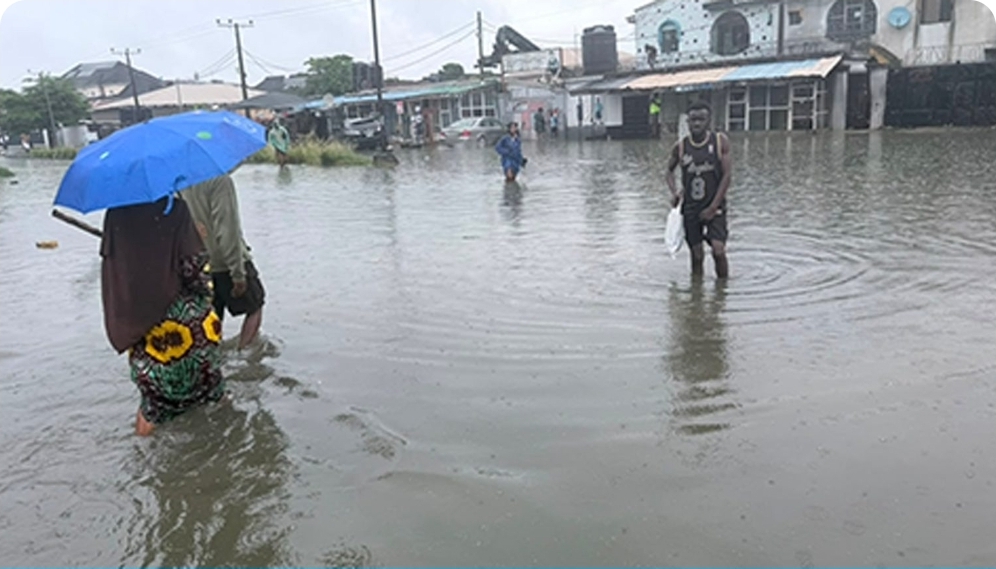

For centuries, Lagos has lived in a delicate relationship with water. Built on lagoons, creeks, wetlands and barrier islands, the city has always existed at the mercy of the Atlantic Ocean. Climate change, rising sea levels and rapid urbanisation have only made that relationship more fragile.
Recent unseasonal flooding across parts of Lagos has once again raised difficult questions about whether government infrastructure projects are being planned with sufficient regard for environmental consequences. In particular, attention has focused on the Lagos-Calabar Coastal Highway and whether the project may have altered drainage patterns or aggravated flooding in vulnerable communities.
Whether the highway is directly responsible for the flooding remains a matter requiring scientific investigation. However, a more fundamental question has emerged: was the project subjected to a legally required Environmental Impact Assessment (EIA) before construction commenced?
The answer to that question appears to be more complicated than the Federal Government would like Nigerians to believe.
The Question the Minister Did Not Want to Answer
At a recent media engagement, Arise News reporter Laila Salami asked the Minister of Works, Dave Umahi, a straightforward question.
She noted that the Environmental Impact Assessment Act requires an EIA to be approved before the commencement of a project and asked whether such approval had been obtained for the Coastal Highway.
Rather than directly answering the question, the exchange quickly became uncomfortable.
The reporter asked whether an exemption had been granted and whether the preliminary approval, which the Minister referred to, could be made available to the public.
The Minister’s responses were notable.
He repeatedly insisted that “everything is in order” and that the government was “following due process.” However, despite several invitations to do so, he neither produced the approval nor clearly stated whether a final Environmental Impact Assessment approval existed before construction commenced.
In most mature democracies, that should have been the end of the matter. The public would simply request the document and examine it.
But Nigeria has developed a peculiar culture of governance in which public officials often treat requests for public documents as acts of personal disrespect rather than legitimate demands for accountability.
The irony is that environmental approvals do not belong to ministers. They belong to the public.
The environment certainly belongs to the public.
And the consequences of environmental mistakes are suffered by the public.
What the Bureau of Public Procurement Revealed
Fortunately, another arm of government appears to have answered the question more directly.
A review document issued during the procurement process by the Bureau of Public Procurement (BPP) paints a troubling picture of the project’s preparation.
The BPP review identified numerous deficiencies in the documentation submitted by the Federal Ministry of Works.
Among its observations were:
Engineering design details were not forwarded.
The Ministry did not identify who prepared the tender documents.
Financial and economic studies were not provided.
Feasibility studies were not provided.
Environmental Impact Assessment reports were not provided.
Most significantly, the Bureau stated:
> “No Environmental Impact Assessment (EIA) reports were forwarded along with this request. The FMW should note that EIA is part of project preparation.”
That statement is devastating.
Not because it proves environmental harm occurred.
Not because it proves the project should never have been undertaken.
But because it suggests that one of the most basic legal requirements for major infrastructure projects had not been completed when procurement processes were already underway.
The Bureau’s language is especially important.
It did not say the EIA was under review.
It did not say the EIA was awaiting final approval.
It did not say the EIA had been submitted separately.
It stated that no EIA reports were forwarded and reminded the Ministry that an EIA forms part of project preparation.
In other words, the Bureau appeared to be telling the Ministry something that should have been obvious from the start.
Why Environmental Impact Assessments Matter
Environmental Impact Assessments are often treated by politicians as bureaucratic obstacles.
They are not.
They are risk management tools.
Their purpose is to identify foreseeable environmental consequences before construction begins.
For a project such as the Lagos-Calabar Coastal Highway, an EIA would ordinarily examine:
Coastal erosion.
Flood risks.
Water flow and drainage patterns.
Impact on wetlands.
Impact on local communities.
Long-term effects on marine ecosystems.
Climate resilience.
The purpose is not necessarily to stop a project.
Rather, it is to identify potential problems and design solutions before billions of naira have been spent and before communities begin suffering unintended consequences.
An EIA is much cheaper than rebuilding damaged infrastructure.
It is far cheaper than compensating displaced residents.
And it is infinitely cheaper than repairing environmental damage that could have been prevented.
Lagos Is Not a City That Can Afford Guesswork
Lagos is uniquely vulnerable.
Scientists and urban planners have repeatedly warned that large portions of the city face increasing risks from rising sea levels and coastal flooding.
The city is already experiencing:
Increased tidal flooding.
Coastal erosion.
Land subsidence.
Pressure on drainage systems.
Extensive loss of wetlands.
In simple terms, Lagos is a city where every major construction project near the coastline should be subjected to the highest environmental scrutiny possible.
Instead, Nigerians are left trying to determine whether the relevant studies existed before construction started.
That uncertainty alone represents a failure of governance.
When governments follow due process, they do not need to ask citizens to trust them.
They simply produce the documents.
Due Process Is Not a State of Mind
One of the recurring themes in Nigerian governance is the phrase “we followed due process.”
Unfortunately, due process is not established by assertion.
It is established by evidence.
A minister saying due process was followed is not proof that due process was followed.
A document demonstrating compliance is proof.
This is particularly important because the Environmental Impact Assessment Act was enacted precisely to prevent governments from approving major projects first and asking environmental questions later.
The law recognises a simple reality: once a project has commenced, enormous political and financial pressure develops to continue regardless of environmental consequences.
That is why assessment comes first.
Construction comes second.
Not the other way round.
The Cost of Weak Environmental Governance
The recent flooding may ultimately be shown to have no connection whatsoever to the Coastal Highway.
Rainfall patterns may explain everything.
Climate change may explain everything.
Poor drainage management may explain everything.
Or the answer may involve a combination of all three.
But that is precisely why environmental assessments matter.
They provide data.
They provide modelling.
They provide evidence.
Without them, policymakers are reduced to speculation and citizens are left debating social media theories.
The larger issue is not merely whether the Coastal Highway contributed to flooding.
The larger issue is whether Nigeria’s public institutions continue to treat legal compliance as optional whenever a project is politically important enough.
That approach may win short-term political victories.
It rarely produces sustainable development.
The Real Question
The controversy surrounding the Coastal Highway ultimately boils down to a very simple question.
If the Environmental Impact Assessment was completed before construction commenced, why not publish it?
If preliminary approval existed, why not release it?
If due process was followed, why not demonstrate it?
Transparency would end the debate almost immediately.
Until then, Nigerians are left with an uncomfortable situation in which a journalist’s straightforward question remains unanswered, while a government procurement review appears to suggest that a key component of project preparation was missing.
For a city already fighting the Atlantic Ocean, that is not a reassuring position to be in.
And for a government that insists everything is in order, producing the paperwork would be far more persuasive than demanding the public simply take its word for it.

