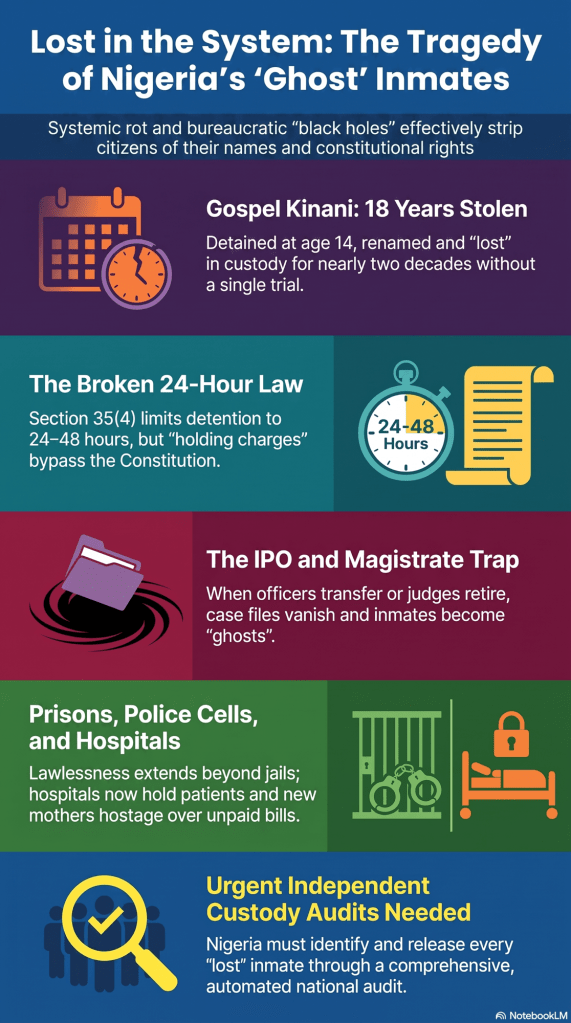

Gospel Kinani’s Case: In a story described as “devastatingly real,” a 14-year-old boy who disappeared in 2007 was found alive 18 years later in a Port Harcourt correctional facility, sparking a 10 billion naira lawsuit.
We love a good international incident. Let a Nigerian get locked up under questionable circumstances in the UK, South Africa, or anywhere across the diaspora, and our collective outrage peaks. We trend hashtags, demand diplomatic interventions, and fiercely debate the injustice of it all.
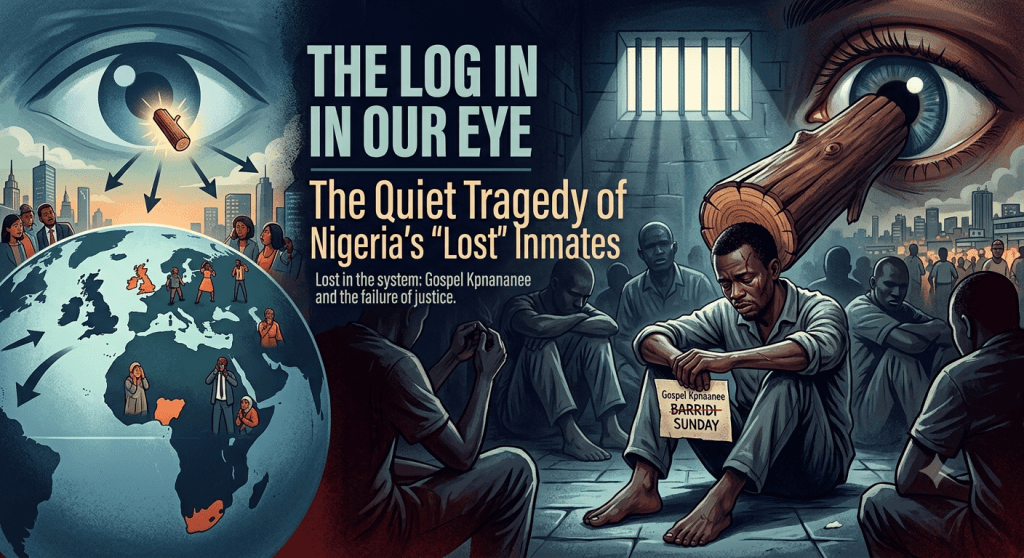
Yet, while we stare intently at the speck in the global eye, we blissfully ignore the massive, rotting log wedged firmly in our own.
The grim reality of the Nigerian justice system was laid bare recently in a devastating report by Arise News. In 2007, a 14-year-old boy named Gospel Kinani disappeared from Ogoniland, Rivers State. For nearly two decades, his family searched for him in vain; the profound grief even claimed the lives of both his parents. Eighteen years later, Gospel was finally found not dead, but alive, broken, and languishing inside the Port Harcourt Correctional Center at 33 years old.
How does a child vanish into the state’s custody for 18 years without a case file, an official charge, or a single court appearance? Simple: the system stripped him of his name, dubbed him “Barridi Sunday,” and effectively erased him from existence.
While political trials and high-society arrests dominate our headlines and satisfy our appetite for drama, it is these “lost in custody” cases that represent the true, systemic rot, a complete and utter disregard for the fundamental human rights of ordinary Nigerians.
The Constitutional Clock vs. Bureaucratic Black Holes
On paper, the Federal Republic of Nigeria possesses a clear framework designed to prevent arbitrary detention. Section 35(4) of the 1999 Constitution dictates a strict statutory timetable for keeping suspects in custody before bringing them before a court of law.
Under these constitutional guidelines, if a suspect is arrested in a jurisdiction where a court is located within a 40-kilometer radius, the maximum detention limit is strictly 24 hours. In more remote areas where no accessible court exists within that distance, the law extends this limit to 48 hours, or a longer period that the court itself deems reasonable under the circumstances.
Furthermore, if a suspect is not officially brought to trial within two months from the date of their incarceration while remaining in custody, or within three months if they have been released on bail, they are constitutionally entitled to be released unconditionally or under the necessary conditions to ensure they appear for trial at a later date.
That is the theory. The practice, however, is a dystopian nightmare.
The Constitutional Clock vs. Bureaucratic Black Holes
On paper, the Federal Republic of Nigeria possesses a clear framework designed to prevent arbitrary detention. Section 35(4) of the 1999 Constitution dictates a strict statutory timetable for keeping suspects in custody before bringing them before a court of law.
Under these constitutional guidelines, if a suspect is arrested in a jurisdiction where a court is located within a 40-kilometer radius, the maximum detention limit is strictly 24 hours. In more remote areas where no accessible court exists within that distance, the law extends this limit to 48 hours, or a longer period that the court itself deems reasonable under the circumstances.
Furthermore, if a suspect is not officially brought to trial within two months from the date of their incarceration while remaining in custody, or within three months if they have been released on bail, they are constitutionally entitled to be released unconditionally or under the necessary conditions to ensure they appear for trial at a later date.
That is the theory. The practice, however, is a dystopian nightmare.
The “IPO and Magistrate” Trap: How the Clock Resets
In the underbelly of Nigerian law enforcement, a suspect’s freedom is routinely tethered to exactly two people: the Investigating Police Officer (IPO) and the presiding Magistrate.
The moment a suspect is remanded into custody often via questionable “holding charges” designed to bypass the 24-hour rule the bureaucratic waiting game begins. But what happens when the IPO is suddenly transferred to another state? What happens when the Magistrate quietly retires, takes a medical leave, or is elevated to a higher bench before the disposition of the matter?
The clock resets.
The case file stalls in a dusty cabinet. The new IPO has to start from scratch (if they bother at all), and the new Magistrate must wait for the matter to be re-assigned. Meanwhile, the suspect, lacking a loud voice or a deep pocket, transitions from an “awaiting-trial person” into a ghost. They become a number, or worse, a falsified name like Barridi Sunday, buried alive under institutional apathy.
The Failure of the Safeguards
The law isn’t entirely blind to this risk. Statutorily, there are supposed to be built-in fail-safes. Visiting Magistrates are required to inspect local police cells, and the Administration of Criminal Justice Act (ACJA) mandates police officers to report a summary of arrests to nearby Magistrates. Furthermore, Chief Judges of the states have the legal authority to conduct prison audits and summarily release individuals held unlawfully.
But as Dr. Reuben Abati pointed out during the Arise News broadcast, these interventions are desperately few and far between. They rely entirely on the extraordinary diligence of specific judges rather than a functioning, automated system. Gospel Kpnananee only tasted freedom because Chief Judge Simeon Amadi happened to conduct an audit. If not for that rare stroke of judicial luck, Gospel could have very well died in custody, anonymous and unavenged.
No Safe Haven: Stations, Prisons, and Hospitals
The terrifying truth is that there are currently no effective, automated safeguarding mechanisms anywhere.
- Police Stations: Suspects are routinely swept up for non-offenses like “wandering” or “loitering”—relics of colonial laws that have no place in modern Nigerian jurisprudence. If you cannot produce an ID card or a bribe on the spot, you are dumped into a van and disappears into the system.
- Prisons: Our correctional centers are notoriously congested, packed to the brim with awaiting-trial inmates who have spent more time in detention than the maximum sentence of the crimes they were originally accused of committing.
- Hospitals: This lawlessness isn’t restricted to iron bars. Private and public hospitals across Nigeria regularly turn into makeshift detention camps, holding patients and sometimes new mothers hostage for months on end because they cannot afford to settle their medical bills.
Time for an Uncompromising Audit
We cannot rightfully complain about how foreign nations treat our citizens when our own government treats its people like disposable livestock.
The Gospel Kpnananee story must not be treated as a one-off tragedy. It is a flashing red siren signaling a systemic emergency. There must be an immediate, comprehensive, and independent audit of every single correctional center and police cell in Nigeria. Every “Barridi Sunday” needs their real name back.
If the state can seamlessly track political dissidents and high-profile tax evaders, it has absolutely no excuse for “losing” a 14-year-old child for half his life. It’s time to clear the log from our eyes.