


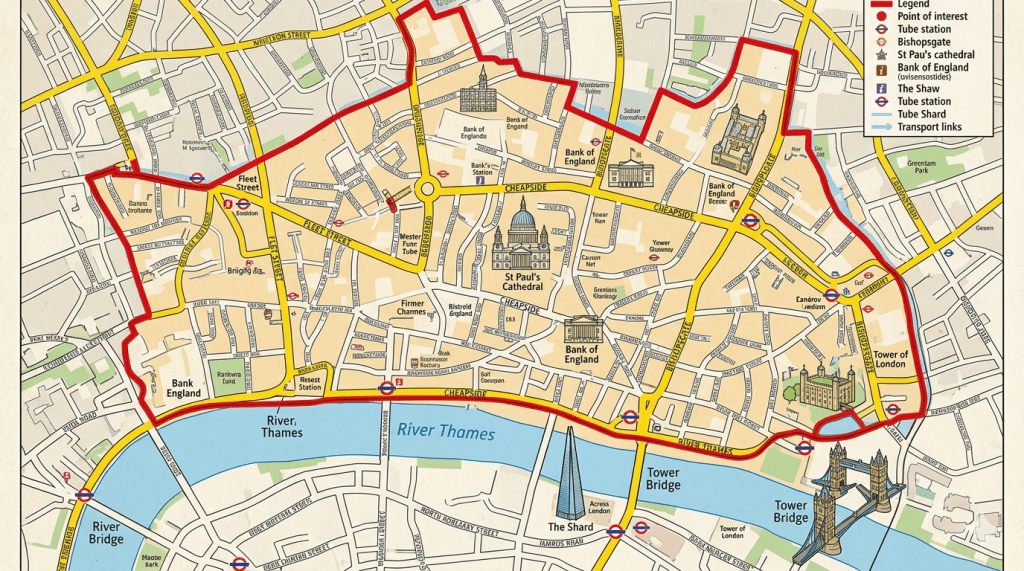
The City of London’s autonomy is one of British history’s most enduring quirks: a tiny 1.1-square-mile enclave (the “Square Mile”) with roots stretching back over 2,000 years that has preserved medieval-style self-governance while becoming the world’s pre-eminent financial district.
Its special status isn’t the conspiracy-level independence claimed in some viral posts (it is fully subject to UK parliamentary sovereignty and national law), but it does stem from a long chain of royal charters, exemptions from national reforms, and a business-weighted voting system that has survived into the 21st century. Here’s a clear, chronological exploration based on historical records.Roman and Anglo-Saxon Foundations (47 AD – 1066)
The area that became the City of London began as the Roman settlement of Londinium around 47 AD, a major commercial port protected by walls built between 190–225 AD. After Roman withdrawal in 410 AD, the walled core was largely abandoned until Alfred the Great reoccupied and fortified it in 886 AD as “Lundenburg,” appointing an alderman (a term still used today) to oversee it.
This early autonomy as a trading hub under royal protection set the template: the City was a distinct entity that paid taxes directly to the king rather than to feudal lords.
Norman Charters and the Birth of the Corporation (1066–1215)
After the Norman Conquest, William the Conqueror issued a charter around 1067 confirming the City’s “ancient liberties” from Edward the Confessor’s reign.
This was not a new grant but recognition of pre-existing rights. By 1132 the City elected its own sheriffs; by 1189 it won the right to choose its own mayor (later styled Lord Mayor). King John’s charter in 1215 (the same year as Magna Carta) formally recognized the City as a “commune” with annual mayoral elections.
Magna Carta’s Clause IX explicitly protected the City’s “ancient liberties and customs,” a provision that remains on the statute books today. The Corporation of the City of London (officially “The Mayor and Commonalty and Citizens of the City of London”) is considered incorporated “by prescription” meaning its legal existence was assumed because of centuries of continuous operation, not a single founding document.
Medieval Peak: Guilds, Wards, and Self-Rule (13th–17th Centuries)
The Corporation’s structure crystallized around 25 ancient wards (each with an alderman), the Court of Aldermen, and the Court of Common Council. Power was closely tied to the livery companies (medieval guilds such as the Goldsmiths, Mercers, etc.), whose members became “freemen” entitled to trade and participate in governance. The “Freedom of the City” (still awarded today) originally meant the right to trade without feudal interference.
Conflicts with the Crown were common.
The City raised armies, lent money to kings, and sometimes defied them. During the Peasants’ Revolt (1381) and other uprisings, citizens defended their walls. The 1630s saw Charles I’s attempt to expand royal control rebuffed in the “great refusal.” After the Great Fire of 1666, the City rebuilt on its medieval street plan and retained its separate sewers commission.
Early Modern Challenges and Restoration (17th–18th Centuries)
Charles II briefly stripped the Corporation’s privileges via a 1683 writ of quo warranto (questioning by what authority it existed). After the Glorious Revolution, Parliament restored them in 1690, confirming the City’s rights by statute rather than royal whim.
This episode underscored a key reality: the City’s autonomy ultimately depended on parliamentary consent, not absolute independence.
The Bank of England (1694) and Royal Exchange anchored the Square Mile as Britain’s financial heart, but the City remained a self-governing entity separate from the growing metropolis outside its walls.19th Century: Exemption from National Reforms
The Municipal Corporations Act 1835 radically reformed most English boroughs to make them more democratic and accountable. The City of London was deliberately exempted because its existing franchise was already considered broader (including business interests). A 1894 Royal Commission recommended amalgamation with surrounding London, but a change of government killed the plan. The City kept its ancient structure while the rest of London modernized.
20th–21st Centuries: Business Votes, Limited Reforms, and Continuity
- 1948: The City lost its separate parliamentary constituency (merged into Cities of London and Westminster).
- 1969/2002: The business vote (non-residents and companies voting in local elections) was preserved when it was abolished elsewhere. The City of London (Ward Elections) Act 2002 actually expanded it: firms appoint voters based on workforce size (one vote per 10 employees, scaling up). Today roughly 24,000 business voters vastly outnumber the 9,000 residents. en.wikipedia.org
- The Corporation retains its own police force (City of London Police), courts (including the Old Bailey), markets, and ownership of large green spaces outside the Square Mile (Epping Forest, Hampstead Heath).
- It has a Remembrancer who sits in Parliament to protect the City’s privileges, an official lobbyist role dating back centuries.
Major 20th-century events (Blitz, IRA bombings) led to the “ring of steel” security perimeter, but the governance model survived unchanged. The Corporation is now a sui generis local authority treated like a London borough for some purposes but with unique powers.
Myths vs. Reality: “State Within a State”?Popular narratives (including the X post that started this conversation) describe the City as operating “outside UK law,” with its own government, police, and mayor, acting as an offshore tax haven immune to Parliament. These claims exaggerate:
- Sovereignty: The City acknowledges Crown and parliamentary supremacy. The monarch’s ceremonial pause at Temple Bar is symbolic, not a legal barrier. Parliament could abolish or merge the Corporation tomorrow; it simply hasn’t. faisalkhan.com
- Legal status: UK laws (including tax, financial regulation, and human rights) fully apply. It is not exempt from parliamentary authority.
- Influence: Critics (e.g., George Monbiot, Nicholas Shaxson) argue the business-dominated system and Remembrancer give finance outsized lobbying power, and the City’s historical role helped seed Britain’s network of overseas tax havens. But the Square Mile itself is not a tax haven.
In short, the City’s autonomy is real but bounded: a medieval corporation that dodged 19th-century reforms, adapted to modern finance, and retains ceremonial and practical privileges no other UK local authority enjoys. It evolved from a walled Roman trading post into a self-perpetuating financial guild that has outlasted kings, fires, wars, and multiple attempts at reform while remaining firmly inside the United Kingdom.


Good
LikeLiked by 1 person