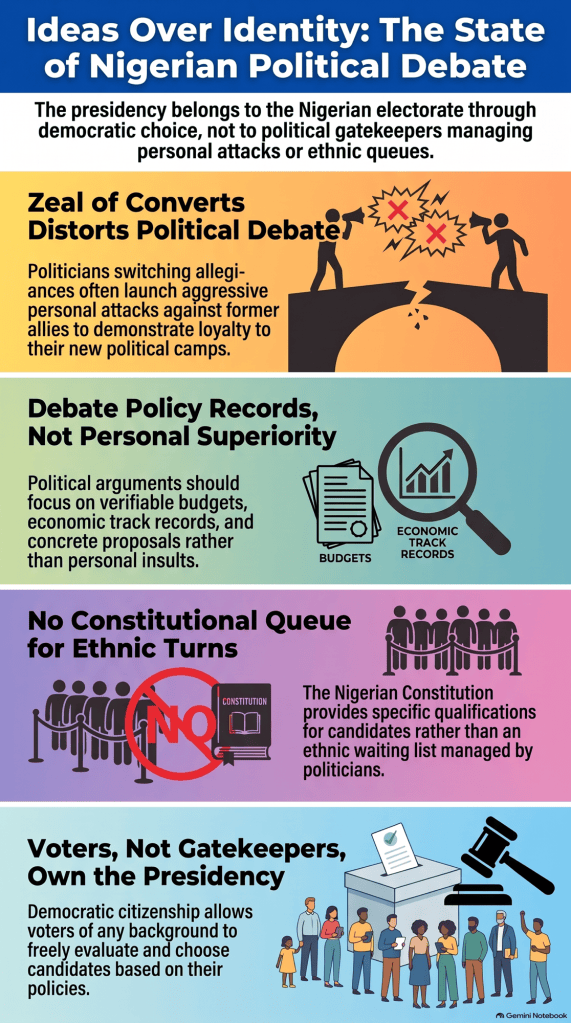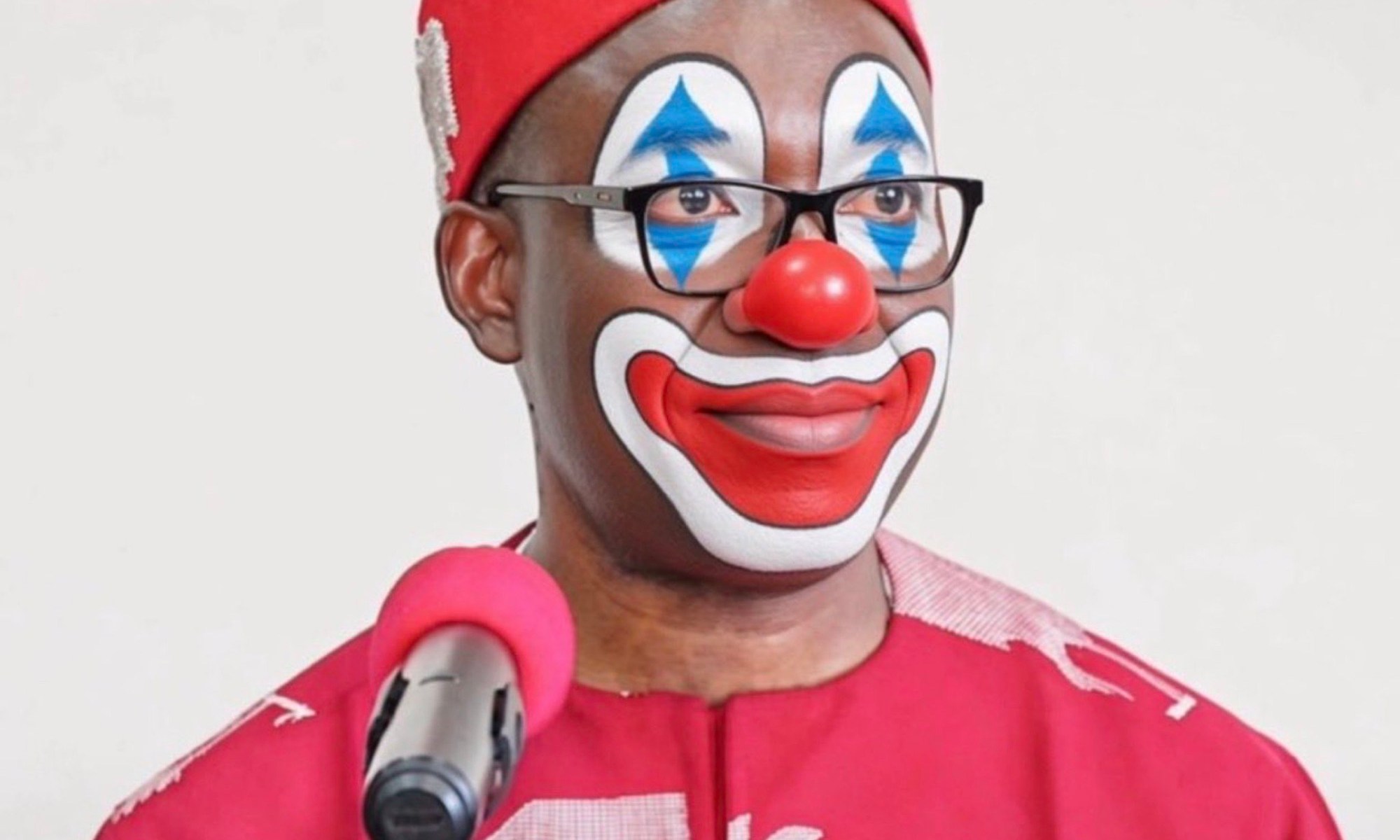
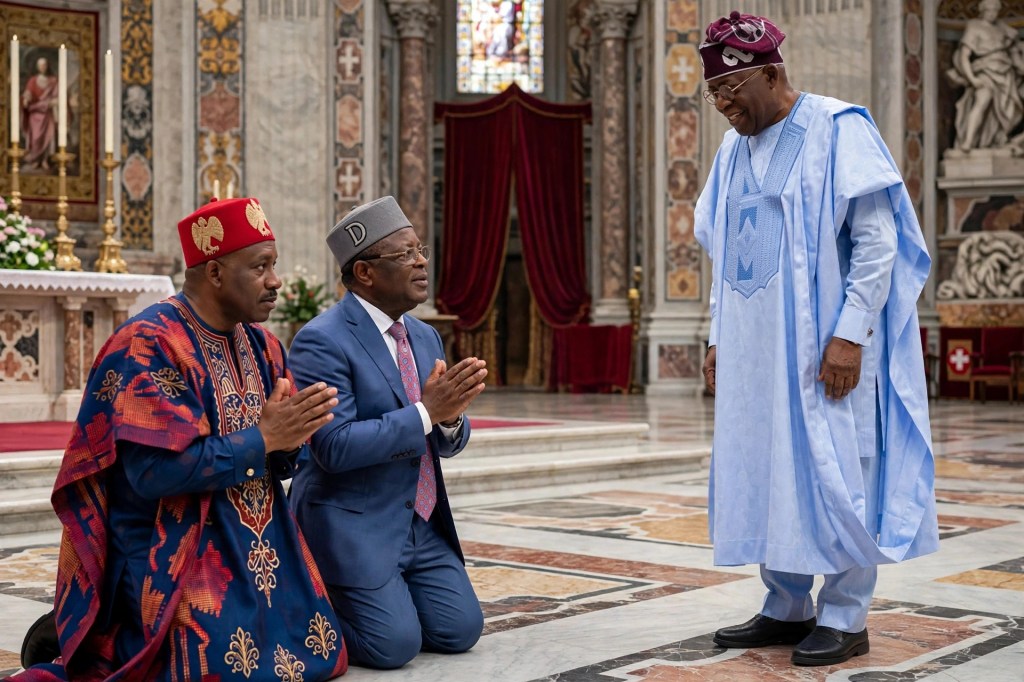
There is a striking political phenomenon in Nigerian politics: the convert can sometimes become more zealous than those who were never required to convert.
It is said that converts are often more Catholic than the Pope. Perhaps it is the psychology of a new allegiance. Having crossed the bridge, the convert feels compelled to demonstrate that the crossing was not accidental. The old position must therefore be denounced with greater enthusiasm, the new position defended with greater fervour, and sometimes the former fellow travellers treated as though they have committed the original sin.
That thought comes to mind when watching the increasingly vigorous attacks on Peter Obi by Charles Chukwuma Soludo, Governor of Anambra State, and Dave Umahi, Minister of Works and former Governor of Ebonyi State.
The irony is difficult to miss.
Both men were once part of the political family around Obi. Today, their political trajectories place them firmly within the governing establishment supporting President Bola Tinubu. That is perfectly legitimate. Politicians change parties, alliances and political philosophies. Democracy would be a rather dull enterprise if nobody were permitted to change his mind.
But changing political allegiance is one thing.
Trying to prove the validity of the new allegiance by relentlessly diminishing the old one is another.
The argument that never quite reaches policy
The most interesting feature of the Soludo-Umahi campaign against Obi is not that they disagree with him.
They should disagree with him.
They should challenge his economics. They should interrogate his record as governor. They should examine his proposals for the Nigerian economy. They should explain why Tinubu’s policies are preferable. They should demonstrate where Obi’s political prescriptions would fail.
That is what political argument is supposed to look like.
Instead, too much of the conversation has become personal.
Soludo and the Anambra government have repeatedly engaged Obi over his record in the state, including claims concerning debts and the financial position he left behind. The administration has also disputed Obi’s claim that he saved more than $150 million for Anambra.
Those are legitimate matters for political debate.
Show us the figures. Show us the accounts. Show us the budgets. Show us the projects. Show us the evidence.
That would be a proper argument between politicians.
But when political disagreement becomes a contest over who is intellectually superior, who has done more for the South-East, or who is entitled to claim political legitimacy, the argument starts moving away from policy and towards personality.
And that is where the convert’s zeal begins to show.
Then comes the extraordinary argument about whose “turn” it is
Dave Umahi recently took the argument to an altogether different place.
Speaking in Benin City, he said that Peter Obi was not superior to him in intellectual capacity, background or record of service. He then declared:
“It is not the turn of Igbos yet.”
He went on to say that the Igbo would one day become president, but that “it is the turn of President Bola Ahmed Tinubu.”
This deserves careful consideration because it reveals something much bigger than a quarrel between two politicians.
Since when did the presidency of Nigeria become a rotational office whose queue is controlled by politicians?
Nigeria’s Constitution does not contain a provision saying that an ethnic group must wait for its turn before producing a president.
The constitutional qualification is not:
Have you waited long enough?
It is not:
Has your ethnic group completed its turn?
And it certainly is not:
Has the incumbent’s political camp decided that your time has arrived?
The constitutional question is whether a candidate satisfies the requirements for election.
The electorate then decides.
That is the whole point of an election.
The dangerous simplicity of “our turn”
There is a particular irony here.
The language of turn has always been part of Nigerian political conversation because Nigeria is a country of many competing identities, regions and political interests. Rotation can be a useful political bargain where parties voluntarily adopt it as an internal arrangement.
But there is a profound difference between saying:
“Our party has agreed to rotate its ticket.”
and saying:
“Your ethnic group must wait because it is not your turn.”
The first is party politics.
The second begins to sound like ownership of the Nigerian presidency by an informal political cartel.
And once that principle is accepted, every Nigerian can ask the obvious question:
Who keeps the queue?
Who decides who has waited long enough?
Who determines whether an ethnic group has served its political apprenticeship?
Who stamped the passport of political entitlement?
There is no constitutional answer because there is no constitutional queue.
Obi does not need an ethnic entitlement
There is another point worth making.
Peter Obi does not need to be supported simply because he is Igbo.
That would be to make the same mistake in reverse.
If Obi is to become president, the argument should be that Nigerians, irrespective of ethnicity, consider his policies, record and political programme worthy of their votes.
An Igbo voter should be free to vote for Obi.
An Igbo voter should equally be free to vote for Tinubu, Atiku, another candidate or nobody.
A Yoruba voter can vote for Obi.
A Hausa voter can vote for Obi.
A Fulani voter can vote for Obi.
An Ijaw voter can vote for Obi.
A Nigerian of any ethnic background can support whichever candidate they choose.
That is what citizenship means.
The retired Catholic Archbishop of Abuja, John Onaiyekan, recently made essentially this point, arguing that Ndigbo should be allowed to choose their preferred presidential candidate freely and that governors should not determine how people vote.
It is difficult to imagine a more elementary proposition in a democracy.
Criticise Obi. By all means.
There is nothing sacred about Peter Obi.
He was Governor of Anambra State. His record is therefore open to examination. His claims are open to challenge. His economic ideas are open to criticism. His presidential ambitions are open to opposition.
If Soludo believes Obi’s record is exaggerated, produce the evidence.
If Umahi believes his own record is superior, produce the evidence.
If Tinubu’s economic programme is better, make the economic case.
If Obi’s presidential programme is defective, take it apart clause by clause.
That would be politics.
Indeed, that is precisely the sort of politics Nigeria desperately needs.
What Nigeria does not need is an argument in which political disagreement is converted into a personal examination of the opponent’s intellectual capacity, family background or supposed political entitlement.
Politics should be a marketplace of ideas, not a schoolyard argument over who is taller.
The strange psychology of the new allegiance
This is why the convert metaphor is so tempting.
Perhaps there is an understandable political psychology behind it.
A politician who has moved from one political camp to another may feel an unconscious need to demonstrate that the new allegiance is genuine. The easiest way to prove loyalty is sometimes to become more hostile to the former camp than those who were never members of it.
The former colleague becomes the new opponent.
The old political association becomes something to be explained away.
And yesterday’s ally suddenly becomes today’s political exhibit.
But there is a danger in this.
Political conversion should not require historical amnesia.
Soludo’s relationship with Obi is part of Nigerian political history. So is Umahi’s political journey. Nobody needs to pretend otherwise.
Nor should either man be condemned merely because he changed political allegiance. Politics is not a marriage in which crossing the floor automatically constitutes adultery.
But changing sides should not require one to rewrite the political meaning of the past.
The bigger issue is Nigeria itself
The question ultimately goes beyond Obi, Soludo and Umahi.
It concerns whether Nigerian politics will continue to be organised around ideas or identities, policies or personalities, constitutional citizenship or ethnic arithmetic.
Nigeria has spent too much of its history arguing about whose turn it is.
The better question is:
What will the person do when it is their turn?
What will they do about power?
What will they do about electricity?
What will they do about education?
What will they do about industrialisation?
What will they do about insecurity?
What will they do about the naira?
What will they do about corruption?
What will they do about a country in which citizens increasingly feel that government is something done to them rather than for them?
Those are questions worth answering.
Whether Peter Obi is better than Dave Umahi, or Charles Soludo, is ultimately a matter for voters to determine from the evidence.
Whether Tinubu’s policies deserve another mandate is similarly a matter for voters.
But one thing ought to be beyond argument:
No Nigerian ethnic group owns the presidency, and no politician owns the queue.
The presidency belongs to the Nigerian people.
The ballot box is the queue.
And Nigerians, not political gatekeepers, decide whose number is called.