
In the grand theatre of Nigerian public life, where contracts are signed with the solemnity of wedding vows and then abandoned with the enthusiasm of a jilted lover, few dramas have rivalled the Federal Republic of Nigeria v Process & Industrial Developments Ltd saga. The 2020 English High Court decision ([2020] EWHC 2379 (Comm)) was merely the intermission. The full production, complete with bribes, perjury and a near-$11 billion bill, only reached its denouement years later. Yet that September 2020 judgment by Sir Ross Cranston remains the pivotal moment when Nigeria was allowed, against all the usual arbitration orthodoxy of finality and speed, to drag the whole rotten affair into the light.
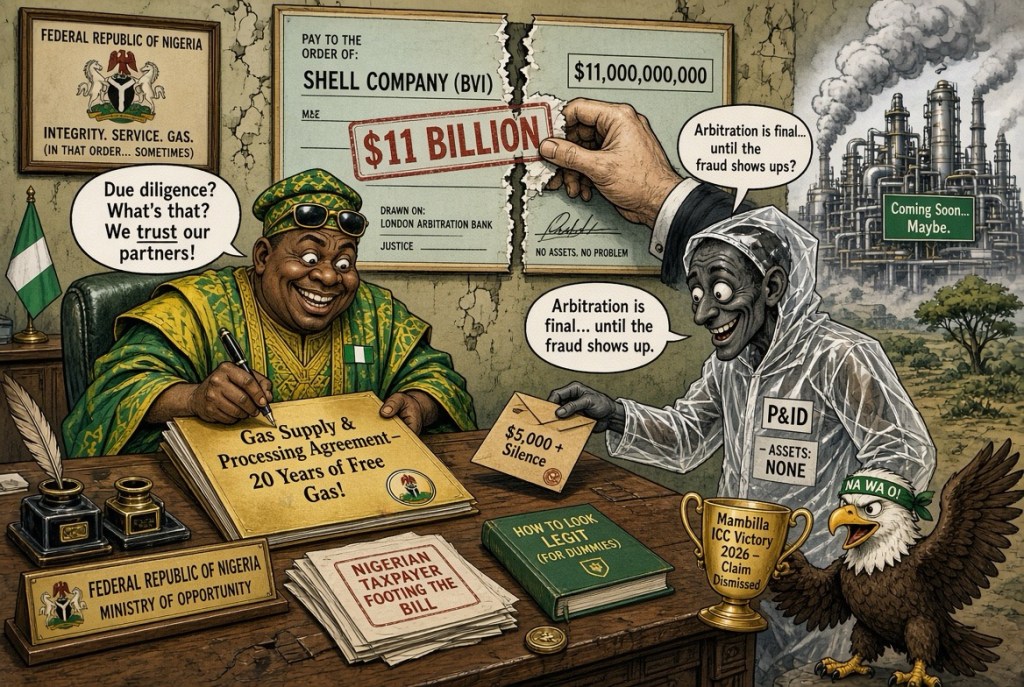
For those who prefer their legal history with a side of satire: in January 2010, Nigeria signed a Gas Supply and Processing Agreement with P&ID, a British Virgin Islands entity of the most ethereal variety. P&ID would, in theory, build a gas processing plant in Calabar. Nigeria would supply the wet gas free of charge. P&ID would strip out the valuable liquids, keep them, and hand back lean gas for power generation. Twenty years of this mutual beneficence was envisioned. Neither party performed. Nigeria did not deliver gas. P&ID did not build a plant. Cue arbitration in London. In 2015 the tribunal found Nigeria in repudiatory breach. In 2017 it awarded P&ID $6.6 billion in lost profits plus interest racing along at 7 per cent. By the time the matter reached Cranston J, the figure was already north of $10 billion enough to make a dent in the federal budget and leave ordinary Nigerians wondering whether their children’s school fees had been diverted into someone else’s arbitration war chest.
Nigeria’s challenge under sections 67 and 68 of the Arbitration Act 1996 arrived scandalously late, years after the usual 28-day window. Cranston J granted the extension of time. He found a strong prima facie case that the GSPA itself, the arbitration agreement and the awards had been procured by fraud: bribes paid to Nigerian officials (notably the Ministry of Petroleum Resources’ legal director Grace Taiga), false evidence about P&ID’s readiness and expenditure, and a general atmosphere of concealment. The delay, though “unprecedented,” was not the product of tactical lethargy or bad faith investigation. Fairness, public policy and the risk that the English court might otherwise become an unwitting vehicle for fraud tipped the scales. Finality is a virtue; it is not a suicide pact.
The subsequent 2023 trial before Mr Justice Robin Knowles confirmed what Cranston J had only glimpsed. The awards were set aside. P&ID had bribed Taiga around the time of contracting and continued the payments during the arbitration to buy her silence. It relied on knowingly false evidence from its founder Michael Quinn. It improperly retained privileged Nigerian legal documents that allowed it to monitor the state’s internal thinking. The arbitration, Knowles J observed with admirable understatement, “was not a fair fight.” The tribunal had worked with the materials it was given; those materials were poisoned.
Implications for Nigeria: The High Cost of Casual Contracting
The P&ID affair is a masterclass in how not to run a resource-rich state. First, due diligence appears to have been optional. A company with no track record, no assets of consequence and a suspiciously convenient set of engineering drawings (apparently recycled from an earlier, unrelated project) was waved through. Required approvals from the Bureau of Public Procurement, the Federal Executive Council and other gatekeepers were, on Nigeria’s own case, missing. The arbitration clause itself departed from the government’s preferred model. In short, the institutional scaffolding that is supposed to protect the public purse was treated as decorative.
Second, the case exposed the fragility of Nigeria’s legal defence in high-stakes international disputes. Allegations that some of Nigeria’s own counsel may have been compromised or that privileged documents leaked with alarming ease are not the sort of detail one wants circulating in London or Paris. When the other side is reading your strategy memos in real time, “zealous advocacy” takes on a rather different meaning.
Third, the financial stakes were existential. An $11 billion liability is not a rounding error; it is a structural threat. That Nigeria ultimately escaped payment is a victory. That it came so close, and only after years of expensive litigation funded by the same taxpayers who would have footed the award, is a cautionary tale written in capital letters.
Enter Mambilla: A Different Script, Same Genre
Fast-forward to September 2026 and the ICC tribunal’s dismissal of Sunrise Power’s claims over the long-delayed Mambilla hydropower project. Here, too, was a multi-billion-dollar dispute rooted in a 2003 build-operate-transfer agreement that never quite built or operated. Sunrise sought roughly $2.35 billion (with related claims pushing potential exposure higher still) and later pursued sums under a 2020 settlement arrangement that had itself become contested. The tribunal rejected the claims, ordered Sunrise and its promoter to reimburse a substantial portion of Nigeria’s legal costs, and cleared a major legal obstacle to the project’s progress.
The contrast is instructive. In P&ID, Nigeria was the late-arriving challenger fighting to set aside an already-issued award obtained amid serious irregularity. In Mambilla, Nigeria successfully defended at the arbitration stage itself. Different facts, different forums, different outcomes—yet the underlying pathology is recognisable: ambitious infrastructure contracts signed with more optimism than scrutiny, followed by years of legal trench warfare when performance evaporates.
Together the cases underline a few uncomfortable truths. International arbitration is not a neutral technocratic exercise when one party arrives with a shell company, selective disclosures and a willingness to grease palms. English courts, for all their deference to arbitral finality, will still intervene when fraud and public policy collide with sufficient force. And Nigerian institutions, when they bother to investigate thoroughly and instruct competent counsel who stay on the right side of privilege, can win.
The Satirical Bottom Line
Nigeria’s public sector has an uncanny talent for turning potential into litigation. Gas that was never delivered, plants that were never built, and power projects that remain stubbornly theoretical have generated more billable hours for London and Paris lawyers than megawatts for Nigerian homes. The 2020 Cranston judgment bought Nigeria the chance to prove the fraud; the 2023 Knowles judgment delivered the verdict. The recent Mambilla ICC award shows that sometimes the state can still close the door before the award is written.
The lesson is not that Nigeria should avoid international arbitration, contracts with foreign parties will continue to contain such clauses. It is that the state must treat contract formation with the seriousness currently reserved for the subsequent courtroom drama. Proper procurement, real due diligence, clean officials, and lawyers who do not confuse client documents with party favours would spare everyone a great deal of expensive theatre.
Until then, the script remains familiar: sign first, investigate later, litigate forever, and hope the English or French tribunal notices the smell before the cheque is written. Nigeria has now won two high-profile rounds. The next contract is already being drafted somewhere. One can only hope the ink is applied with more care than the last time.

