

In every functioning state, taxation is the social contract rendered arithmetical. The citizen pays; the state provides. In Nigeria, the citizen pays then pays again and the state mostly watches, occasionally collects the receipt.
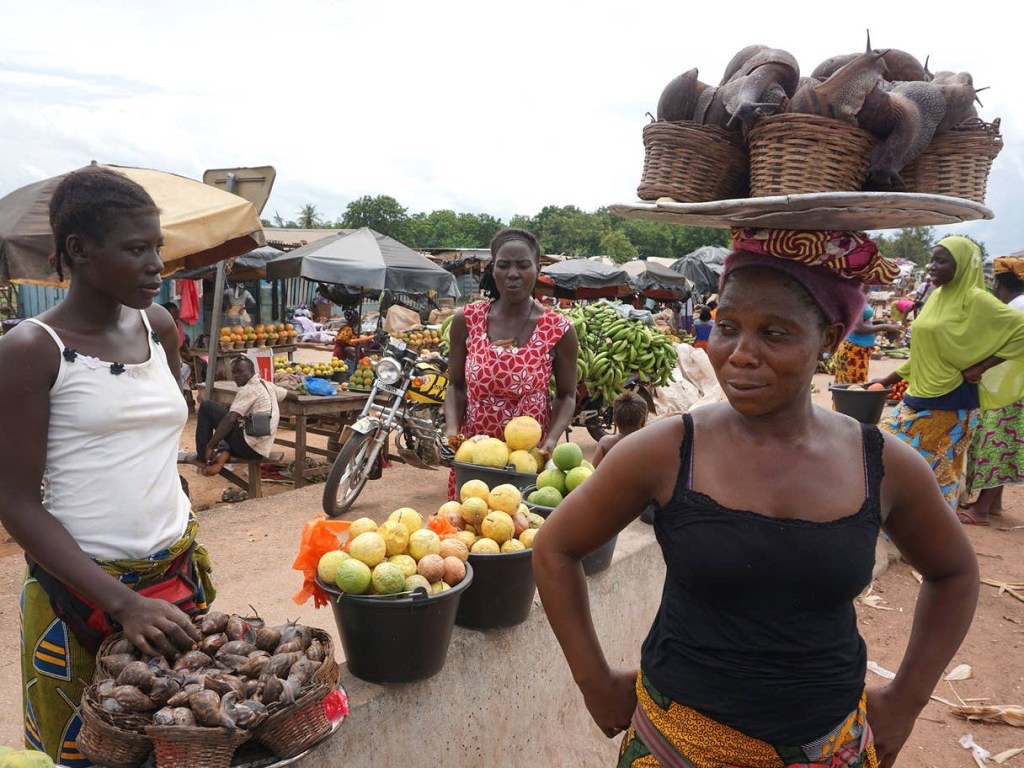
Meet Mama Chioma. She rises before dawn, wraps her wares in old newspapers against the harmattan chill, and makes her way to the local government market a concrete slab of ambition from the 1980s that has not been repaired since and will not be repaired again. She sells tomatoes, pepper, and garden eggs. She is, in the clinical vocabulary of the international financial institution, a participant in the informal economy. In the rather more honest vocabulary of lived Nigerian experience, she is a one-woman revenue authority, paying taxes to every power that presents itself with sufficient menace to collect.
Her ledger for the day has two columns. Not the orthodox columns of profit and loss those would require something approaching a margin. No, Mama Chioma’s columns are the governmental and the para-governmental: those who extract from her because the law authorises it, and those who extract from her because the law has absented itself entirely and left a vacuum that muscle has been good enough to fill.
Mama Chioma’s Daily Tax Ledger Market Day, Any Day, Any Year Description Column A: The State Column B: The Other State Market space Local government levy fixed, non-negotiable, regardless of whether she sells a single tomato Goods in transit Police roadblock levy: undocumented, unreceipted, constitutionally illegal, reliably collected Personal security Community “protection” fee to local enforcers whose relationship to the law is imaginative at best Market tax proper Flat-rate council tax: assessed on the stall, not the earnings a tax designed by people who have never not sold their full stock Going home Whatever the checkpoint found unconvincing about her vehicle’s documentation Net remainder for Mama Chioma after a full day’s trading: exercise left to the reader
Motion Without Movement
There is a phrase in physics more properly, a paradox describing the condition of being in perpetual activity while arriving nowhere. Mama Chioma has discovered it empirically. She is in motion. She is always in motion: up at five, at market by six, selling until four, home by six if the roads are kind, which they are not, because the roads are not roads in any sense that an engineer would recognise, merely a sequence of decisions by tarmac to give up at various intervals.
She moves. She bargains. She hauls. She pays. She moves again. And at the end of it she has moved in a large, exhausting, expensive circle back to where she started, minus whatever the morning’s gauntlet has extracted. The economists call this the poverty trap. The politicians call this the informal sector. Mama Chioma calls this Tuesday.
In every functioning state, taxation is the social contract rendered arithmetical. The citizen pays; the state provides. Nigeria has refined this formula: the citizen pays and then pays again and the state, having collected from both ends of the transaction, retires to consider the question of provision at a later date.
What is remarkable and here we must pause to admire the sheer architectural ingenuity of it is that each layer of extraction is administered with perfect bureaucratic seriousness. The local government levy comes with a receipt. The police roadblock does not come with a receipt but comes with a receipt-shaped gesture, a hand extended with the authority of the uniform behind it. The community protection fee is collected by young men who have clearly been on a course in civic seriousness, because they too present with a gravity entirely disproportionate to the moral status of their enterprise. Everyone has a form. Everyone has a schedule. Everyone, it seems, has a rate.
Coming Home to the Second Shift
She returns. The market is done. The day’s extractions are complete. One might suppose that having been comprehensively taxed by both the formal and informal apparatuses of the Nigerian state, Mama Chioma might at last be left in peace to enjoy whatever remains. One would be wrong.
The utilities are privatised. This is the word: privatised. It carries, in the development economics literature, a faint scent of efficiency, of optimisation, of the brisk handshake between capital and the consumer interest. What it means in practice is that the electricity when it condescends to arrive, which is not often and never on schedule is billed at rates that the distribution company sets with the confidence of a monopolist, which is exactly what it is. The Nigerian state collects payments for electricity through a labyrinthine structure of discos and generation companies and regulatory bodies, all of them interposed between the citizen and the commodity like a series of tollbooths on a road that leads nowhere in particular.
The electricity does not always come. The bill always does.
The drainage does not exist in the engineering sense of infrastructure designed to manage water. It exists in the geographic sense of a low-lying spot where water accumulates when it rains, which in southern Nigeria is regularly, forcefully, and without prior consultation. The flood arrives. The flood departs. It takes with it the week’s inventory stored on the ground, the children’s school things, and whatever precarious equilibrium the household economics had managed to achieve. The state has not built drainage. The state has, however, in several local governments, levied a development rate which notionally covers infrastructure of exactly this kind. The levy is collected. The infrastructure remains notional.
The road outside her house would not pass a road inspection conducted by anyone whose standard of comparison was a road. It is a geological feature. It was once tarmac. Evidence of this earlier identity remains in scattered fragments, like the remnants of a civilisation that was briefly promising and then thought better of it.
The Hospital, the School, and the Full-Cost Recovery of State Absence
When Mama Chioma or her children fall ill, they attend the General Hospital, which is what the building is called. Inside, a different taxonomy applies. The admission card is not free there is a charge. The drugs are not supplied there is a charge to purchase them from the pharmacist across the road, who has a reliable pipeline from the hospital’s own dispensary, an arrangement of entrepreneurial elegance that the hospital board has looked at closely and decided not to see. The injection materials needles, syringes, swabs are brought from outside. There is a charge. The bed, if available, has a charge associated with its use. The doctor’s attention, when it occurs, is bundled with an informal expectation of gratitude in material form.
The state, let us be clear, has not abandoned the hospital. The state has built the hospital, staffed the hospital, and structured the hospital’s budget such that it cannot function without charging its patients for every component of their care. This is a form of full-cost recovery that the World Bank would, in other contexts, describe as a fiscal discipline. In this context it is a sick woman paying for the needle that delivers the medicine that the government hospital does not have.
The market trader has, without a degree in public finance or the benefit of a consultancy retainer, produced a more accurate tax incidence analysis than anything currently circulating in Abuja. She knows what she pays, to whom, and for what. For what, alas, is the question that defeats her. The answer, in each case, is: nothing you would notice.
The school her child attends levies school fees, which is expected. It also levies a building development fund, a sports equipment levy, a PTA contribution (compulsory and recurring), a uniform fee assessed semi-annually, an examination preparation levy, and an annual prize-giving day contribution the school calls voluntary, in the same spirit that the police checkpoint calls its toll discretionary. The child learns in a classroom with a broken window and a blackboard last renewed when Obasanjo was still wearing khaki. The levies arrive quarterly with perfect punctuality.
As You Go Up the Food Chain
It would be a mistake to think this is a problem of the market stall. Ascend the economic ladder in the artisanal sense that Nigerian economic ladders permit, which is to say, grip carefully and do not trust the rungs and the structure replicates itself at each elevation with improved vocabulary and the same essential character.
The small business owner pays the market levy, the police levy, the council levy, the FIRS assessment, the LIRS assessment, and the business premises permit, and then the fire service inspection fee, and then the Lagos State Signage and Advertisement Agency rate for the sign outside, and then the unofficial but entirely unavoidable contribution to the street chairman’s discretionary fund. The medium-sized business adds PENCOM, NSITF, FIRS levies for training, the Nigerian Content Development and Monitoring Board levy if you are in the right sector, and an audit by a government agency that has discovered a technical deficiency in your returns requiring resolution by means that the agency’s visiting officer is prepared to discuss privately.
Every human endeavour is taxed to the hilt in the formal column, in the informal column, and in the grey column that partakes of both, occupied by government actors performing in a non-governmental capacity with all the earnest dedication of a method actor fully committed to the role.
The IMF’s Report and the Audacity of the Unencumbered
It is at this point having surveyed the market stall, the flooded compound, the bare hospital shelf, the school with its quarterly levy schedule that one encounters, blinking gently into existence from a printer in Washington or Geneva, a report from an international financial institution concluding that Nigerians are under-taxed.
The report will have graphs. The graphs will compare Nigeria’s tax-to-GDP ratio unfavourably with benchmark economies. The report will recommend expanding the tax base, reducing exemptions, improving compliance, and reforming the revenue administration architecture to capture leakages. It will not contain a column for what Mama Chioma paid at the police checkpoint. It will not contain a row for the PTA building levy or the community protection rate or the distribution company’s bill for electricity that the distribution company did not distribute. These do not appear in the fiscal framework because they do not appear in the fiscal framework.
The report will be formally received by the Minister of Finance, who will welcome the analysis and indicate the government’s commitment to fiscal reform. A technical committee will be constituted. The committee will produce a white paper. The white paper will recommend a finance act amendment. The amendment will pass. Mama Chioma will pay a new levy.
There is a concept in constitutional law the non-delegation doctrine which holds that the legislature may not transfer its sovereign power to tax to unauthorised third parties. Nigeria has, in practice, developed a sophisticated jurisprudential alternative: the state does not delegate the power to tax so much as it fails to prevent others from exercising it independently, which is a different thing, legally speaking, and entirely the same thing in the experience of the person being taxed.
The police officer at the checkpoint is not exercising a delegated statutory power. He is operating freelance in a space vacated by enforcement, accountability, and consequence all three of which the state has successfully privatised into non-existence. The thug at the market gate is not a licensed revenue officer. He is a market correction in an environment where the state has cornered the market on absence and left the gap to whomever arrives first with sufficient confidence to fill it.
The international report does not model this. The fiscal architecture does not price it. The tax reform agenda does not address it. And Mama Chioma, who has no access to the model, the architecture, or the agenda, pays for it, every single day, in full, in advance, without receipt, without services rendered, and without the faintest prospect of refund.
She is, by any honest accounting, the most heavily taxed person in Nigeria. She will not appear in the table that proves Nigerians are under-taxed. The table is not wrong, precisely. It is merely measuring something else entirely: the distance between the state’s fiscal imagination and the citizen’s fiscal reality, which in Nigeria has always been substantial enough to constitute a sovereign jurisdiction of its own.
The social contract, in theory, is mutual. You pay; the state provides. Nigeria has developed a refinement: you pay twice, once to the state and once to those the state has licensed by neglect; the state provides the invoice and departs. Mama Chioma, who did not study public finance but has absorbed its principles through thirty years of market trading, has reached the same conclusion that the economists eventually will: a tax system that extracts without delivering is not a tax system. It is, structurally and functionally, a protection racket operated at scale the difference between the state’s version and the checkpoint officer’s version being, largely, that the state’s version has a letterhead.
Reform, when it comes, will be welcomed. The question is whether the reformers are counting the same things Mama Chioma is counting. So far, the evidence suggests they are operating from entirely different ledgers and that only one of those ledgers is written in the ink of lived consequence.


Injustice is everywhere.
LikeLiked by 1 person
Ear hear
LikeLike
Wow. This is the kind of writing a live for. This is a full thesis on taxation generally, double taxation and the Constitutional regime on taxation. Don’t get it twisted, Mama Chioma lives in Nigeria but so many sisters of hers are across the typical African continent or even globally. Shout outs from Uganda and please keep you feet on the pedal… Don’t stop writing. Simply accelerate your distribution, Someone at World Bank ad IMF must see this!
LikeLiked by 2 people
You are too kind with your generosity of your spirit, please help spread awareness and our existence
LikeLike
Good day
LikeLiked by 4 people
Thank you for this information. I knew it was bad but these details are incredibly disturbing. Reposting!
LikeLiked by 2 people
Many thanks, please keep engaged and spread the word 🙏
LikeLike
Here in the US same thing under the regime serving oligarchs.
LikeLiked by 4 people
There seems to be no light at the end of the tunnel that Mama Chioma continues to trudge through, day after weary day. Perhaps life offered greater certainty in the tribal era, when the rules of society, however imperfect, were at least understood and broadly accepted.
Above all, Nigeria needs honesty. Whether democracy, in its present form, can function effectively amid such deeply entrenched financial and moral corruption is an open question. The priority for the country’s social and political architects should be to build institutions that are governed by clear rules, applied impartially, and backed by swift and certain consequences for violations. At the same time, any durable system must remain attentive to the legitimate expectations and aspirations of its people.
LikeLiked by 6 people
Your contribution, my essay and others makes these examples of our wounds and light and openness are treatments. We will heal but we must be prepared for a long and rough ride and we will reach our democratic destination. Thanks for your considered contribution
LikeLiked by 1 person
Correct
LikeLike
Really enjoyed this piece! I write philosophy and literature essays at lucazaniwriting.com, if you’re interested I’d love for you to check it out.
LikeLiked by 2 people
Great article! I’ve been publishing articles on philosophy and literature on here if you’d like to check it out. My most recent one discusses language, https://weurd.substack.com/p/metaphor-is-a-gun-one-we-ought-to
LikeLiked by 2 people
You are on Substack nice one
LikeLike
Following you on Substack you can do likewise
LikeLiked by 1 person
This needed to be shared. Thank you
LikeLiked by 1 person
You are too kind, help spread awareness of this situation
LikeLike
Thank you too 😊
LikeLiked by 2 people
Thanks Multiple🧩
LikeLiked by 2 people
Thanks for the post. Multiple taxation is a problem but the bigger problem is awareness of the populace and lack of adequate channels to present their grievance. Time will evolve and average Mama Chioma may even be a graduate and self employed and the game will change.
LikeLiked by 2 people
I love your enthusiasm. Mama Chioma is probably a widow or single mother. Through sheer grit and thick skin, she’ll probably succeed in educating a graduate who will help her in navigating the complexities around her dilemma.
LikeLiked by 2 people
There is probably a Mama Chioma in our own lives and she sits as a metaphor for the of affairs in our country and the live and live attitude of our country’s men and women
LikeLike