



There is a particular kind of Nigerian comedy that requires no jokes, only a calendar. Take a recent entry: on a Tuesday in late June, the Delta State House of Assembly solemnly declared the seat of Hon. Collins Egbetamah vacant, three months after he left the All Progressives Congress for the Nigeria Democratic Congress. Section 109 was invoked with the gravity of men reading from tablets brought down a mountain. The Clerk was directed. INEC was notified. A by-election was promised. The Constitution, for once, worked exactly as written.
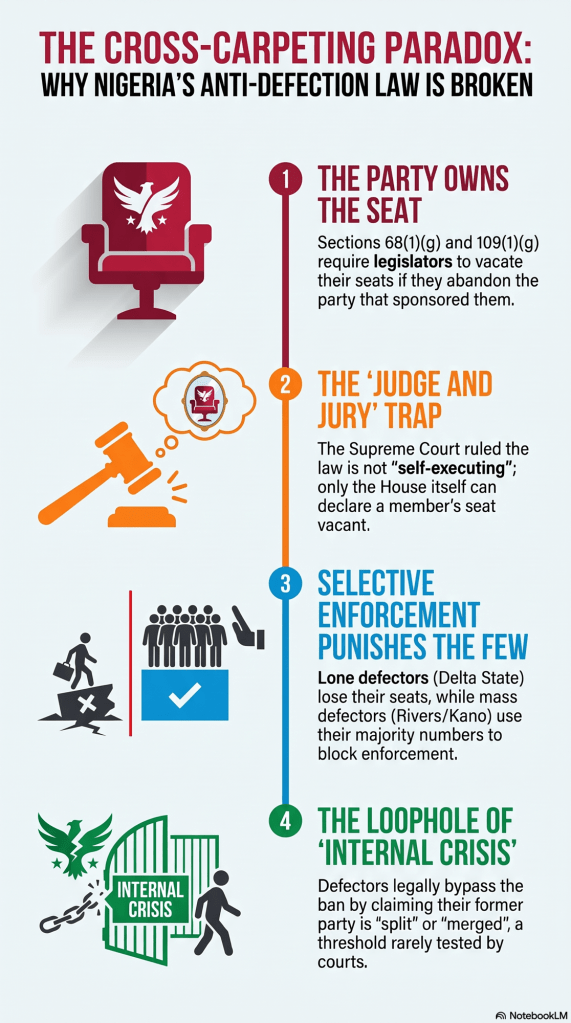
Now travel four hundred kilometres east to Rivers State, where twenty-seven lawmakers defected en masse from the PDP to the APC and the same constitutional provision fell into a coma from which it has not yet woken. Or drift north to Kano, where twenty-one of twenty-four state legislators are reported to have abandoned the NNPP for the APC, and the House finds itself constitutionally unable to notice its own membership has changed, because there is no one left in the room to bring the motion. Section 109(1)(g) is, on paper, one provision. In practice, it is two: one that bites a lone, friendless defector with no numbers to protect him, and another that goes mysteriously blind the moment defection is wholesale, coordinated, and useful to the party in power.
This is the cross-carpeting bar in the year 2026: a rule that punishes inconvenience and rewards arithmetic.
Why the clause exists at all
To understand the scale of the abuse, you have to understand the mischief the clause was built to cure. Nigeria’s First Republic collapsed partly under the weight of carpet-crossing. The 1962 crisis in the old Western Region, in which a faction led by Chief Samuel Akintola broke from Chief Obafemi Awolowo’s Action Group and triggered a declaration of a state of emergency, remains the textbook case of how floor-crossing could be weaponised to topple a regional government without ever facing the electorate again. The lesson the framers of the 1979 and later 1999 Constitutions drew from this was straightforward: a legislator’s seat belongs, in some meaningful sense, to the party whose platform won it, not to the individual occupying it as a personal estate. Sections 68(1)(g) and 109(1)(g) were the constitutional answer, vacate your seat if you abandon the party that put you there, unless you can show the party itself fractured beneath you.
That proviso is the whole ballgame, and it is where the courts have done their most interesting, and most politically convenient, work.
The judicial architecture, and its load-bearing cracks
In Amaechi v Omehia, the Supreme Court laid the foundation stone: the mandate belongs to the party, not the candidate. It is a doctrine that, once stated, ought to make defection legally suicidal in nearly all circumstances. But the proviso to Section 109(1)(g) creates an exit ramp a defector keeps his seat if his old party split, fragmented, or merged to such a degree that it became “impossible or impracticable” to function. In Abegunde v Ondo State House of Assembly, the Supreme Court held that this threshold is a high one; ordinary internal wrangling, the everyday blood sport of Nigerian party politics, will not do. The fragmentation must be near-terminal.
That is the theory. The practice, demonstrated repeatedly, is that the proviso has become less a legal test and more a rhetorical costume any defector can borrow for an afternoon. Every politician who jumps ship now discovers, retroactively, that his former party had been irreparably riven by crisis all along a crisis that, curiously, only became visible to him at the precise moment a more profitable address became available.
The more devastating blow to the clause’s credibility, however, came from the Supreme Court itself in the Rivers State House of Assembly litigation arising from the Fubara-Wike standoff. The Court held, correctly as a matter of textual law, that Section 109 is not self-executing. Defection must be alleged, presented to the House in session, and the House itself not the Governor, not the courts, not an aggrieved citizen with a newspaper clipping must be satisfied before a seat can be declared vacant. The Court went further, holding that membership of a political party is the party’s “internal affair,” beyond judicial reach.
Each sentence of that holding is defensible doctrine. Stacked together, they produce an absurd result: the only body empowered to enforce the anti-defection clause is the very body whose membership has just been altered by the defection in question. Ask the Rivers State House of Assembly, dominated by the defectors, to declare its own dominant faction’s seats vacant, and you are asking turkeys to organise Christmas. The presiding officer who must “be satisfied” is, more often than not, a beneficiary of the very defection he is supposed to be policing.
This is the mischief lurking inside the section, as you rightly suspect: the trigger mechanism was built for a world of isolated, minority defectors who could be safely expelled by a hostile majority. It was never stress-tested against a scenario in which the defectors are the majority. When that happens Rivers, Kano, and surely more states to come the clause does not merely fail to operate; it actively cannot operate, because the only hand on the switch belongs to the person who has already walked through the door it is meant to lock.
Decoration, not deterrent
Compare the treatment of executive defectors for good measure. In Attorney-General of the Federation v Atiku Abubakar, the Supreme Court confirmed that a Vice President who defects cannot be stripped of office by the courts, because removal of that office is governed exclusively by Section 143’s impeachment mechanism, not by Section 68 or 109. The same logic shields governors and deputy governors, as the attempted proceedings against Governor Umahi confirmed: defection simply is not a constitutional ground for vacating executive office at all. So the clause’s bite, such as it is, is reserved entirely for legislators and even there, only for the legislators unlucky enough to lack the numbers to protect themselves.
What you are left with, then, is a provision that functions exclusively as a tool of intra-elite discipline rather than a genuine safeguard of representative democracy. A backbencher who defects alone, like Mr Egbetamah in Delta State, gets the full constitutional treatment within weeks motion, resolution, Clerk’s letter, by-election. A bloc of legislators who defect together, with the backing of a state governor or a ruling party hungry for a supermajority, simply absorbs the chamber itself, and the clause built to stop exactly that becomes a museum piece: admired, cited extensively in law journals, and entirely without operational consequence.
The framers wanted to prevent the wholesale capture of legislative chambers through inducement and floor-crossing, the precise sin of 1962. What Nigeria’s political class has built instead, with the courts’ inadvertent assistance, is a system in which wholesale capture is the one form of defection the Constitution is structurally incapable of punishing, while isolated, low-stakes defections are punished with theatrical promptness. The text survives. The spirit was buried sometime around the Rivers State crisis, with full judicial honours and a moment of silence that has lasted rather longer than intended.
 Centre for Nigeria Progress