

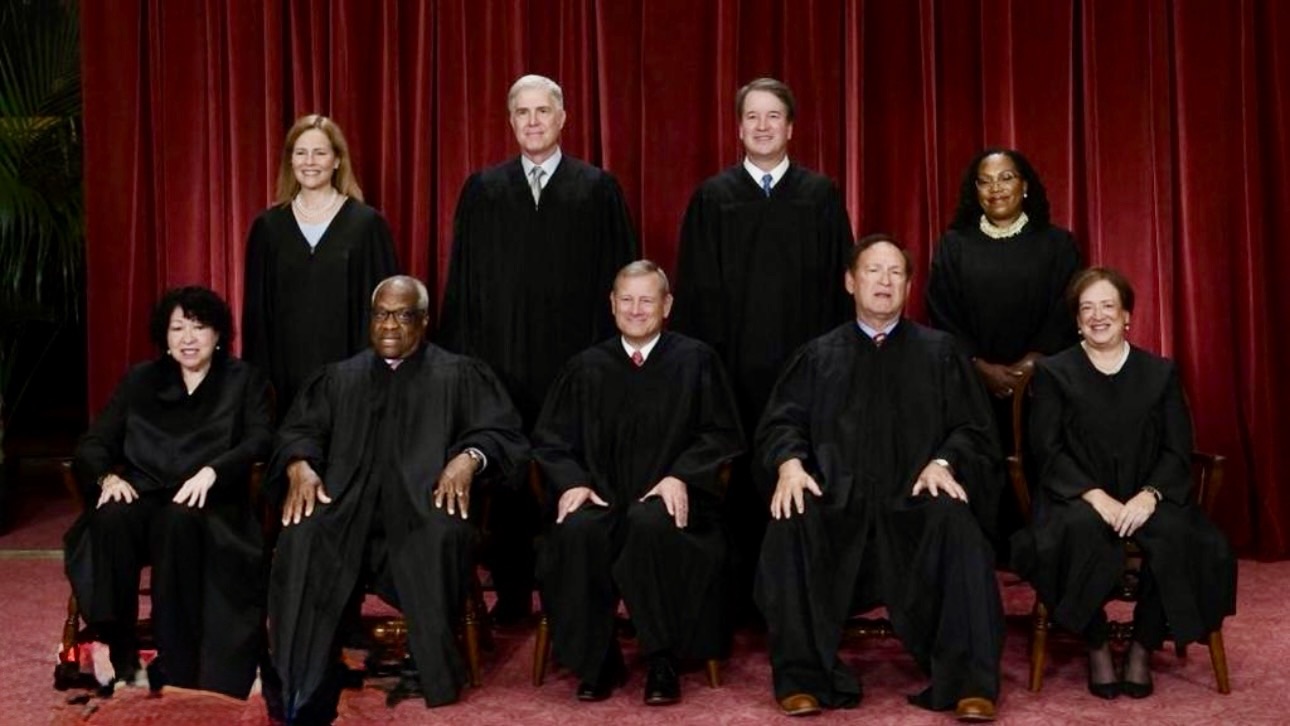

Six justices have now confirmed what the Fourteenth Amendment confirmed in 1868. The remarkable thing is not that they said it. It is that three of their colleagues, and a sitting president, required the exercise at all.
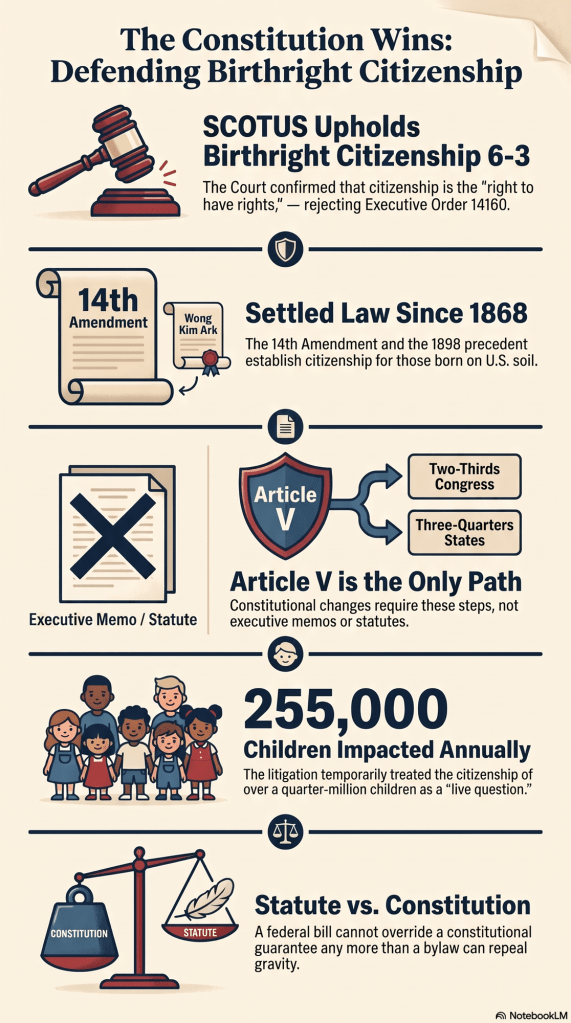
There are certain propositions in public life that do not survive the indignity of being put to a vote, a hearing, or a panel of nine. The sun rises. Tuesday follows Monday. And, until this week, an American Justice Department somehow felt entitled to treat the Fourteenth Amendment as a discussion document rather than the settled law of the land. On the first morning of his second term, Donald Trump signed an executive order purporting to redefine who is “subject to the jurisdiction” of the United States for the purposes of citizenship, a phrase the Amendment uses, a phrase the Supreme Court interpreted in 1898, and a phrase that has survived a World War, a Cold War, and several decades of restrictionist huffing without anyone seriously proposing that a president could simply decree it away. On Tuesday, by a vote of six to three, the Supreme Court told him so. Chief Justice Roberts, writing for the majority, observed that citizenship is “the right to have rights,” which is either a fine turn of constitutional phrase or the title of a Broadway musical nobody asked for. Either way, he was right, and it took the better part of eighteen months of litigation to say so.
IT IS THE CONSTITUTION, STUPID
Let us be precise about what was actually litigated, because precision is the one courtesy the executive order itself never extended to the text it was attempting to rewrite. The Fourteenth Amendment says that persons born in the United States and subject to its jurisdiction are citizens. Executive Order 14160 proposed that children born to parents who were undocumented, or merely visiting on a temporary visa, were not in fact “subject to the jurisdiction” of the country in which they were standing, eating, and presumably paying sales tax. This is not a bold reinterpretation. It is a category error dressed up as constitutional scholarship, and every court that examined it before the Supreme Court got there, district and appellate alike called it what it was.
If an administration genuinely believes a constitutional provision produces the wrong outcome, the Constitution itself supplies the remedy, and has done since 1787: Article V. Two-thirds of both chambers, ratification by three-quarters of the states, and a great deal of patient, unglamorous persuasion. What the Constitution does not supply, anywhere in its text, is a clause permitting a president to issue a memo and have a hundred and thirty years of settled doctrine quietly evaporate. The document is not scripture, immune from amendment and demanding only faith. It is a working instrument with a built-in mechanism for change. Mr Trump, evidently uninterested in the mechanism, chose the memo. One imagines him meeting the Fourteenth Amendment in the manner of a man arriving at a closed shop and trying the locked door anyway, repeatedly, on the theory that conviction alone might do the work of a key.
THE THREE WHO HESITATED
Credit where it is due: six justices, including Justice Barrett among the Court’s conservative wing, declined to be moved by a century-old grievance dressed in fresh constitutional clothing. Justice Kavanaugh concurred in the result on narrower, statutory grounds, which is the judicial equivalent of agreeing with the verdict while quietly filing a separate complaint about the indictment. That leaves three dissenters, Justices Thomas, Alito and Gorsuch, who found, by various routes, that the framers of the Reconstruction Amendments did not really mean what the plain text, the 1898 precedent in *Wong Kim Ark*, and a century of administrative practice all say they meant. Justice Thomas’s dissent in particular argued that the Fourteenth Amendment was principally aimed at the formerly enslaved, which is true as history and inadequate as law, since the drafters chose language of sweeping generality precisely because they were legislating a principle, not cataloguing a grievance.
It is worth dwelling on the optics, since the administration has shown itself unusually attentive to them. A constitutional text, debated in the 39th Congress, ratified in 1868, affirmed by the Supreme Court itself in 1898, codified again by statute, and applied without serious interruption through Japanese internment, two world wars and the entire arc of post-war immigration law, met three sitting justices of the highest court in the land who looked at it afresh in 2026 and found it ambiguous. That is not jurisprudence. That is motivated reasoning wearing a robe.
“Hold my executive order,” said the President, having just met the Constitution for the first time in any serious way.
THE GIRL WHO SAID ONE IN A MILLION
The second indictment is reserved for the Court itself, and it has nothing to do with how the justices eventually ruled. It concerns the fact that they agreed to rule at all. Every lower court that examined this order, and there were many, found it so transparently unconstitutional that the appropriate judicial response would have been a brisk, unanimous dismissal, the legal equivalent of declining to dignify the question. Instead, the Supreme Court granted certiorari before judgment, scheduled oral argument, and permitted a sitting president to attend in person, the first ever to do so, lending the entire spectacle the gravity of a coronation rather than the brush-off it deserved.
There is a particular kind of romantic delusion familiar to anyone who has watched a hopeful suitor mistake a brutal rejection for an opening. The young woman says, not unkindly, that he has perhaps one chance in a million. The young man, undeterred by the arithmetic, hears only the word “chance,” and walks away encouraged. That is precisely the posture the administration was permitted to adopt the moment the Supreme Court agreed to hear *Trump v. Barbara* rather than kicking it into touch. A petition with no serious prospect of success was elevated to the dignity of a constitutional crisis, complete with presidential attendance, breathless cable coverage, and eighteen months in which 255,000 children a year, by the Migration Policy Institute’s estimate, had their citizenship litigated as though it were a live question rather than a settled one. The Court won the case for the Constitution. It should never have allowed the Constitution to be put on trial.
THE SEQUEL NOBODY ASKED FOR
True to form, the President’s reaction to losing combined defiance with arithmetic he has apparently not yet been told the truth about. Posting that “no long and unwieldy Constitutional Amendment is necessary,” he proposed that Congress simply legislate birthright citizenship out of existence, a suggestion that mistakes a constitutional floor for a statutory ceiling. One does not amend the Fourteenth Amendment with a bill and a signature; one amends it via Article V, which is the very route Mr Trump has just spent two paragraphs of Truth Social declaring unnecessary. He also found time, in a separate post, to sarcastically congratulate Xi Jinping and “the Great Country of China” on their “massive Birthright Citizenship win,” which is the sort of observation that reads as wit only to the person making it.
Speaker Johnson has already signalled that the House will “deal with” the matter, and a bill with eighty-seven Republican co-sponsors sits ready in the wings, alongside a Senate companion with eight. None of it can do what its sponsors imagine it can do. A statute cannot override a constitutional guarantee any more than a council bylaw can repeal the law of gravity. But the theatre will doubtless continue, because the theatre was never really about the law. It was about being seen to fight it.
What this episode confirms is not a new principle of American constitutional law but an old and uncomfortable truth about the institutions meant to guard it. The Constitution survived intact, as it generally does when the people sworn to defend it eventually remember the oath. But it survived a presidency that treated a foundational guarantee as a negotiating opener, and a Court that treated the negotiation as worth entertaining. Both the executive and the judiciary, in their own ways, played at vandalism with the document this week, one by attacking the wall, the other by deciding the attack deserved a hearing before the wall was allowed to remain standing. The wall stood. It always was going to. The pity is that it had to prove it.
 Centre for Nigeria Progress