


The Confession Dressed as a Briefing
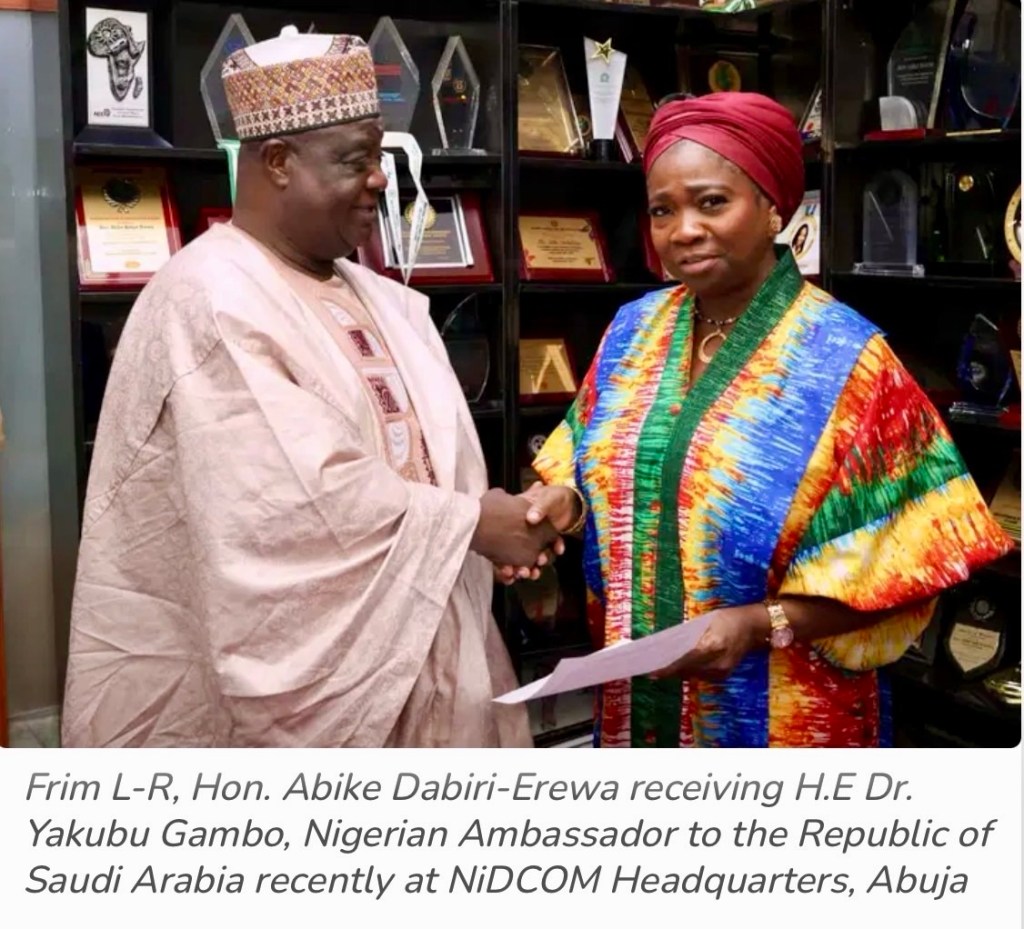
Ambassador Yakubu Gambo did Nigeria the rare courtesy of telling the truth in public, which in the diplomatic trade counts as a small scandal in itself. Standing before Abike Dabiri-Erewa at NiDCOM’s Abuja headquarters, he confirmed what families of the detained have known for years without an official ever saying it plainly: Nigerians who have finished serving their Saudi jail terms remain locked up anyway, held hostage to fines they cannot pay and a government that has not worked out how to pay them either. He framed it as a welfare concern, a matter for coordination and consolidation of diaspora associations under one umbrella. It is, more accurately, a description of a state that has run out of leverage and is calling the shortfall a strategy.
There is nothing unlawful in what Riyadh is doing, strictly speaking. Saudi criminal procedure requires that detention track a specific order for a specific period, and in theory a prisoner should not remain in custody once that period lapses. In practice, courts routinely attach a monetary penalty to a custodial sentence, and release, let alone deportation, is conditioned on that penalty being settled, whether by the convict, his family, his employer, or whoever else can be persuaded to write the cheque. The gap between the letter of the law and the texture of its administration is where the Nigerian citizen sits, technically free, functionally still a prisoner, waiting on an embassy that has neither the money nor, it seems, the appetite to close the file.
The Multilateral Mirage
It would be satisfying to say Nigeria has a lever sitting unused, and the Organisation of Islamic Cooperation is the usual candidate offered up in these conversations, fifty seven member states, the second largest intergovernmental body after the United Nations itself, surely capable of leaning on one of its own founding patrons. The trouble is that the OIC’s human rights organ, the Independent Permanent Human Rights Commission, was built to advise, not to compel. Its own statute confines it to technical cooperation and consultancy for member states willing to receive it, which is a polite way of saying it has no instrument that resembles an order, a sanction, or even a formal finding that binds anyone to anything. It is also headquartered in Jeddah, under the patronage of the very state whose prison administration is the subject here, which tells you rather a lot about how far that body will ever travel from Saudi Arabia’s comfort.
So the multilateral door was never really open. Nigeria’s paralysis is not a failure to find the right international forum. It is the absence, full stop, of any coercive instrument, financial, diplomatic, or reputational, that would move Riyadh to act faster than it wishes to. Nigeria buys no meaningful volume of Saudi exports that Riyadh would miss, hosts no significant Saudi investment it could threaten, and cannot retaliate against Saudi nationals in Nigeria because there are not enough of them living here to make the gesture register. Diplomacy between unequal partners tends to default to supplication, and supplication is what Ambassador Gambo delivered, dressed up as a progress update.
Nobody in Government Buys a Ticket to Jeddah in Handcuffs
“The point is that many of these Nigerian detainees … would have completed their jail terms by now even if they were duly tried, convicted and jailed.”
That line, offered years ago by a distraught parent to a Sunday newspaper, still describes the condition Gambo was confirming this week, which should embarrass a government fond of describing itself as reformist. But embarrassment requires proximity to consequence, and there is none here. The Nigerians accumulating in Saudi detention on unpaid fines are not senators’ sons, are not the children of permanent secretaries, are not connected to anyone whose displeasure would cost a minister his post. They are traders, labourers, artisans, the occasional unlucky professional, exactly the demographic whose suffering generates a press statement rather than a budget line.
Compare the energy Abuja finds for citizens who matter to it. When the complaint touches someone with a constituency, a passport belonging to a person of consequence, the machinery moves with unusual speed. When it is a labourer’s unpaid fine standing between him and a flight home, the file is handed to NiDCOM, a statement is issued about unity among diaspora associations, and the underlying problem, that nobody in the Federal Government has allocated money to clear these fines as a matter of course, sits untouched for another news cycle.
This is not a story about Saudi Arabia’s opacity, which is well documented and not this piece’s subject. It is a story about a government whose foreign policy toward the vulnerable abroad is calibrated by exactly one variable, whether the vulnerable person could conceivably be someone in government. Until that variable changes, Ambassador Gambo will keep giving briefings that sound like confessions, NiDCOM will keep issuing statements about coordination, and Nigerians who finished paying their debt to Saudi justice in every sense but the literal one will keep waiting behind a gate that only money, not law, not diplomacy, and certainly not the OIC, will ever open.
 Centre for Nigeria Progress