


There is an old, apocryphal Chinese proverb that sounds like a blessing but functions as a curse: “May you live in interesting times.”
Well, congratulations. We are living through what might be the most “interesting” era in modern political history.
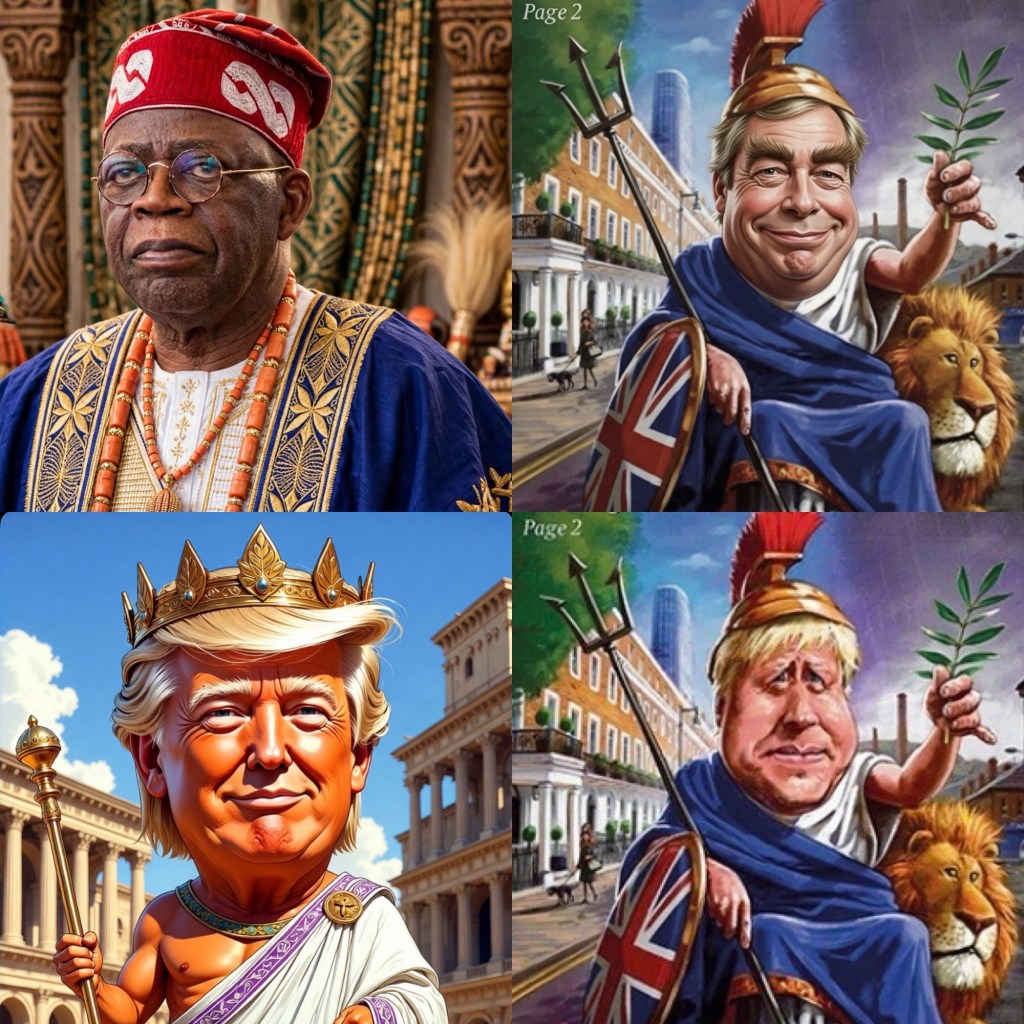
If you had told a political scientist thirty years ago that a lineup featuring Boris Johnson, Nigel Farage, Donald Trump, and Bola Ahmed Tinubu would simultaneously dictate the fortunes, policies, and discourse of major world democracies, they would have recommended you take a quiet walk and a cold shower. Yet here we are, sitting in the front row of a geopolitical comedy-drama where the plot is made up and the rules don’t seem to matter.
These leaders—spanning London, Washington, and Abuja—share more than just high-profile charisma and a knack for dominating the 24-hour news cycle. They represent a fundamental shift in how power is acquired, exercised, and retained in modern democracies.
The Art of Dismantling Guardrails
Historically, democracies relied on two key mechanics to keep the peace: written constitutional guardrails and unwritten norms of shame. If a politician was caught in a brazen scandal, violated a long-standing convention, or blurred the line between public duty and personal enrichment, the system (or social pressure) usually forced a quiet exit.
Enter the era of shamelessness as a political superpower.
- Boris Johnson took the British constitution—a delicate system built entirely on the concept of “good chaps” doing the honorable thing—and showed what happens when a “bad chap” simply refuses to leave the room. From proroguing Parliament to casually shrugging off ethics violations, Johnson proved that unwritten rules are only as strong as a politician’s willingness to care about them.
- Nigel Farage, without ever holding a seat in the UK Cabinet, managed to rewrite the entire geopolitical trajectory of Britain. By mastering the art of populist pressure, he effectively held the ruling Conservative Party hostage from the outside, proving that you don’t need to hold formal office to dismantle systemic alliances.
- Donald Trump took the American system of checks and balances—long considered the gold standard of democratic design—and treated it like a suggestive guideline. From appointing loyalists to institutional oversight bodies to challenging the peaceful transfer of power, Trump demonstrated that federal guardrails crumble remarkably fast when an executive simply ignores them.
- Bola Ahmed Tinubu in Nigeria mastered the art of political machinery long before taking the presidency. Operating under the famous philosophy of “Emilokan” (“It is my turn”), Tinubu’s political trajectory highlights how deep institutional leverage, vast patronage networks, and state-level dominance can turn democratic processes into an administrative formality.
Democracies and the New Normal
What makes this lineup so compelling—and concerning—is that none of them seized power through traditional military coups or total authoritarian overthrow. They were elected. They used the mechanics of democracy to alter the nature of democracy itself.
In doing so, they exposed a terrifying reality: the traditional electoral process is increasingly incapable of self-correcting against systemic disruption.
When institutional guardrails are dismantled from within, elections often cease to function as a mechanism for accountability. Instead, they become echo chambers of tribalism, financial leverage, and media manipulation. When corrupt regimes or hyper-populist movements nest inside democratic frameworks, voting them out becomes an uphill battle against a system they’ve already reshaped to their own advantage.
Where Do We Go From Here?
Living in “interesting times” is exhausting. It turns every news cycle into a high-stakes thriller and every election into an existential crisis.
The lesson of the Johnson-Farage-Trump-Tinubu era isn’t just that individual politicians can be extraordinarily disruptive. The real lesson is that our democratic institutions were far more fragile than we cared to admit. They were built for a different era—one that assumed politicians would play by the rules simply because the rules existed.
Now that the blueprint for bypassing those rules has been written, it won’t be easily forgotten. The question for the next generation isn’t whether we will continue to live in interesting times, but whether our democracies can survive them.

