There is a Cameroonian shopkeeper somewhere in Durban who woke up last month to find a mob outside his door. He had not stolen from anyone. He had not captured any state entity. He had not, to the best of available evidence, awarded R14.7 billion in irregular contracts to a family of businessmen with the ear of a sitting president. He had simply opened a shop. And yet, if you listened to the marchers outside with their placards and their righteous fury, you would conclude that this man, this foreigner, this illegal, this menace, was the primary author of South Africa’s economic misfortune.
The story they are selling is simple, satisfying, and almost entirely false. It is also, by this point, a remarkably familiar genre.
South Africa is burning the wrong building. And the architects of the actual fire are watching from a safe distance, nodding sympathetically.
I. What the Zondo Commission Actually Found
Before one can understand what is happening on the streets of Johannesburg and Durban in 2026, one must understand what happened in the boardrooms and ministerial offices of the Zuma administration between 2009 and 2018. The Zondo Commission, that four-year, R1 billion national inquiry that produced six volumes of findings and implicated over 1,400 individuals, documented a systematic looting of the South African state that defies casual description.
The commission, formally known as the Judicial Commission of Inquiry into Allegations of State Capture, Corruption and Fraud in the Public Sector, was established in January 2018. By the end of its proceedings, it had examined over 300 witnesses and processed more than eight million pages of documents.
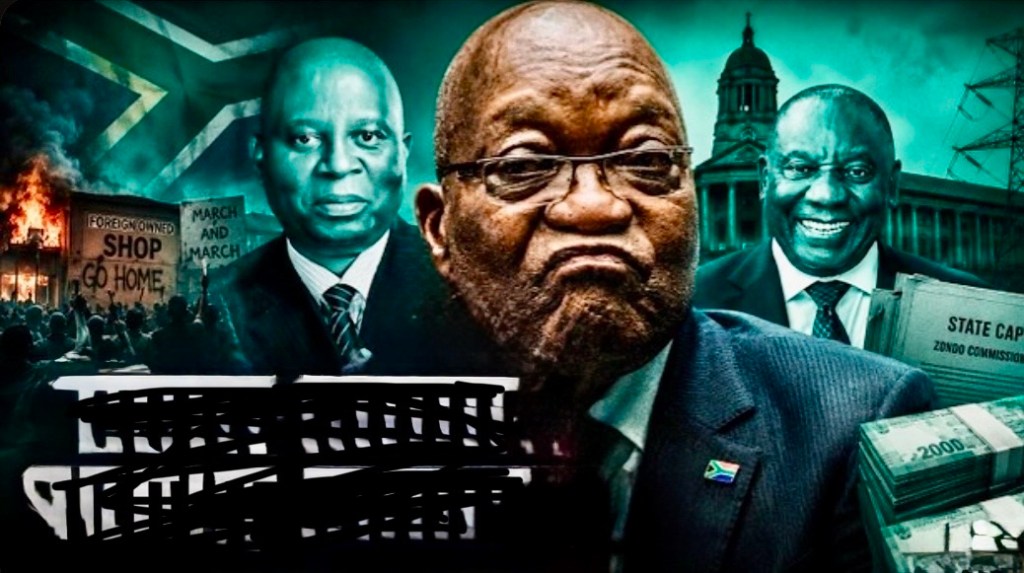
Its conclusions were damning. Chief Justice Raymond Zondo found that Eskom entered into irregular contracts worth R14.7 billion mainly with entities linked to the Gupta family, who were Zuma’s friends. “The evidence proves a scheme by the Guptas to capture Eskom, install the Guptas’ selected officials in strategic positions within Eskom as members of the board, the committees of the board and the executives, and then divert Eskom’s assets to the Guptas’ financial advantage,” Zondo stated.
This was not incidental corruption, the petty kind that afflicts all governments like rot in the woodwork. As one analyst put it, state capture in South Africa went beyond mere money theft; it was about repurposing state machinery. Key loyalists to Zuma and his party were placed in top positions at state-owned enterprises and law enforcement, while competent, honest officials were marginalised or fired to remove roadblocks to corruption.
The result: critically important infrastructural enterprises like Eskom, the transport entities Transnet, Prasa and South African Airways were eroded of their capacity. Institutional decay in the form of loss of experienced human capital, decline in services such as passenger and freight rail-transport, unreliable electricity and water supply, erratic revenue collection and the decline of local governments meant that the state worked for interests other than the public.
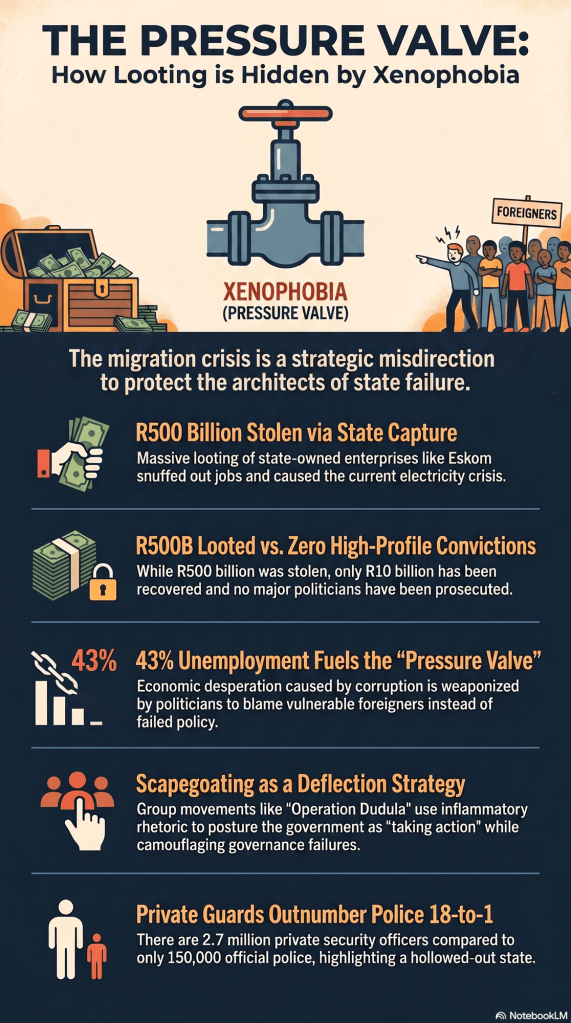
President Ramaphosa estimates that more than R500 billion was stolen during his predecessor’s tenure. The state capture loot made a few thousand immensely wealthy, but snuffed out jobs and opportunities that could have lifted millions out of poverty. It was a crime of staggering scale and audacity.
And as of today? Only R10 billion has been recovered from State Capture investigations. No high-profile politician or corporation has been successfully prosecuted. The bungling of high-profile cases shows that elites can get away with impunity because the state is failing.
In other words: R500 billion looted. R10 billion recovered. Zero orange jumpsuits. Infinite hashtags about foreigners.
II. The Context: A Country Running on Empty
Into this hollowed-out state walk the unemployed millions. Since 2024, the country’s deteriorating socioeconomic conditions, including an unemployment rate of over 43 percent, have coincided with the rise of anti-immigrant activism and the formation of newer vigilante groups like March and March.
South Africa’s economy in 2025 continues to struggle, with weak growth and mounting structural pressures, with growth forecasts downgraded to approximately 1.2 percent for the year. Unemployment remains critically high, with youth unemployment hovering around 40 percent, feeding social unease and stunting growth. The nation’s trust in the police is at all-time lows, there are now 2.7 million registered private security officers and just 150,000 official police officers.
So here is the country that Operation Dudula and March and March are operating in: a population rendered desperate by a decade of systematic state robbery, living through electricity blackouts caused by the very looting the Zondo Commission documented, policed by an institution so depleted it has been outnumbered by private security guards. The rage is real. The deprivation is real. The question is only whether it is being directed at its actual cause.
It is not.
III. The Machinery: How Spontaneous Anger Is Manufactured
Operation Dudula, whose name means “force out” or “knock down” in isiZulu, was founded in Soweto and claims to combat crime, unemployment, and strained public services allegedly caused by undocumented migrants. The group emerged from discourse that blamed migrants for the fallout and economic hardship of COVID-19 deaths and lockdowns.
Operation Dudula frames its campaign as a grassroots response to socioeconomic grievances, but its methods reveal a pattern of targeting both documented and undocumented foreigners alike.
The pattern of escalation is not spontaneous. It follows a recognisable rhythm: inflammatory social media content amplified by coordinated networks, a trigger event exploiting local tensions, mobilisation of groups toward foreign-owned premises, and then the extraction phase in which the vacated commercial space, the shop, the lease, the inventory conveniently passes to local interests. This is less a movement and more a business model with ethnic camouflage.
In November 2025, the High Court of South Africa found Operation Dudula and its leadership guilty of engaging in intimidation, harassment, and incitement of hate speech and violence on the grounds of nationality, social origin, and ethnicity, and further prohibited the group from demanding identity documents from members of the public or otherwise taking the law into their own hands.
Undeterred, the movement reorganised. City by city, South Africa’s two leading anti-foreigner figures, media-facing activists Jacinta Ngobese-Zuma and Zandile Dabula have continued to organise and lead marches against foreigners. March and March, the shadowy anti-foreigner movement led by Ngobese-Zuma which emerged in 2025, marched in Tshwane and Johannesburg using the rhetoric of anti-migrant hate.
And now, a deadline. As of this writing, March and March has declared 30 June 2026 as the date by which all undocumented migrants must leave the country, a demand issued by a private organisation with no legal authority whatsoever, which has nonetheless sent hundreds of thousands of people fleeing across the continent.
IV. The Politicians Who Lit This Particular Match
It would be convenient if the entire enterprise were the work of fringe lunatics operating outside the mainstream of South African politics. It is not. The mainstreaming of anti-immigrant politics has been quite deliberate, and the fingerprints are easily traceable.
The unspoken agreement not to target vulnerable groups for political gain was broken by three individuals: Herman Mashaba, Nhlanhla “Lux” Dlamini, and Gayton McKenzie. The first to use anti-immigrant rhetoric to win votes was a politician called Herman Mashaba. Like many such politicians, Mashaba did not overtly attack foreigners because that would constitute clear hate speech, but rather attacked “illegal immigrants.”
Herman Mashaba, leader of ActionSA, stated that foreign nationals who run tuck shops use their businesses as illicit drug channels, destroying small businesses in townships and villages, and disrupting communities’ way of life. Gayton McKenzie, while speaking at the Patriotic Alliance’s ten-year celebration, said of foreign nationals: “they must go home,” contending that foreign nationals are responsible for crime, drug peddling, unemployment, and other problems.
The academic literature is catching up with what observers have long noted. Political scientists argue that securitization is being used as a deflection strategy to camouflage failures of governance, and that immigrants are scapegoated so as to posture government as doing something about the concerns of citizens, specifically failure to tackle illegal immigration and crime, particularly crucial as South Africa prepares for local government elections in 2026. Some political parties only obtained sizeable votes precisely because their campaigns used the securitization move against illegal immigrants.
To be fair, and fairness requires noting this McKenzie has since issued a belated warning to his supporters. He told party members during a Facebook Live address that they must not engage in violence or intimidation, warning: “I don’t want to see a PA member at March and March. I’m not a leader who wants to be fashionable like ActionSA’s leader Herman Mashaba, but leading my people to jail.”
One appreciates the sentiment. One also notes that the mob does not easily disassemble once the demagogue has finished stoking it.
Analysts note that there were “any number of political actors” in South Africa who have capitalised on anti-immigrant sentiment for their own benefit over the years. The ANC itself went from condemning xenophobia to putting anti-immigrant rhetoric into the White Paper on Citizenship, Immigration and Refugee Protection. Populist figures such as Mashaba and McKenzie contributed to “moving what was fringe and uncomfortable, to something that is comfortable and central to South African politics.”
This is how the trick works. The politician does not need to throw the first stone. He simply needs to make stone-throwing feel patriotic.
V. The African Blowback: Sawing Off the Branch
South Africa’s political class, consumed by its domestic electoral arithmetic, has managed to overlook one rather important detail: the country has significant commercial interests across the African continent, and those interests are now under threat.
South African companies such as MTN Group and Standard Bank have faced calls for boycotts in some countries. South African artists have reported cancelled performances and growing public hostility in parts of Africa. Justice Minister Mmamoloko Kubayi has warned that recurring xenophobic violence is damaging South Africa’s international reputation and weakening regional relations.
Diplomatic pressure on South Africa is mounting as more African countries threaten retaliatory measures over renewed xenophobic attacks targeting foreign nationals. With over 118 Nigerians reportedly killed in xenophobic incidents between 2015 and 2026, Abuja insists that rhetoric must now be matched with action. Ghana’s Ministry of Foreign Affairs summoned South Africa’s acting High Commissioner to protest the harassment and intimidation of Ghanaian citizens.
South African business groups have warned that hostility disrupts vital corporate operations, strains diplomatic ties with regional partners, and threatens the safety of personnel and infrastructure across cross-border trade corridors. South Africa benefits enormously from legal investments as well as genuine entrepreneurship, skills, and talents from other African countries. When individuals target foreign nationals, they directly harm South Africa’s economic interests.
Analysts warn that prolonged instability and negative international perceptions could discourage foreign direct investment and complicate efforts to deepen cross-border trade and cooperation under the African Continental Free Trade Area.
The irony is almost too neat. A country whose state-owned enterprises were looted into dysfunction destroying jobs, triggering load-shedding, and precipitating the very unemployment crisis that now fuels anti-immigrant anger is now threatening to destroy its remaining continental commercial presence in order to distract from the politicians who did the looting.
VI. The Real Story
Here, then, is the story that gets lost in the noise: South Africa is not experiencing a migration crisis. It is experiencing a manufactured political crisis designed to redirect public anger away from the architects of actual state failure.
The Cameroonian shopkeeper did not hollow out Eskom. He did not appoint Gupta-aligned executives to SOE boards. He did not preside over the systematic dismissal of honest public servants. He did not receive R15 billion in irregular government contracts and then flee to Dubai. He simply opened a shop and has now become, in the telling of certain South African politicians, the explanatory variable for a catastrophe entirely of their own making.
Our main claim is that securitization is being used as a deflection strategy to camouflage failures of governance, and that immigrants are scapegoated so as to posture government as doing something about the concerns of citizens.
This is not a new technique. Governments that have failed their populations have always found it useful to identify a proximate enemy visible, vulnerable, and conveniently unable to vote. The genius of the South African variant is that it has been outsourced to civil society organisations, allowing politicians to stoke the fire while standing theatrically apart from the flames.
The Zondo Commission spent four years and R1 billion assembling the most comprehensive account of state looting in South African democratic history. It named names. It made recommendations. What we have instead is multiple excuses from institutions tasked with implementing the commission’s findings and recommendations. The Civil Society Working Group on State Capture has found a generally lacklustre approach to addressing state capture.
No prosecutions. No recovered assets worth speaking of. No justice. But a great deal of marching.
Conclusion: The Pressure Valve
The purpose of a pressure valve is to release steam before the boiler explodes. The political utility of xenophobic violence is structurally identical: it releases enough public anger, directs it at a safe target, and ensures that the pressure never builds to the point where it destroys the people who actually caused the heat.
The Cameroonian shopkeeper is the pressure valve.
The Malawian vendor is the pressure valve.
The Nigerian trader, the Zimbabwean nurse, the Congolese asylum seeker all of them are pressure valves in a political machine that runs on manufactured grievance and is operated by people whose own conduct, if fully prosecuted, would fill several South African prisons.
Until South Africa is willing to ask who actually designed the boiler and who was running it during the nine wasted years the pressure will keep building, the valves will keep being opened, and the wrong people will keep paying the price.
The true story is not the migration crisis. The true story is the strategic misdirection of national rage to protect the architects of state corruption.
That is the story. Everything else is theatre.