



In politics, timing is everything. But for the soul of the Labour Party, the clock is finally moving again.
Andy Burnham’s monumental apology admitting that Labour “didn’t get it right” and was “too slow to call for a ceasefire” in Gaza, is a crucial first step toward lancing a boil that has festered within the party’s progressive flank. For the voters, members, and MPs who watched in horror as the Keir Starmer initially stumbled and kept digging that hole, this moment isn’t just about semantics. It is about healing deep-seated inner pain and to stop digging a hole.
Let’s be entirely frank. Realistically, there was very little a British Prime Minister could have done to physically halt Netanyahu’s government genocidal action in Gaza. But British politics isn’t just about hard power; it is about moral clarity. It is about putting the country’s name on the side of the righteous.
Instead, Keir Starmer spent his ascension blinded by internal factionalism. Obsessed with his ideological “anti-semitism faux warfare” against the party’s left, he conflated legitimate humanitarian outrage with internal party management. In focusing entirely on his pristine, curated path to power, Starmer failed to see the larger picture: the catastrophic, real-world harm occurring daily in Gaza.
The Data Behind the Collapse: How Gaza Fractured the Party
Make no mistake: while Starmer achieved a headline landslide, it was structurally hollow. His rigid refusal to break from the Washington consensus nearly severed the umbilical cord between Labour and its most loyal voting blocs and heartland.
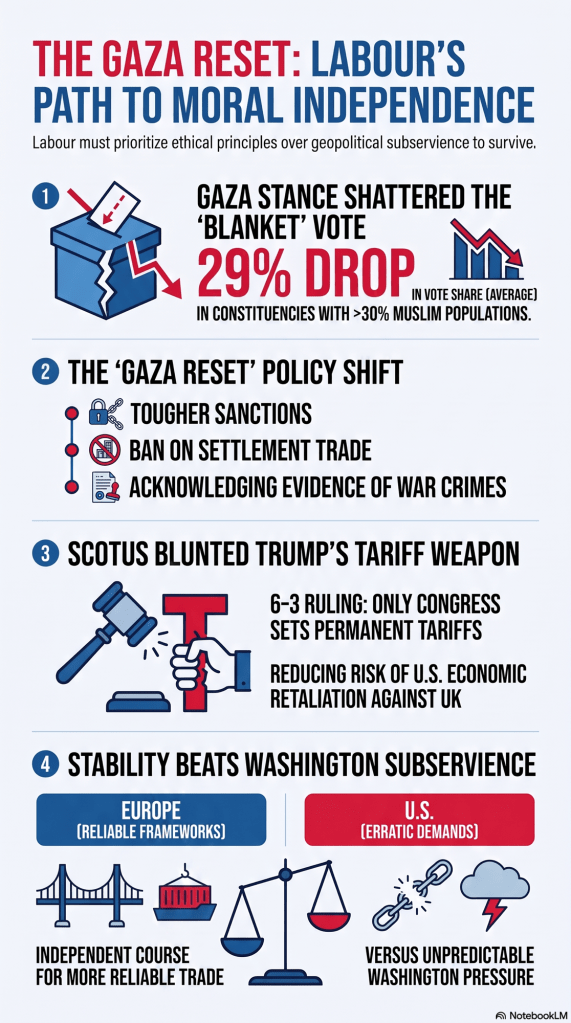
The most brutal damage occurred in constituencies with significant Muslim and progressive populations, where the “blanket” Labour vote effectively shattered. Nationally, in the 21 seats where more than 30% of the population identifies as Muslim, Labour’s share of the vote plummeted by an average of 29 percentage points.
This moral paralysis translated into direct parliamentary losses. Labour outright lost five previously bulletproof, safe seats to pro-Palestine independent candidates standing on clear anti-war platforms including heavyweights like Shadow Cabinet member Jonathan Ashworth in Leicester South, alongside losses in Dewsbury and Batley, Blackburn, Birmingham Perry Barr, and Jeremy Corbyn’s victory in Islington North.
Where Labour limped across the finish line, majorities were gutted. Shadow Health Secretary Wes Streeting clung to Ilford North by a razor-thin 528 votes, while Justice Secretary Shabana Mahmood saw her vote share in Birmingham Ladywood crater by 40%.
Voters defected in droves to the Green Party and anti-war independents. Post-election polling confirmed that a massive 70% of ethnic minority voters who abandoned Labour for another left-wing party cited the leadership’s stance on Gaza as the deciding factor. It was this deep, moral disconnect that ultimately created the space for Starmer’s own political demise.
Burnham’s Moral Pivot: A Shift in Tone and Trade
Burnham’s intervention signals a necessary tonal and policy reset to stop the bleeding. While he deferred specific legal definitions of “genocide” to the international courts, his actual policy proposals suggest a much tougher spine.
Going forward, Burnham’s proposed Gaza line focuses heavily on concrete measures rather than mere rhetoric.
He is advocating for tougher individual and entity sanctions against those fueling the conflict, a potential ban on trade in goods originating from illegal settlements, and a clear, unblinking acknowledgment of the mounting evidence of war crimes.
By explicitly linking a zero-tolerance stance on antisemitism with the absolute right to hold the Israeli government to account, Burnham is proving that you can be both fair and morally courageous.
The Next Battlefront: Clear Blue Water and the Tariff Threat
If this new Labour government wants to survive and thrive, the lesson from the Starmer era is clear: side with the saints, no matter what clothes the evil is wearing.
But the foreign policy reset cannot stop at the borders of the Middle East. To hoover up support and cement his new government’s popularity, Burnham’s next move must be to create clear blue water between Westminster and Donald Trump’s America. Subservience to Washington has historically been the graveyard of Labour prime ministers (just ask Tony Blair).
Fortuitously, the economic forecast for distancing the UK from Washington has completely changed, thanks to a massive legal plot twist from the US Supreme Court.
In a stunning 6–3 decision (Learning Resources, Inc. v. Trump), SCOTUS struck down Trump’s sweeping “Liberation Day” global tariffs, ruling that the International Emergency Economic Powers Act (IEEPA) does not give the president the authority to unilaterally levy taxes. The Court firmly reminded Trump that the power to tax and set tariffs belongs strictly to Congress.
The Foreign Policy Realignment: Tariffs are the only stick Trump uses to conduct his foreign policy, it is his primary tool for economic extortion. By clipping his executive trade powers, SCOTUS has effectively blunted Trump’s favorite weapon.
Trump is now legally bottlenecked into restrictive, temporary legal mechanisms like Section 122 “balance-of-payments” tariffs, which carry strict statutory limitations, capping his actions at 150 days unless Congress approves an extension.
The Economic Takeaway for the UK
The fear that distancing Britain from Trump would result in immediate, catastrophic economic retaliation is now vastly overstated. If the UK stands firm on its ethical principles, it holds a much stronger hand for two distinct reasons.
First, Trump is legally constrained. He can no longer whimsically slap permanent, retaliatory, across-the-board tariffs on British goods without running into a wall of US congressional oversight and immediate domestic lawsuits.
Second, stability beats subservience. The UK economy is actually safer charting an independent course. Bowing to Trump’s erratic economic demands creates severe policy uncertainty for British businesses; standing apart allows the UK to foster more reliable, legally sound trade frameworks with Europe and the global market.
By standing firm against a volatile, legally restricted White House, Burnham can reclaim Britain’s independent moral voice on the world stage, heal the internal wounds of his party, and prove that this Labour government answers to principles, not empires.
The apology is a good start. Now, let’s see the action.
 Centre for Nigeria Progress