

Donald Trump has an extraordinary political gift. He can turn tomorrow into a permanent destination.
Whether the subject is healthcare, trade, infrastructure, peace in the Middle East or now Iran, there is a familiar rhythm. An announcement. A flourish. A declaration that success is “very close.” Then another announcement. Then another. Like a magician whose favourite trick is promising that the rabbit will appear in just one more hat.
The performance never really ends because the finale never quite arrives.
For anyone who watched Trump’s first presidency, the current saga over Iran has a familiar soundtrack. Every few weeks comes another declaration that an agreement is imminent. Every few weeks, the finish line politely packs its bags and moves another mile down the road.
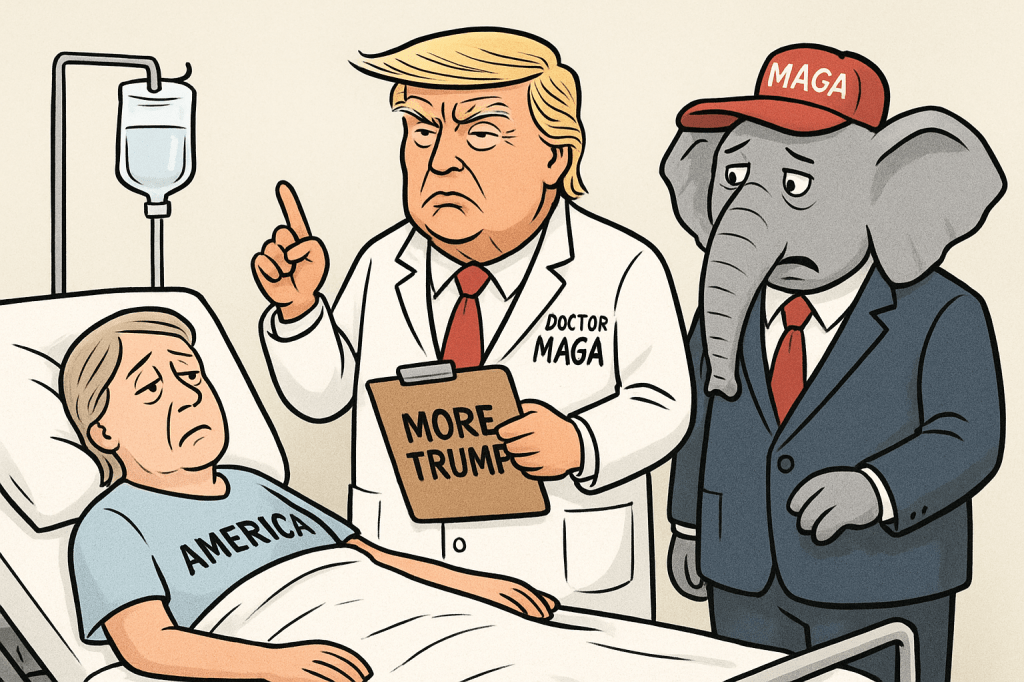
It feels remarkably similar to another long-running serial: The Great Replacement of Obamacare.
The ACA Replacement That Never Came
Repealing and replacing the Affordable Care Act (ACA), commonly called Obamacare, was one of Trump’s defining campaign promises.
The replacement wasn’t simply going to exist. It was going to be better.
It would cover everyone.
It would cost less.
It would be beautiful.
And, above all, it would be ready very soon.
Americans were treated to an endless procession of deadlines:
- During the 2016 campaign, Trump repeatedly promised an immediate replacement after repeal.
- In 2017, he insisted Republicans had a healthcare plan ready to go.
- In 2018, after legislative failures, another replacement was said to be in preparation.
- In 2019, Trump declared a “phenomenal healthcare plan” would be unveiled after the election.
- In 2020, he famously stated that a comprehensive replacement would arrive in “two weeks.”
- The promised two weeks quietly became months, then years, without a comprehensive ACA replacement emerging.
The Affordable Care Act, meanwhile, stubbornly refused to disappear.
It is perhaps the longest-running two-week project in modern political history.
Welcome to Iran’s Version of “Two Weeks”
Fast forward to the present.
Swap “healthcare plan” for “Iran agreement.”
The language barely changes.
According to reporting that has tracked Trump’s statements throughout the conflict, he repeatedly declared that peace was close, that negotiations were nearly complete, or that agreements had effectively been reached. Reuters compiled numerous examples stretching across months, with announcements that “major points of agreement” had already been secured and finalisation was imminent.
Independent analyses counted even more.
One review noted that Trump had suggested an Iran agreement was imminent at least 38 times before an actual preliminary framework emerged.
CNN reportedly assembled an entire montage of these repeated declarations.
It became political Groundhog Day.
Agreement coming.
Agreement nearly done.
Agreement almost signed.
Agreement definitely happening.
Agreement… please stand by.
The One Trick Pony
Trump’s critics often accuse him of exaggeration.
His supporters call it optimism.
Both may be missing something more interesting.
Trump appears to govern through anticipation.
The promise itself becomes the policy.
The announcement becomes the achievement.
The expectation replaces the delivery.
Success is always just beyond the next news cycle.
In this model, deadlines are not obligations.
They are renewable subscriptions.
Politics by Trailer
Hollywood releases trailers before films.
Trump often releases trailers instead of films.
Every announcement promises that something enormous is about to happen.
Sometimes it does.
Sometimes it partly does.
Sometimes it quietly changes shape.
Sometimes it simply vanishes beneath the next announcement.
Healthcare.
Infrastructure Week.
The border.
Trade deals.
The wall.
Now Iran.
Different script.
Same production company.
The Constant Is Confidence
None of this means every negotiation fails or every policy collapses.
Politics is complicated.
International diplomacy is even more so.
Negotiations frequently evolve and deadlines move for reasons beyond any president’s control.
But what distinguishes Trump is not merely that events change.
It is the extraordinary confidence with which certainty is projected long before certainty exists.
Every agreement is described as historic before the ink is dry.
Every solution is presented as inevitable before the other side has even agreed.
Conclusion
Trump has built a political style around perpetual imminence.
Tomorrow is always spectacular.
Next week is transformational.
Two weeks is practically constitutional.
His critics see empty promises.
His supporters see relentless confidence.
Either way, there is one remarkable consistency stretching from the Affordable Care Act to Iran.
Donald Trump may change the subject.
He rarely changes the timetable.
Or, to borrow from his own political calendar:
Check back in two weeks.

