

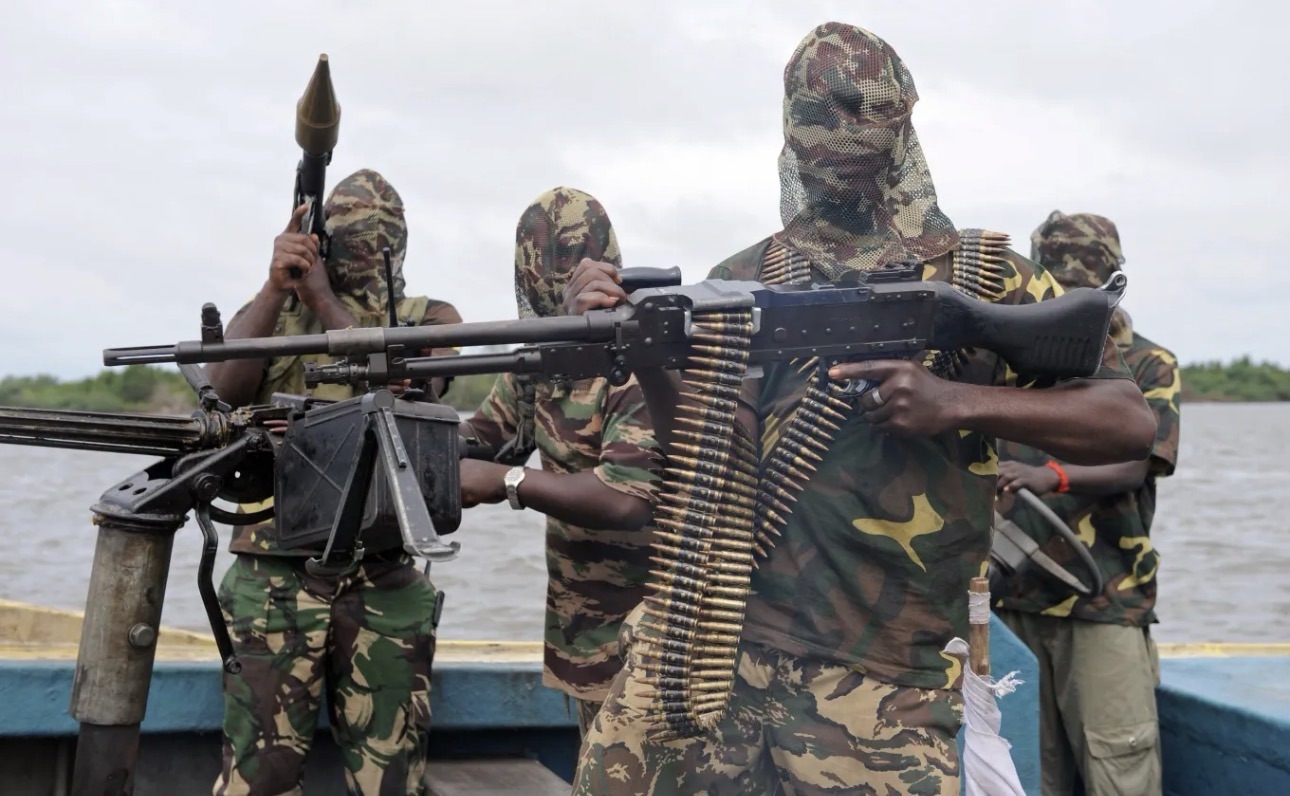

From the forests of Biafra to the badlands of Zamfara, Nigeria’s army has shown a peculiar talent for keeping its enemies well-supplied. Fifty years on, the tradition holds.
There is a remark, preserved in the oral tradition of the Biafran officer class, that deserves wider currency. A former commander on the secessionist side watching a documentary camera with the relaxed candour that only retirement and historical distance permit observed that the Nigerian federal army had, in practice, served as Biafra’s quartermaster general. Whenever federal troops were routed, Biafran fighters recovered weapons, ammunition, and vehicles that the beleaguered Ojukwu administration could never have procured through legitimate channels. Without the Nigerian army’s generosity in defeat, Biafra’s war machine would have seized up considerably sooner.
One could excuse this as the fog of a civil war, fought more than half a century ago, against a secessionist force that was organised, ideologically motivated, and in possession of trained officers. The losses were embarrassing but explicable. What is rather harder to explain and rather less forgivable is that the same institutional tendency has survived into the twenty-first century, now servicing an altogether different clientele: bandits, kidnappers, Jihadist affiliates, and the assorted armed entrepreneurs of Nigeria’s chronic insecurity.
“Nigeria’s army has been described as mighty on paper many of its soldiers ‘ghosts’ who exist only on the payroll, much of its equipment stolen and sold to insurgents.”The Economist, October 2021
The mechanism has changed. The Nigerian army is no longer losing weapons to a disciplined secessionist force in pitched battle. It is losing them or more precisely, selling them through a retail operation embedded within its own ranks.
Gaddafi’s Warehouse Sale
Before we reach the domestic supply chain, we must pass through Libya which is where the post-2011 arms bazaar was thrown open to all comers. When NATO’s air campaign helped remove Colonel Muammar Gaddafi in 2011, it performed a service for democratic aspiration that it simultaneously undermined by leaving behind a weapons bonanza of staggering proportions. Over four decades, Gaddafi had accumulated stockpiles of small arms and light weapons with the hoarding instinct of a man who trusted no one. The intervention toppled the man but had no coherent plan for the arsenal.
The weapons began to move almost immediately. Assault rifles, mortars, mines, and plastic explosives crossed into Algeria, Niger, Mali, and Chad within weeks of the conflict’s outbreak. Tuareg fighters who had served in the Libyan military returned home to Mali armed, experienced, and available for hire. The cascade of consequences, as a UN report would later note, destabilised nations and spread a tide of trafficked weapons across the Sahel. In Nigeria, the direct beneficiary was Boko Haram, which expanded its area of control and spidered into Cameroon, Chad, and Niger on the strength of the new supply.
The UN’s own disarmament office confirmed as recently as June 2026 that weapons looted during the 2011 Libyan conflict have resurfaced in the hands of extremist groups across Nigeria and the wider Sahel. That is fifteen years of a weapons pipeline that the international community watched open and chose, essentially, not to close. NATO had a mandate for regime change. Post-conflict arms control was, as they say in diplomatic circles, “a matter for the relevant authorities.” There were no relevant authorities. There still aren’t.
The Domestic Supplement
The Libyan overflow was the original sin. What followed in Nigeria was something more entrepreneurial. Academic research published in peer-reviewed security literature has documented that Nigerian military personnel have been directly implicated in supplying arms and ammunition to armed bandits in the north-west. This is not a fringe allegation traded on conspiracy blogs. It is a finding footnoted in serious scholarship, and it has since been corroborated by the Nigerian state itself.
In May 2025, the Nigerian military detained over two dozen soldiers and police officers for allegedly selling weapons from military stockpiles to armed groups, including terrorists. The military spokesperson described it as a “counter-arms and ammunition racketeering operation.” Racketeering. In the armed forces. The language, clinical and procedural, barely conceals what it describes: a side business, running alongside the official business of national defence, in which the tools of warfare are retailed to the enemy for profit.
Nigeria’s National Security Adviser, Nuhu Ribadu, confirmed in October 2024 what everyone paying attention had already concluded: rogue elements within the security services were selling government weapons to terrorists and bandits. He said this at an arms destruction ceremony which is itself a mordant detail, suggesting that the government’s answer to weapons proliferation is to publicly incinerate some weapons while privately distributing others.
“The Wall Street Journal reported that the Nigerian military paid nearly $50,000 in cash to buy back an anti-aircraft gun seized from soldiers by the bandits who had taken it.”Arise News, October 2021
The Wall Street Journal reported on one particularly baroque episode: bandits in the Rugu forest had seized an anti-aircraft gun during a clash with a military unit, and the Nigerian Air Force concerned that it posed a threat to President Buhari’s flight path paid nearly $50,000 in cash to buy it back. The Air Force denied this. The denial was not convincing. And in any event, by the time the ransom was reportedly paid, the bandits had already acquired additional anti-aircraft guns. The buy-back was, to put it gently, a sub-optimal procurement strategy.
The Northwest Theatre
The consequences of this dual supply chain Libyan overflow and domestic leakage are now visible across north-west Nigeria with a clarity that makes official denials look faintly absurd. In Zamfara State alone, approximately 725 villages across thirteen local government areas are under bandit control. In the first half of 2025, at least 2,266 people were killed by insurgents or armed bandits more than the total for all of 2024. Bandits have attacked military bases, overrun police stations, abducted schoolchildren by the hundreds, and in Birnin Gwari, Katsina, and Sokoto demonstrated weapons sophistication that no one seriously believes grew out of local craftsmanship.
The emergent threat is no longer merely criminal. The Mali-based Lakurawa network a Fulani-rooted armed group with confirmed links to the Islamic State Sahel Province, designated a terrorist organisation by Abuja in 2025 carried out a string of attacks across Sokoto and Kebbi States between January and June 2025, killing 59 civilians and targeting communications infrastructure. Analysts at the Soufan Center have warned that the north-west may be consolidating as a second insurgency theatre, mirroring the Lake Chad crisis in the north-east, but with considerably more dangerous proximity to Abuja.
In December 2025, the United States fired more than a dozen Tomahawk missiles at ISIS training camps in Sokoto State. The Nigerian government praised the strikes and said it had provided the necessary intelligence. This is the reductio ad absurdum of the entire situation: Nigeria’s security establishment, some elements of which have been selling weapons to groups affiliated with the Islamic State, provided targeting intelligence for American missiles aimed at those same groups. One appreciates the operational agility. The strategic coherence is harder to locate.
The Structural Diagnosis
How does an institution repeat the same functional failure across six decades and two entirely different conflicts? The answer, dispiriting in its simplicity, is that the failure is not accidental. It is structural.
Nigerian soldiers earn approximately $31 a month. The general officer corps, meanwhile, oversees procurement budgets running into billions of dollars with accountability mechanisms that The Economist with its characteristic British understatement described in 2021 as inadequate. Ghost soldiers populate unit rosters and collect salaries; their equipment, not required by non-existent men, becomes available for other purposes. What The Economist called the Nigerian army being “mighty on paper” is precisely the condition: an institution whose paper strength vastly exceeds its operational reality, with the difference being siphoned off through a hundred informal channels.
Northwest bandit networks are estimated to have taken in $1.42 billion in ransom in a single year. ISWAP earns approximately $191 million annually taxing trade across the Lake Chad Basin ten times what the Borno State government itself collects. These are not marginal criminal operations. They are parallel economies, funded in part by ransom, in part by illegal mining across Zamfara’s gold, copper, and lithium deposits, and in part if the accumulated evidence means anything by the retail activities of corrupt security personnel.
The political class has its own stake in the disorder. Illegal mining operations in conflict zones do not run without political cover. The same insecurity that terrorises rural communities creates the governance vacuum in which informal extraction of minerals, of ransom, of weapons becomes possible.
There is, somewhere in the archives, a transcript or a reel of film in which a former Biafran officer smiles at the camera and credits the Nigerian army for its logistical contribution to the secessionist cause. He was making a point about military incompetence. He was not he could not have been anticipating that fifty years hence, the observation would require only minor updating: that the Nigerian army’s unofficial role as quartermaster general would continue, the enemy having changed but the institution’s entrepreneurial relationship to its own weaponry remaining admirably consistent.
One looks at the Libyan pipeline and the domestic leakage, at the detention of soldiers for selling arms to terrorists, at an NSA publicly confirming that his own security services are arming the state’s enemies, at a military reportedly paying $50,000 to buy back hardware that was seized from its own troops, and one arrives at a question the Nigerian state has never quite answered: at what point does institutional failure become institutional policy?
The Biafran warlord’s observation was meant as a bitter joke. In 2026, it reads as institutional continuity.

