

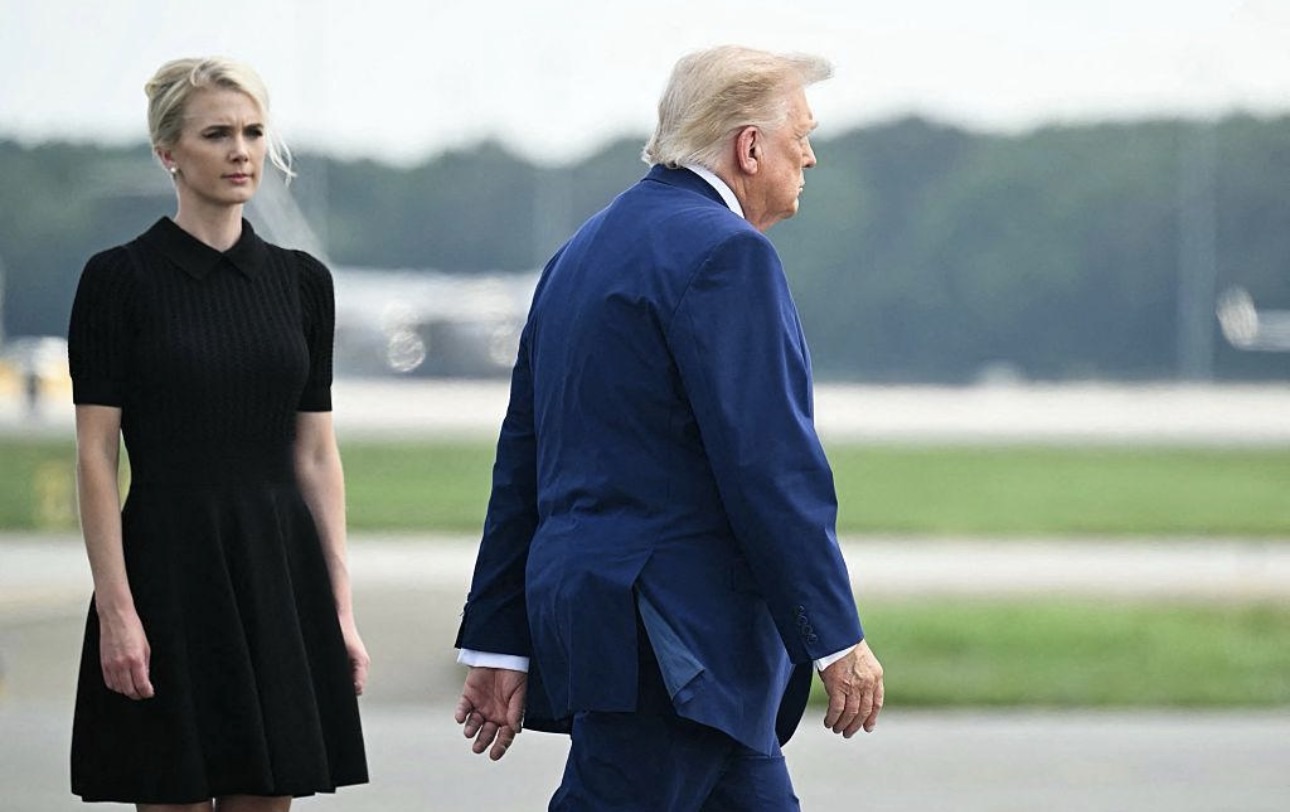
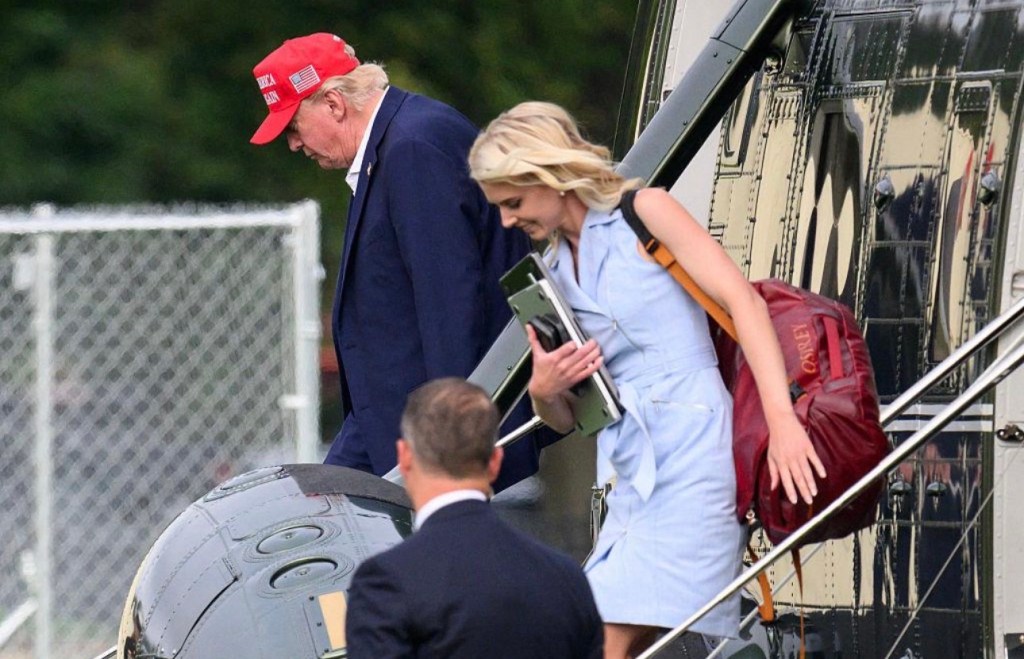
Donald Trump has spent much of his political career turning molehills into mountains.
A rumour becomes a scandal. A disagreement becomes a conspiracy. An inconvenient question becomes evidence of a plot. An opponent is not merely wrong, but corrupt, compromised, bought, controlled or secretly working for somebody else.
Trump has weaponised insinuation with extraordinary political effectiveness.
He has also spent years teaching his followers that nothing is ever quite what it appears to be.
Now, rather deliciously, the conspiracy machine has begun pointing in his direction.
And one name keeps appearing in the headlights:
Natalie Harp.
The Trump whisper factory
Harp is not some random White House employee who happened to appear in a photograph with the President.
She is a highly trusted aide who has become an unusually constant presence around Trump. She has been described as his “human printer”, producing printed material for him and assisting with his Truth Social operation.
Reports have also described an intensely devoted relationship between Harp and the President.
Her own estranged brother has publicly described the relationship as “unhealthy” and characterised her as essentially Trump’s fan club.
None of that proves a romantic relationship.
And that distinction is important.
There is presently no established evidence that Trump and Harp are having an affair. We should not turn suspicion into fact merely because the story is irresistible.
But then came the aeroplane.
And suddenly the gossip acquired a rather large runway.
The plane that made everyone look twice
In July, following the NATO summit in Ankara, Turkey, American intelligence reportedly detected a possible threat involving a missile attack against Trump’s aircraft.
The Secret Service therefore devised an extraordinary deception.
Trump initially boarded what appeared to be Air Force One. But he was subsequently moved, secretly, through a catering truck to another military aircraft.
The original aircraft then continued its journey as a decoy.
This was serious presidential security business.
But then came the passenger list.
Trump took a remarkably small group with him.
Among them was Defense Secretary Pete Hegseth.
There were also two long-serving Trump loyalists, Dan Scavino and Walt Nauta.
And there was Natalie Harp.
Meanwhile, Secretary of State Marco Rubio and Treasury Secretary Scott Bessent remained on the aircraft functioning as the decoy, along with members of the White House staff and the press corps. The decoy aircraft continued under the Air Force One call sign while Trump’s smaller aircraft travelled separately.
Think about that for a moment.
The President of the United States was secretly spirited away from the aircraft designed to make everyone believe that he was still aboard.
His Secretary of State stayed behind.
His Treasury Secretary stayed behind.
The press corps stayed behind.
And Natalie Harp went with him.
To be absolutely fair, this was not necessarily Trump’s personal decision. Trump has said that the Secret Service instructed him to make the switch and that he followed its security advice.
There may have been perfectly sensible operational reasons for every passenger selected.
But politics is not conducted in a laboratory.
It is conducted in the human imagination.
And the optics?
Well, the optics have packed their bags and boarded the gossip train.
The decoy plane problem
The bizarre circumstances created an irresistible political narrative.
Imagine explaining it without knowing anything else:
The President secretly leaves the aircraft.
The Secretary of State stays behind.
The Treasury Secretary stays behind.
Journalists stay behind.
A handful of trusted people accompany him.
And among those selected is the young female aide who has become one of the most visibly constant figures in his personal orbit.
You don’t need a conspiracy theorist to write that screenplay.
The facts have already supplied the first act.
The rest is where speculation begins.
And this is precisely where we should be careful.
The plane proves proximity. It does not prove romance.
But proximity, in politics, inevitably generates questions about influence, access and trust.
Those are legitimate questions.
The irony is almost too perfect
For years Trump has operated on the principle that suspicion itself can be a political weapon.
He has accused opponents of conspiracies without necessarily producing the evidence necessary to establish them.
He has encouraged his political movement to look behind every curtain.
Now people are looking behind his.
And Trump does not appear to enjoy the experience.
That is the delicious irony.
The man who popularised political suspicion has discovered that suspicion has no political passport.
It can cross party lines.
It can cross ideological borders.
And occasionally, it can land in the White House.
Questions that sound like they belong at home
There is also something uniquely awkward about the nature of some of the questions now being asked.
Who is Natalie Harp?
Why is she so close to the President?
Why does she appear to have such unusual access?
Why was she among the tiny group selected to accompany Trump on the secret flight?
Why was she on the safer aircraft while Cabinet secretaries remained aboard the decoy?
What exactly is her role in Trump’s decision-making and communications?
These are legitimate questions about presidential access and influence.
But then the conversation inevitably slides into another category of question.
The sort of question that perhaps belongs at the breakfast table rather than in the White House briefing room.
“Donald, who exactly is Natalie Harp?”
That is the point where political journalism starts wandering towards marital interrogation.
And that is where we should resist the temptation to become the thing we criticise.
Do unto Trump as Trump did unto others?
There is an understandable temptation among Trump’s critics to enjoy this.
After all, Trump has spent years making personal insinuations about his opponents.
He has dragged private lives into political combat.
He has treated rumours as ammunition.
He has frequently shown little concern for the collateral damage inflicted on people caught in his rhetorical crossfire.
So there is a certain grim satisfaction in watching the weapon turn around.
But revenge is not journalism.
If there is evidence of wrongdoing, expose it.
If there is evidence of an abuse of presidential authority, investigate it.
If an aide has inappropriate influence over presidential decisions, establish the facts.
If security procedures were compromised, demand answers.
But if there is no evidence of a sexual relationship, do not manufacture one.
Otherwise we simply become participants in Trump’s favourite political pastime: turning suspicion into certainty.
The conspiracy boomerang
Trump’s political method has often been remarkably simple:
Create the suspicion.
Repeat the suspicion.
Give the suspicion a name.
Attack anyone who questions the suspicion.
Eventually, the suspicion becomes political reality among those who already want to believe it.
Now the same mechanism is operating around him.
The difference is that this time there are some genuinely curious facts to examine.
A secret flight.
A decoy aircraft.
Cabinet secretaries left behind.
A small circle of trusted passengers.
And Natalie Harp, whose extraordinary closeness to the President was already attracting attention, sitting beside him on the escape aircraft.
That is enough to justify questions.
It is not enough to justify a verdict.
Trump discovers the other side of the question
Perhaps the most amusing part of this episode is that Trump is now being asked to answer the sort of questions he has spent years asking about everybody else.
And Trump has always understood the power of a question.
A question does not need an answer to be politically useful.
Sometimes the question itself is the weapon.
That was Trump’s genius.
Now the weapon has changed hands.
The President who spent years asking:
“What are they hiding?”
is discovering the discomfort of being asked:
“What are you hiding?”
And that is a very different seat in the courtroom.
Perhaps Mrs Trump has the first right to ask the most personal questions.
But the American public has every right to ask who has the President’s ear, who has access to him, who travels with him and who is trusted with the secrets of the presidency.
Those are not questions about romance.
They are questions about power.
And power is never private when it sits behind the Resolute Desk.
The irony writes itself
Trump spent years making mountains out of molehills.
Now a mountain has appeared outside his own door.
Whether it contains anything more substantial than political smoke remains to be established.
But the smoke is certainly visible.
And Trump, of all people, should understand the danger of smoke.
He taught America that where there is smoke, there must be a conspiracy.
Now America is simply applying the Trump method to Trump.
The irony is almost unbearable.
The conspiracy theorist has become the subject of the conspiracy theory.
The hunter has become the hunted.
And somewhere in the White House, perhaps someone is finally asking the question Trump has spent years teaching the world to ask:
“What exactly is going on here?”
For once, Donald Trump is not holding the microphone.
He is the one being interviewed.

