

Some politicians are remembered for their ideas.
Some for their courage.
Some for changing history.
Lindsey Graham may be remembered for changing sides with such athletic precision that NASA could have tracked the manoeuvres from space.
For over three decades, the South Carolina Republican became one of Washington’s most recognisable political figures, surviving scandals, ideological earthquakes, party revolutions and presidential feuds with the resilience of a cactus in a drought.
If politics were a marriage, Graham had already found his soulmate.
It was power.
Growing Up Above the Bar
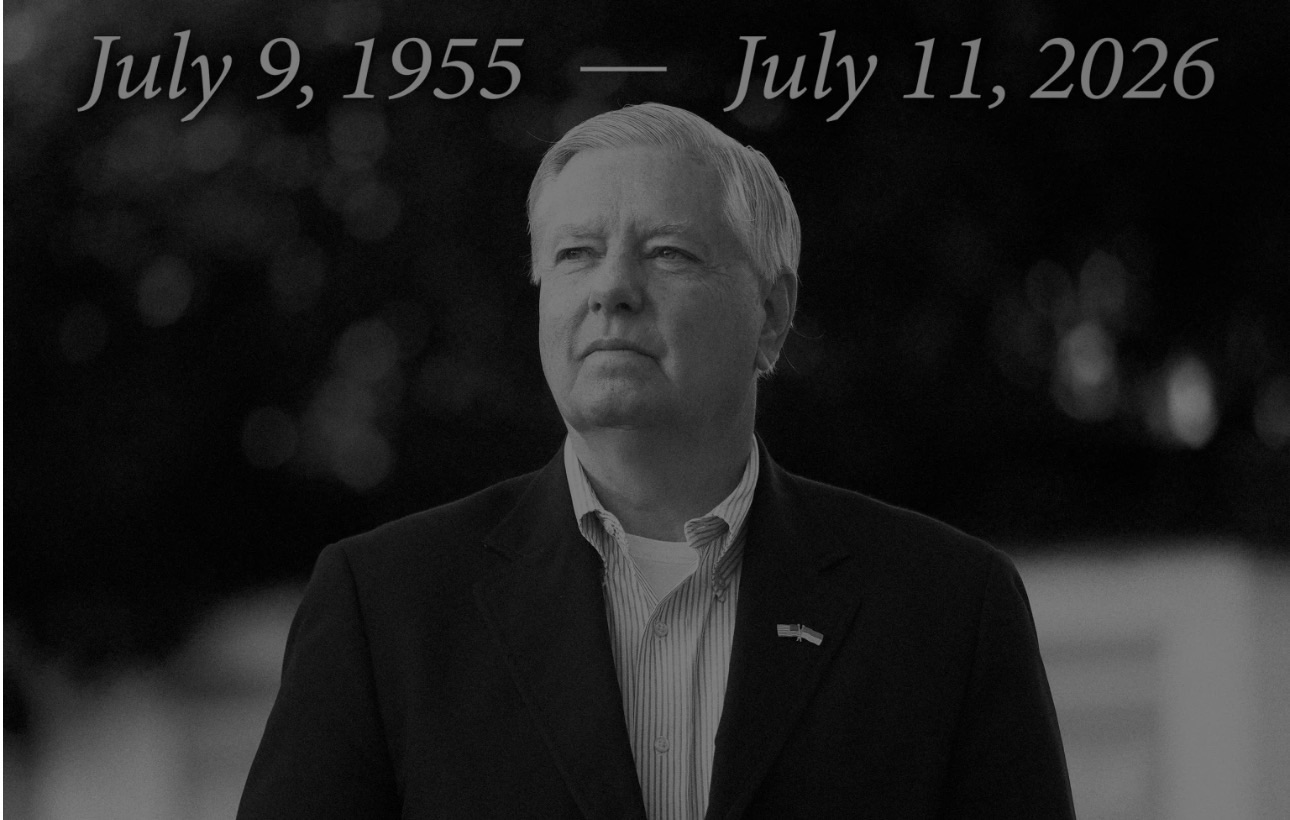
Lindsey Olin Graham was born on 9 July 1955 in Central, South Carolina.
His parents owned a combination bar, restaurant, liquor store and pool hall. The family even lived upstairs, meaning Graham literally grew up above the bar.
The arrangement was an education in American society long before he attended law school.
Customers came from every walk of life.
Politics flowed as freely as the drinks.
Power had regular customers.
Young Lindsey learned an important lesson that would define his career.
The people in charge may change.
The importance of staying close to them never does.
The Lawyer in Uniform
After graduating from the University of South Carolina School of Law, Graham joined the United States Air Force as a military lawyer.
It lacked the aerial heroics of Top Gun, but military service gave him something far more useful in politics: credibility.
He remained in the Air Force Reserve for decades before retiring as a colonel.
The résumé was expanding nicely.
Lawyer.
Officer.
Future politician.
Washington loves a well-tailored biography.
Clinton’s Impeachment
When Republicans swept into Congress in 1994, Graham won a seat in the House of Representatives.
America soon met an ambitious young congressman who became one of the House managers prosecuting President Bill Clinton during the impeachment trial.
At the time, Graham passionately argued that character mattered.
Integrity mattered.
Truth mattered.
Future historians would eventually discover that political principles, like mobile phone contracts, sometimes come with upgrade options.
The McCain Years
Graham’s influence grew dramatically after arriving in the Senate in 2003.
His closest political companion became Senator John McCain.
Together they were Washington’s permanent foreign affairs tour guides.
If there was a military conflict anywhere on the globe, Graham and McCain often seemed to be discussing it before the Pentagon had finished reading the morning newspapers.
Their shared belief in an assertive American foreign policy became their political trademark.
Critics joked that they collected frequent-flyer miles faster than diplomatic solutions.
The Presidential Candidate Nobody Ordered
In 2015, Graham decided the White House looked like an attractive career move.
His presidential campaign generated enthusiasm somewhere between a library chess tournament and a council planning meeting.
Polling numbers barely noticed his existence.
He eventually withdrew after failing to gain traction.
Still, Graham possessed one priceless quality.
He never stopped looking for the next opening.
Donald Trump Changes Everything
Then came Donald Trump.
Initially, Lindsey Graham sounded less like a supporter and more like Trump’s unofficial prosecutor.
He described Trump as a “race-baiting, xenophobic religious bigot.”
He warned Republicans that nominating Trump would destroy the Republican Party.
He questioned Trump’s judgment.
He questioned Trump’s temperament.
He questioned whether Republicans had collectively misplaced their minds.
Then something remarkable happened.
Donald Trump won.
The Greatest Political U-Turn Since…
Politics occasionally produces astonishing conversions.
Lindsey Graham produced an entire franchise.
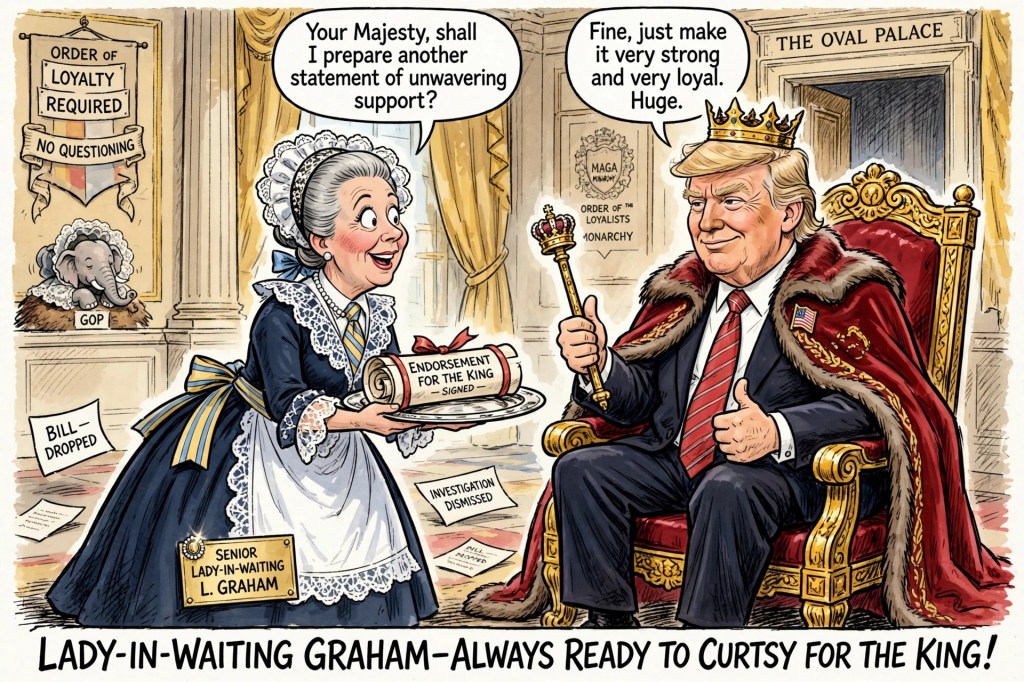
The senator who once declared Trump unfit for office slowly transformed into one of Trump’s most dependable defenders.
Criticism became cooperation.
Cooperation became friendship.
Friendship became political loyalty.
Washington has witnessed ideological evolution before.
Rarely has it occurred at such breathtaking speed.
The transformation became so complete that late-night comedians eventually stopped writing jokes.
Reality had already done the work for them.
January 6 and Another Pivot
Following the attack on the U.S. Capitol on January 6, 2021, Graham appeared ready for another dramatic break.
Standing on the Senate floor, he declared:
“Count me out. Enough is enough.”
Commentators predicted the end of the Graham-Trump alliance.
They underestimated Graham’s instinct for survival.
As Trump’s influence over Republican voters endured, Graham quietly found his way back into the fold.
Like a political compass with only one setting, he once again pointed towards the centre of Republican power.
Consistency, At Least Overseas
One area where Graham rarely wavered was foreign policy.
Whether advocating military support for Ukraine, defending Israel, confronting Russia, warning Iran or promoting American military strength abroad, Graham remained one of Washington’s last unapologetic interventionists.
His domestic politics often resembled improvisational theatre.
His foreign policy rarely changed its script.
Married to Politics
Lindsey Graham never married and had no children.
He often joked about bachelorhood.
Looking back, perhaps marriage would have created a scheduling conflict.
Politics occupied every available space.
Campaigns.
Committees.
Television interviews.
Fundraisers.
Election nights.
If there was room in his heart, politics had already rented it on a long-term lease.
The Final Curtain
On 12 July 2026, Lindsey Graham died suddenly at the age of 71 from an aortic dissection, bringing to an end one of the most remarkable careers in modern American politics. Tributes flowed from Republicans, Democrats and foreign leaders who had sparred with, worked alongside or simply watched the South Carolina senator reinvent himself time and again. (AP News)
Then came one final twist that even Hollywood scriptwriters might have rejected as too sentimental.
South Carolina Governor Henry McMaster appointed Graham’s younger sister, Darline Graham Nordone, to complete the remaining months of his Senate term after President Donald Trump publicly endorsed the idea. She became the first woman ever to represent South Carolina in the United States Senate and will serve until January 2027, when the winner of a special election takes office. (AP News)
The appointment carried a poetic symmetry.
When Lindsey was just twenty-two, both parents died within fifteen months of each other.
Rather than pursue his own ambitions uninterrupted, he became the legal guardian of his thirteen-year-old sister, helping to raise her into adulthood.
Half a century later, she walked into the Senate chamber to occupy the very seat her brother had held for nearly twenty-four years.
Washington rarely writes endings this neatly. (AP News)
Obituary: The Survivor
Lindsey Olin Graham (1955 to 2026) was many things.
Military lawyer.
Congressman.
Four-term United States senator.
Presidential candidate.
Constitutional prosecutor during Bill Clinton’s impeachment.
John McCain’s closest political ally.
Donald Trump’s fiercest Republican critic.
Donald Trump’s steadfast Republican defender.
His critics accused him of possessing no fixed ideology beyond self-preservation.
His admirers described him as pragmatic, adaptable and endlessly loyal to those he ultimately chose to support.
Perhaps both sides were right.
Few politicians have navigated America’s changing political landscape with such extraordinary durability.
He witnessed the Clinton years, the Bush era, Obama’s presidency, Trump’s rise, Biden’s administration and Trump’s return, remaining politically relevant through each dramatic shift.
Some politicians build monuments.
Others build movements.
Lindsey Graham built longevity.
Whether history remembers him as a principled conservative, a consummate pragmatist or Washington’s greatest political shape-shifter will remain a matter for historians.
One conclusion, however, seems difficult to dispute.
Lindsey Graham never really retired from politics because politics was never merely his profession.
It was his lifelong companion.
For better or worse.
Until death did them part.

